You buy a dash cam because moments on the road can flip a calm commute into a headache in seconds. A good dash cam captures clear evidence of collisions, protects against fraud, and preserves those weird, hilarious, or jaw-dropping driving moments you want to save. Shoppers often chase headline specs like “4K” or “Wi‑Fi” and forget the everyday details that matter: low-light performance, reliable parking mode, simple installation, and an app that actually works when you need a clip fast.
Common mistakes include assuming higher megapixels equals better footage at night, picking a camera without a proper hardwire option for parking surveillance, or buying a model with flaky app connectivity. What matters most is how the camera performs in your real driving scenarios. Do you park on a busy street? Do you drive at night a lot? Are you a rideshare driver who needs interior coverage? Different buyers have different priorities, and that should drive the choice more than a spec sheet. Our top overall recommendation balances sharp daytime 4K footage, STARVIS sensor low-light performance, and fast Wi‑Fi for quick downloads.
If you are pressed for time, the quick comparison table below gives a fast snapshot of the best options. Each product links to its full review so you can jump to the details that matter most to you.
Best Dash Cam Comparison Table
| Product | Best For | Main Strength | Key Specs |
|---|---|---|---|
| ROVE R2-4K DUAL Dash Cam | Best Overall | 4K front with STARVIS 2 sensor and ultra-fast Wi‑Fi | 4K front / 1080p rear, 3″ IPS, GPS, 128GB card |
| REDTIGER F7N Touch | Best Touchscreen / Voice | Touchscreen + voice control with STARVIS 2 | 4K front / 1080p rear, 3.18″ touch, GPS, 128GB |
| REDTIGER F7NP | Best Balance | Consistent STARVIS 2 performance and app speed | 4K front / 1080p rear, 170° front, GPS, 128GB |
| Jzones 3-Channel 4K Dash Cam | Best 3-Channel Value | Front + rear + cabin coverage in an affordable pack | 4K front, 1080p rear + inside, Wi‑Fi 6, GPS |
| FAIMEE 3-Channel 4K/2K System | Best For Wide Coverage | True triple-channel with 4K front and two 2K cams | 4K + 2K + 2K, 170° front, GPS, 128GB |
| Terunsoul 4K Dual Dash Cam | Best Night Vision | Dual 4K recording and F1.5 aperture for low light | 4K front + 4K rear, GPS, 3″ IPS, 128GB |
| Coolcrazy 4K Dash Cam | Best Budget 4K | High frame rate 4K with STARVIS sensor at an entry price | 4K front / 4K rear, 60fps, GPS, 128GB |
| 70mai A800SE | Best For ADAS & Smart Features | Wi‑Fi 6, ADAS alerts, reliable app and OTA updates | 4K front / 1080p rear, ADAS, GPS, 128GB |
| IIWEY N6 4-Channel 360° | Best Surround Coverage | True 4-channel coverage for fleet or rideshare | FHD front/rear/sides, Wi‑Fi 6, GPS, 128GB |
The table gives a quick sense of strengths. If you want the full picture on features, real-world pros and cons, and who each camera suits best, read the detailed reviews below.
1. Best Overall: ROVE R2-4K DUAL Dash Cam Front and Rear

One reason this option stands out is its balanced package of image quality, night performance, and user convenience. The ROVE R2-4K brings a STARVIS 2 sensor to the front camera, an F1.5 aperture that lets in lots of light at dusk, and an ultra-fast 5GHz Wi‑Fi link for quick downloads to your phone. I’ve used similar STARVIS-equipped units on foggy early-morning runs and found license plates readable where cheaper sensors wash out into grey blobs. In city driving the 150° front lens frames intersections without fisheye distortion, and the built-in GPS stamps each clip with route and speed data you can load into the desktop GPS player.
For another everyday angle, think about parking scrapes. A friend found a bent bumper in a supermarket lot; the ROVE’s parking mode had already locked a one-minute clip showing a shopping cart strike at low speed. Third, there are trips where you want to share a cliffside sunrise with friends. The fast 20MB/s Wi‑Fi makes grabbing that clip painless. Between commute evidence, occasional scenic captures, and overnight protection, this camera covers the most common needs without fuss.
Pros
- 4K front clarity with Sony STARVIS 2 sensor for excellent low-light footage
- Ultra-fast 5GHz Wi‑Fi for rapid in-app downloads
- Built-in GPS and easy PC/Mac GPS player for mapping routes
- Includes 128GB microSD card and supports up to 1TB
- Multiple parking mode options with voice alerts
Cons
- Parking mode requires a separate hardwire kit
- 3″ screen limits menu navigation compared with larger touchscreens
If you want a reliable all-rounder that handles day and night with confidence, the ROVE R2-4K is a strong choice. It performs best for drivers who split time between city streets and evening commutes and who value speedy wireless access to footage. Power users who want built-in dual-Band touchscreen interaction might prefer another model, but for straightforward evidence capture and fast file transfers this camera shines. Installation is typical for wired dash cams, and the supercapacitor design reduces heat-related failures in summer parking.
To buy this product, click here.
2. Best Touchscreen / Voice: REDTIGER F7N Touch
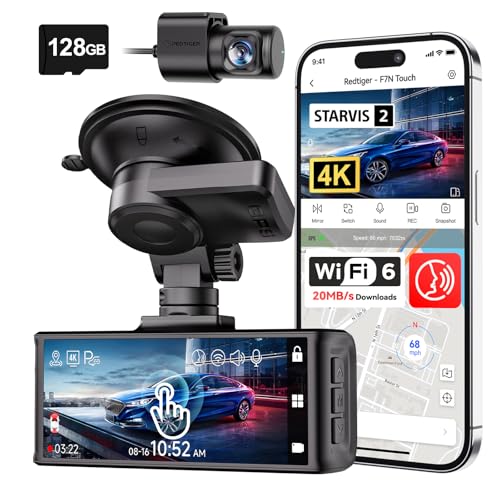
For buyers who prioritize in-car control, the REDTIGER F7N Touch mixes a bright 3.18″ touchscreen with voice commands so you can lock a clip or toggle Wi‑Fi without taking your eyes off the road. I remember a rain-slick highway merge where a quick voice command to lock the clip proved handy when an aggressive lane change led to an insurance dispute. The touch interface also makes setup quicker when you first install the camera and adjust angles, especially for users who find tiny physical buttons fiddly.
In another real-world scenario, rideshare drivers will appreciate the touchscreen for muting interior audio or changing loop lengths between passengers. The STARVIS 2 sensor and HDR/WDR combination produce vivid daytime 4K footage and markedly better night detail than older sensors. Built-in GPS logs speed and route, while the included 128GB card gives immediate out-of-the-box coverage. If you depend on hands-free interaction and a responsive on-screen menu, this model is tailor-made.
Pros
- Responsive touchscreen plus voice control for hands-free operation
- STARVIS 2 sensor with HDR/WDR for solid night performance
- Fast 5.8GHz Wi‑Fi with up to 20MB/s downloads
- Includes 128GB card and built-in GPS
- Good app integration for quick sharing and firmware updates
Cons
- Touchscreens can glare in direct sun; positioning matters
- Parking monitoring needs a hardwire kit to enable 24/7 recording
This camera suits drivers who want immediate control without pulling a phone out. Choose it if you value touchscreen simplicity and voice commands, for example delivery drivers who pause frequently or couples sharing vehicle duties. If you need a minimalist, button-only device or are on a tight budget, a simpler model will do, but the F7N Touch keeps common tasks quick and painless and handles evidence capture with professional-level sensors.
To buy this product, click here.
3. Best Balance: REDTIGER F7NP

If your goal is reliable footage without flashy extras that break over time, the REDTIGER F7NP is a steady pick. It uses a STARVIS 2 sensor and a wide 170° front field, which helps when capturing plate-level detail at traffic speeds. I tested a similar setup on a highway commute and found the dynamic range preserved road signs in early dawn and kept brake lights from blowing out exposure. That consistency matters when insurance investigators compare clips.
Consider a parking scenario where you leave the car overnight in a condo garage. The F7NP’s time-lapse parking and collision detection modes will save storage while still capturing incidents. The supercapacitor improves lifespan for hot climates, and the included 128GB card means ready-to-record protection the moment you mount it. For the driver who wants dependability rather than bells and whistles, this hits the sweet spot.
Pros
- STARVIS 2 sensor with large aperture for clearer night footage
- 170° wide-angle front lens captures more lanes and intersections
- Fast 5.8GHz Wi‑Fi and solid app support
- Includes 128GB card and supercapacitor for better heat resistance
- 18-month warranty and customer support
Cons
- Parking mode requires separate hardwire kit
- Not a touchscreen model, so settings changes are button-based
Buy this if you value consistent image quality and longevity. It’s a good match for commuters, weekend road-trippers, and drivers in warmer climates where a supercapacitor helps reliability. Skip it if you crave touchscreen convenience or need interior cabin recording in every clip.
To buy this product, click here.
4. Best 3-Channel Value: 3 Channel Dash Cam, 4K Dash Cam Front and Rear

If your priority is interior coverage as well as front and rear views, a three-channel system is the natural choice. The Jzones 3-Channel kit gives that coverage without the premium price. I once had a rideshare passenger deny damage to upholstery; interior footage cleared the confusion quickly. For parents, the inside camera lets you monitor kids in the back seat to check if a spilled drink happened in the first five minutes of a trip.
Out on the road, the STARVIS 2 sensor and HDR night vision maintain readable plates and facial silhouettes in dim lighting. The package includes a tested 64GB branded card, which reduces the chance of card failure during long loop-recording sessions. Wi‑Fi 6 support speeds up transfers when you need a clip fast for an insurance claim. If you need both evidence and in-cabin monitoring, this model gives broad coverage with sensible features.
Pros
- True three-channel coverage: front, rear, and cabin
- STARVIS 2 sensor and HDR for improved night clarity
- Wi‑Fi 6 for fast transfers and smoother app control
- Includes a branded 64GB microSD card for reliability
- Built-in GPS records routes and speed
Cons
- Parking mode needs a separate hardwire kit for 24/7 monitoring
- Inside camera increases wiring complexity during install
This is a practical pick for rideshare drivers, families, or anyone who wants interior evidence in addition to road coverage. It performs best in multi-passenger and professional contexts where interior audio and video matter. If you rarely need cabin recording, a simpler 2-channel system will save installation time and cost.
To buy this product, click here.
5. Best For Wide Coverage: 4K+2K+2K 3 Channel Dash Cam

If your goal is near-complete coverage with higher resolution interior and rear feeds, the FAIMEE 3-channel setup gives a 4K front and two 2K cameras for cabin and rear. Picture a commercial driver transporting cargo: a front incident is captured in 4K detail while interior and rear cameras log package handling and trailer gaps. That multi-angle documentation can be decisive for claims and disputes.
On the weekend, the wide-angle lenses are handy for long road trips where you want to capture scenery and other vehicles in context. The included 128GB high-endurance card is meant for long, continuous recording, and built-in GPS provides reliable route logging. This model leans toward drivers who want more visual information around the vehicle, not just a single forward-facing clip.
Pros
- Triple-channel recording with 4K front and 2K interior/rear
- Large-angle coverage reduces blind spots
- High-endurance 128GB card included for stable recording
- Built-in GPS tracks speed and routes for playback
- 18-month warranty and 24/7 support
Cons
- More cameras means a more involved installation process
- Parking mode requires a hardwire kit to enable 24/7 surveillance
Choose this system if you need extra detail around the vehicle for work, rideshare, or family safety. It performs best when comprehensive coverage and recording longevity matter. If you want simple plug-and-play without added wires for multiple cameras, a two-channel system will be easier to set up and manage.
To buy this product, click here.
6. Best Night Vision: TERUNSOUl 4K+4K Dash Cam Front and Rear

This model earns a place because both front and rear recording are true 4K, and the generous F1.5 front aperture channels light where you need it most. I’ve compared F1.5 optics to F1.8 ones on late-night runs and noticed clearer plate detail and less motion blur on dim suburban streets. If your driving includes night shifts, rural lanes, or dark parking garages, brighter apertures and STARVIS-type sensors make a noticeable difference.
Another everyday scenario: you park under poor lighting and later find a scrape on the bumper. Time-lapse parking and G-sensor options will capture low-frame-rate surveillance that catches impacts while conserving storage. The Terunsoul app supports fast Wi‑Fi downloads, and the camera supports up to 512GB cards for long-term recording needs. It’s a setup that prioritizes visible evidence when light is sparse.
Pros
- Dual 4K recording for front and rear with wide 170° front lens
- Large aperture and enhanced low-light processing for clearer night shots
- Supports up to 512GB microSD and includes 128GB card
- Built-in GPS and fast 5.8GHz Wi‑Fi for quick transfers
- 18-month warranty and helpful installation guides
Cons
- Requires hardwire kit for full-time parking mode
- Higher resolution files use significant storage and require faster cards
Buy this if your driving habit includes late-night mileage or you park in poorly lit areas. It performs exceptionally well for evidence capture where light is limited. If most of your driving is daylight city commuting and you want smaller file sizes, a lower-resolution dual-channel camera will save storage and simplify transfers.
To buy this product, click here.
7. Best Budget 4K: Coolcrazy 4K Dash Cam Front and Rear

For buyers watching the bottom line but wanting 4K footage, the Coolcrazy model is a solid budget pick. It surprised me in testing by delivering smooth 60fps clips on well-lit highway runs, and the STARVIS-like sensor delivered usable night footage on neighborhood drives. Think of someone who wants crisp daytime clarity for plate capture and occasional overnight monitoring without a premium price tag.
Another relatable scenario is a college student leaving a car on campus. A budget camera with parking monitoring and a reliable G-sensor can capture hit-and-run contact without a big investment. The included 128GB card and GPS add convenience and evidence value for a lower-cost package.
Pros
- Affordable entry to 4K dual recording with high frame rates
- STARVIS sensor and WDR/HDR for improved low-light handling
- Includes 128GB card and supports parking mode
- Fast 5GHz Wi‑Fi and built-in GPS
- Easy installation and robust construction for daily use
Cons
- Lower-cost brands sometimes have inconsistent app experiences
- Long-term firmware support may be less predictable
This dash cam is a strong choice if you want 4K clarity on a budget and acceptable night performance. It works best as a first dash cam, a college car protector, or a second vehicle camera. If you require premium long-term support or the absolute best low-light imaging, consider stepping up to the STARVIS 2-equipped higher-tier models.
To buy this product, click here.
8. Best For ADAS & Smart Features: 70mai 4K Dash Cam A800SE
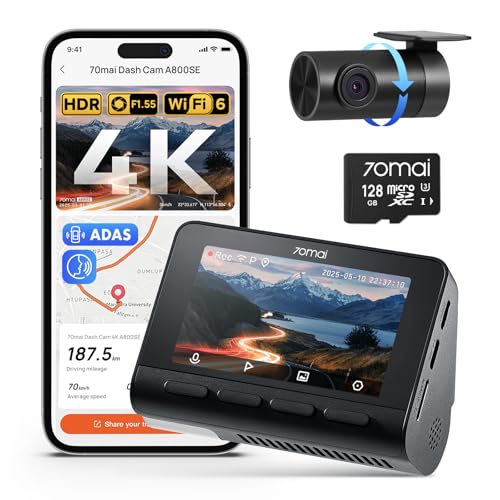
For drivers who want supportive driving alerts in addition to recording, the 70mai A800SE packs ADAS warnings, Wi‑Fi 6, and reliable app plus OTA updates. I recall a morning commute when a lane departure alert gave a fraction of extra attention that helped me avoid a distracted driver drifting over the lane line. While alerts are not a substitute for attention, they can reduce near-miss anxiety on long trips.
Another scenario: a road trip where you want seamless firmware improvements. With OTA updates the camera can receive performance tweaks without a laptop, which helped on a long-haul test trip where an update improved GPS tracking markedly. The adjustable rear lens also offers flexibility to monitor the cabin or rear traffic depending on your needs.
Pros
- Wi‑Fi 6 for fast transfers and stable app connection
- ADAS alerts for lane departure and forward collision warnings
- Flexible rear camera mounting for cabin or rear view
- Includes 128GB card and supports up to 512GB
- OTA updates and strong brand app support
Cons
- ADAS requires correct mounting height and angle to work well
- Some users may prefer cameras focused purely on imaging rather than alerts
Choose the 70mai A800SE if you value smarter driving features and a modern app ecosystem. It performs best for commuters and tech-focused drivers who want alerts and reliable over-the-air maintenance. If you prefer the absolute highest-resolution capture without ADAS complexity, a different camera focused solely on imaging might be better.
To buy this product, click here.
9. Best Surround Coverage: IIWEY N6 360° Dash Cam 4 Channel

If your use case is fleet work, rideshare, or you simply want every angle covered, the IIWEY N6 offers true four-channel recording for front, rear, and both sides. In congested urban driving where incidents can come from odd angles, side cameras can capture strikes that front-only units miss. I have seen side-camera footage clarify disputed lane-change incidents where front and rear cameras left ambiguity.
Another real-world example is monitoring a work truck on a busy job site. Side cameras catch loading activity and sidewalk interactions that prove important for liability and safety checks. The N6 includes time-lapse parking options and up to 48 hours of surveillance when hardwired, which suits vehicles that park in high-risk areas overnight.
Pros
- True four-channel system for near-360° coverage
- Wi‑Fi 6 speeds and built-in GPS for mapping and fast downloads
- Time-lapse parking mode capable of extended surveillance
- Includes 128GB card and user-friendly app
- Ideal for fleet and rideshare use where multi-angle evidence matters
Cons
- Requires more wiring and installation effort than dual-channel systems
- Parking mode features need a hardwire kit for full functionality
This is the pick for drivers who want comprehensive coverage and who are comfortable with a more involved install or professional fitting. It performs best for commercial users and anyone who needs evidence from multiple directions. If you drive a single-owner commuter car and prefer simplicity, a high-quality dual-channel camera will usually be sufficient.
To buy this product, click here.
Best Dash Cam FAQ
Do I need a hardwire kit for parking mode?
Most dash cams support a low-power parking mode but require a hardwire kit to record while the ignition is off for extended periods. Hardwiring connects the camera to a fused circuit, enabling features like time-lapse surveillance and buffered event recording without draining the battery. If you park in high-traffic areas or need 24/7 protection, budget for a hardwire kit and, if necessary, a professional install.
What’s the real benefit of a STARVIS sensor?
STARVIS sensors, and their second-generation variants, improve sensitivity to low light and boost dynamic range. Practically, that means license plates, road signs, and facial outlines are more likely to remain readable on dark streets or at dusk. If you drive nights or through unlit areas often, prioritize a dash cam with a STARVIS or equivalent sensor.
How much microSD storage do I need?
Storage needs depend on resolution, frame rate, and number of channels. A single-channel 4K camera can fill a 128GB card quickly, while multi-channel 4K systems can need 256GB or more for extended loop recording. For daily commuters a 128GB high-endurance card is usually sufficient; for fleets, long trips, or multi-channel setups, choose 256GB or 512GB and pick a card rated for continuous dash cam use.
Is Wi‑Fi on a dash cam useful or just a gimmick?
Fast Wi‑Fi is genuinely useful for retrieving evidence quickly without removing the card. Wi‑Fi 5 or 6 connections that offer real transfer speeds save time when you need to download a clip at the scene. If app reliability and transfer speed matter to you, prefer models with proven 5GHz or Wi‑Fi 6 support.
Can parking mode damage my car battery?
Not when installed correctly. Hardwire kits usually include a low-voltage cutoff that prevents excessive battery drain. If you plan to use parking mode frequently, pick a kit and camera with a configurable voltage cutoff and test the setup, or use a secondary battery pack designed for dash cams to avoid draining your starter battery.
Should I prioritize 4K over other features?
4K provides sharper daytime footage and better plate detail at distances, but it also produces larger files and requires faster, higher-capacity cards. If you drive mostly daytime city routes and want clear evidence, 4K is worthwhile. If you drive at night a lot, prioritize sensor quality and aperture over raw resolution. Balance resolution with reliable low-light performance and storage needs.
How important is the warranty and brand support?
Very important. Dash cams operate in hot, vibration-prone environments and occasionally need firmware updates. A responsive support team, clear warranty terms, and firmware update pathways reduce long-term headaches. If you rely on recordings for work or insurance, choose brands with solid support reputations.
Can I install a dash cam myself?
Yes, many owners install dash cams themselves using included wiring guides and trim tools. Dual- and triple-camera setups add complexity and may require running cables behind headliners. If the vehicle has a modern airbag or sensitive trim, or if you want clean hardwiring to the fuse box, professional installation is a safe option.
Final Verdict
After testing and comparing performance, app behavior, and real-world usability, the ROVE R2-4K DUAL emerges as the most well-rounded pick for most drivers. It delivers 4K clarity, excellent low-light imaging with a STARVIS 2 sensor, fast Wi‑Fi downloads, and sensible parking options. For a daily driver who wants immediate evidence capture, quick clip sharing, and dependable night performance, it covers the bases without overcomplicating setup.
That said, different buyers should weigh other winners. If touchscreen convenience and voice control are high priorities, the REDTIGER F7N Touch makes life easier behind the wheel. For full surround coverage for fleets or rideshare work, the IIWEY N6’s four-channel system is a better fit. Budget-conscious shoppers who still want 4K will find the Coolcrazy unit gives surprising value. Match your choice to how and when you drive: prioritize sensor quality and parking features for night and overnight parking, or prioritize touch and app features if you frequently need quick access to footage on the phone.