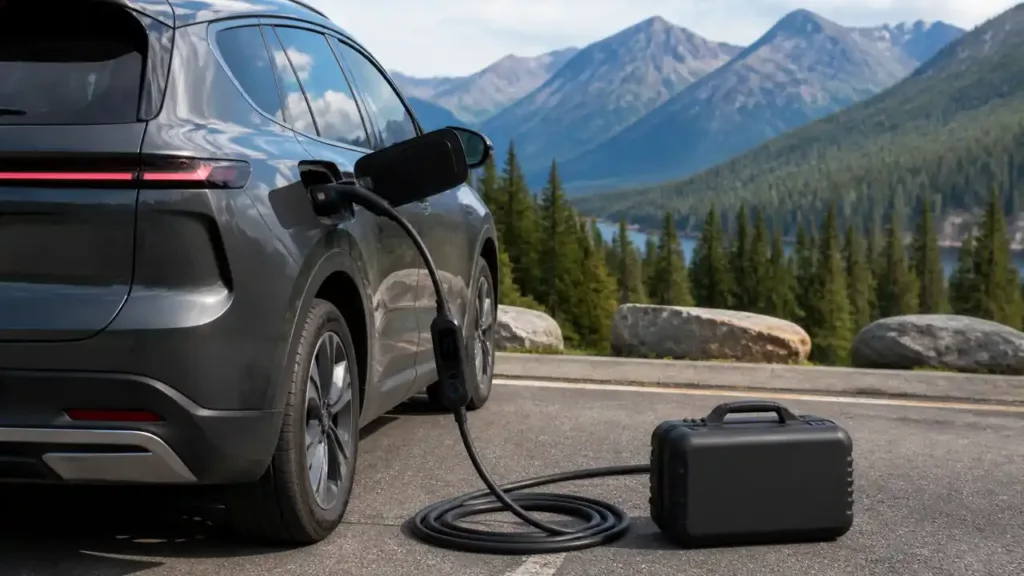
You do not really think about a portable EV charger until the trip gets weird. Maybe you pull into a small motel after midnight, the fast charger you counted on is down, and the only thing staring back at you is a dryer outlet in the laundry room or a regular household plug by the ice machine. That is the moment this category starts making a lot more sense. The best portable EV charger for road trips gives you a realistic backup plan, a little peace and quiet, and a way to claw back enough range while you sleep, eat, or visit family.
A lot of buyers make the same mistakes here. They grab the cheapest cord they can find, forget to check plug type, ignore cable length, or assume every “portable” charger works equally well on both 120V and 240V. On the road, those details hit hard. A charger that supports both Level 1 and Level 2, offers adjustable amperage, and can handle ugly weather is usually far more useful than one that looks fancy on a product page. Different drivers also need different things. A Tesla owner may want native NACS support, while a J1772 driver may care more about outlet flexibility and cable reach. For most travelers, the Raylix 2026 Upgraded Level 1&2 Portable EV Charger stands out as the strongest all-around pick because it balances portability, useful controls, and road-friendly flexibility without getting overcomplicated.
If you want the fast shortlist first, the quick picks below and comparison table will help you size up the top options in a minute or two.
Quick Picks
- Best Overall: Raylix 2026 Upgraded Level 1&2 Portable EV Charger
- Best Budget Pick: VEVOR Level 1&2 EV Charger
- Best Premium Option: MACH 3 Fast 40 Amp Level 1&2 Portable EV Charger
- Best Value Choice: AIXINE Level 1&2 EV Charger
Best Portable EV Charger For Road Trips Comparison Table
| Product | Best For | Power | Main Strength |
|---|---|---|---|
| Raylix 2026 Upgraded Level 1&2 Portable EV Charger | Most drivers | Up to 16A, 120V/240V | Excellent travel-friendly balance of controls, display, and outlet flexibility |
| VEVOR Level 1&2 EV Charger | Budget shoppers | Up to 16A, 120V/240V | Low-cost entry with timer, long cable, and travel bag |
| MACH 3 Fast 40 Amp Level 1&2 Portable EV Charger | Heavy-use travelers | Up to 40A, 120V/240V | High-output charging with broad compatibility and long warranty |
| AIXINE Level 1&2 EV Charger | Value seekers | Up to 16A, 120V/240V | Strong durability, 25-foot reach, and included waterproof case |
| KingVlotix 40 Amp J1772/Tesla Portable EV Charger | Mixed EV households | Up to 40A, 120V/240V | Includes Tesla adapter and wide amperage adjustment |
| EVDANCE Level 1&2 Portable EV Charger | App-based control | Up to 16A, 120V/240V | WiFi and Bluetooth monitoring in a travel-ready package |
| Lectron Level 1 Tesla Charger | Tesla owners using standard outlets | 15A, 120V | Native NACS simplicity and app support |
| ELEGRP Level 1/2 EV Charger | Weather exposure | Up to 16A, 120V/240V | IP67 build with 25-foot cable and strong safety focus |
| Portable EV Charger 16A Level 1&2 | Light packers | Up to 16A, 120V/240V | Compact design with simple LCD and long warranty |
If you want the fuller story, the reviews below show where each charger shines, where it falls short, and which kind of road trip it suits best.
1. Best Overall: Raylix 2026 Upgraded Level 1&2 Portable EV Charger

One reason this option stands out is how well it fits the messy reality of road-trip charging. You get dual-voltage support, a NEMA 6-20 plug for 240V charging, a 5-15 adapter for standard household outlets, and adjustable current settings from 8A to 16A. That mix matters when you are bouncing between home garages, rental cabins, and older motels where you have no clue what outlet situation you are walking into until you are already carrying your bag inside.
The Raylix also feels more dialed-in than a lot of basic travel chargers. Its TFT display shows useful charging data directly on the unit, including voltage, current, power load, and temperature. That sounds small until you are charging overnight in unfamiliar conditions and want a quick look before heading to bed. The built-in 1 to 12 hour delay timer is another practical touch for drivers who plan charging around lower utility rates or want charging to start later after a late arrival. At up to 16A on 240V, it is still a moderate-speed charger rather than a beast, but for most people looking for a trunk-ready backup or primary travel charger, that is exactly the sweet spot.
Pros
- Works on both 120V and 240V with included adapter setup
- Adjustable 8A, 10A, 12A, and 16A current settings are useful in older buildings
- TFT display gives clear real-time charging information
- Delay timer helps with overnight and off-peak charging
- Good balance of portability, features, and weather resistance
Cons
- 21-foot cable is decent, though not the longest in this group
- 16A output will feel slow for drivers used to higher-amperage Level 2 charging
- J1772 only, so Tesla owners need an adapter
This is the charger I would point most road-trippers toward first. It suits drivers who want a reliable backup that does more than the bare minimum, yet still packs easily and stays simple to use. If you need 40A charging from RV-style outlets, another model below fits better. If your real need is a flexible, no-drama charger that can rescue a trip without filling half your trunk, the Raylix makes a very convincing case.
To buy this product, click here.
2. Best Budget Pick: VEVOR Level 1&2 EV Charger
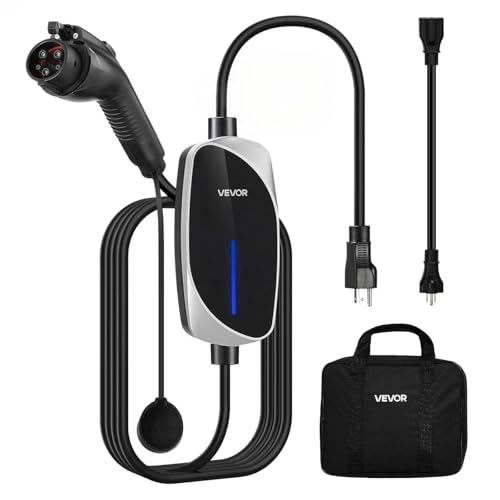
For buyers who want a road-trip charger without spending a pile of money, the VEVOR makes a lot of sense. It covers the basics that matter most: 120V and 240V compatibility, up to 16A charging, a 25-foot cable, delay timer, and a carrying bag. That is a strong utility package for a budget pick. Picture the typical use case here. You are staying at a relative’s house, the driveway is awkward, and the outlet is farther from the car than you hoped. That 25-foot cable starts earning its keep fast.
What keeps this from feeling like a throwaway option is that it still includes practical safety and convenience features. You get adjustable current modes, live status indicators, fault alerts, and ETL/FCC certification claims. The control box is rated IP66, which is reassuring for driveway charging in rain, slush, or dusty summer conditions. This is not the charger you buy for premium app controls or extra-polished fit and finish. It is the one you buy because you want solid travel utility at a lower cost, and you would rather put the rest of the budget toward the trip itself.
Pros
- Excellent budget-friendly feature set for travel use
- 25-foot cable gives more parking flexibility than many compact units
- Works on standard household outlets and 240V NEMA 6-20 outlets
- Delay timer and LCD monitoring add useful convenience
- Includes carrying bag and wall mount accessories
Cons
- Only two current choices, so it is less tunable than some rivals
- Brand polish and support reputation may not feel as strong as better-known names
- Tesla drivers need a separate adapter
The VEVOR is best for budget-minded EV owners who still want a real travel charger, not a stripped-down emergency cord that leaves them squinting at a blinking light and hoping for the best. Skip it if you want app control or broader amperage adjustment. Grab it if you want a simple, affordable charger that still checks the boxes that matter on the road.
To buy this product, click here.
3. Best Premium Option: MACH 3 Fast 40 Amp Level 1&2 Portable EV Charger

If your idea of a road trip involves big daily miles, short overnight stops, and squeezing every useful hour out of a 240V outlet, the MACH 3 is the premium play here. It supports up to 40A charging on 240V through a NEMA 14-50 plug, while still offering Level 1 charging through a 5-15 adapter. That bigger power ceiling changes the conversation. At a cabin with a 14-50 outlet or an RV-friendly site, this kind of charger can recover a far more meaningful chunk of range by morning than the 16A units in this roundup.
It also brings some polish for people who like more control. There is an LED display for live charging updates, plus app connectivity through Bluetooth and WiFi. Compatibility is broad too, with support for J1772 vehicles and included Tesla mobile NACS compatibility claims. The five-year warranty is one of the more attractive support promises in this group. The tradeoff is obvious, of course. This is a larger, heavier, more expensive charger than the compact 16A travel units. You buy this because your trips are serious, your charging windows are tighter, and you actually expect to use portable charging as a meaningful part of your travel routine.
Pros
- Up to 40A charging offers much better recovery from 240V outlets
- Supports both Level 1 and Level 2 use
- Broad vehicle compatibility including Tesla/NACS claims
- App control and onboard display add flexibility
- Excellent five-year warranty for peace of mind
Cons
- Bigger and less convenient to pack than many 16A models
- Higher cost makes less sense for occasional backup use
- Best performance depends on access to a NEMA 14-50 outlet
The MACH 3 is for drivers who think in terms of charging opportunity, not just emergency backup. It suits frequent travelers, RV-park users, and households with more than one EV driver sharing equipment. If most of your charging on trips will happen through ordinary wall outlets, it is more charger than you need. If your travel patterns regularly put you near 14-50 power, this one earns its premium label.
To buy this product, click here.
4. Best Value Choice: AIXINE Level 1&2 EV Charger

This model earns a place because it hits a nice middle ground between price, durability, and road-ready practicality. It offers up to 16A charging on 240V, includes a 120V adapter, and gives you a full 25-foot cable. For travel, that longer cable is a huge quality-of-life win. Think of a cramped garage where the outlet is stuck behind a workbench, or a vacation rental where the only usable plug is on the side wall near a pile of garden tools. Cable reach can save a lot of grumbling.
The AIXINE also has a tougher feel on paper than many budget-leaning chargers. It uses a TPU-coated cable, oxygen-free copper cores, and an IP67 rating, plus it comes with a waterproof storage case. That storage case matters more than people realize. A portable charger tossed loose into a trunk picks up dirt, moisture, and tangles fast. The one-touch scheduling and current adjustment add a little convenience without forcing you into app setup or other extra steps. It is a straightforward charger for drivers who want useful features and respectable build quality without stepping into the heavier 40A class.
Pros
- Very good mix of price, build quality, and travel practicality
- 25-foot cable is excellent for awkward parking spots
- IP67 rating and waterproof case help with rougher travel use
- Dual-voltage setup supports both home and road charging
- Simple one-touch scheduling and current adjustment
Cons
- Less feature-rich than app-enabled competitors
- Still limited to 16A charging speed
- Tesla owners need a separate adapter
The AIXINE is a smart pick for drivers who want one charger to live in the trunk for months at a time and still work reliably when the trip gets improvised. It is especially appealing if you care more about cable length, durability, and storage convenience than phone-based controls. If app monitoring matters to you, look elsewhere. If simple, sturdy, and well-priced sounds good, this one lands nicely.
To buy this product, click here.
5. Best For Mixed EV Households: KingVlotix 40 Amp J1772/Tesla Portable EV Charger

If your driveway has a Tesla one day and a J1772 vehicle the next, the KingVlotix has a very practical appeal. It includes both a J1772 connector and a Tesla adapter, supports 240V charging up to 40A through NEMA 14-50, and can drop to Level 1 use through a 5-15 adapter. That versatility is gold for families sharing gear, people switching vehicles, or drivers who host visiting EV-owning relatives during holidays and long weekends.
The current adjustment range from 6A to 40A is one of the broader ones here, which helps when you are dealing with uncertain circuit capacity. Imagine pulling into a friend’s detached garage and deciding you would rather charge slower than trip a breaker in the middle of the night. This charger gives you that kind of control. The 25-foot cable and memory function for preferred current settings make repeated use easier too. It is not the smallest travel unit, and 40A gear is naturally bulkier, but the flexibility is hard to ignore if you need one charger to play multiple roles.
Pros
- Works with J1772 EVs and Tesla vehicles thanks to included adapter
- Up to 40A charging offers strong Level 2 performance
- Broad 6A to 40A current adjustment range
- 25-foot cable helps in real-world parking situations
- Good option for home use and road-trip backup in one package
Cons
- Bulkier than lightweight 16A travel chargers
- Performance advantage depends on access to a 14-50 outlet
- May be overkill for solo drivers with one non-Tesla EV
The KingVlotix is for the buyer who hates specialized gear and wants one charger that can cover a bunch of scenarios. It shines in mixed-brand households and for people who want a portable charger that feels close to a home charger when plugged into proper 240V power. Skip it if compact packing is the top goal. Choose it if flexibility across vehicles matters more.
To buy this product, click here.
6. Best For Smart Control: EVDANCE Level 1&2 Portable EV Charger
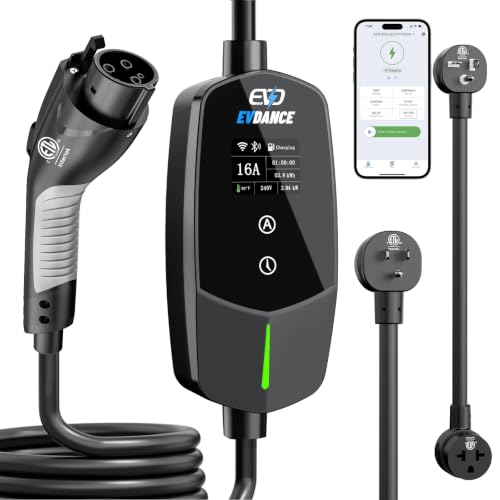
If your goal is a portable charger that feels modern and connected, this EVDANCE model is one of the more appealing choices. It supports Level 1 and Level 2 charging through standard 5-15 and 6-20 outlets, tops out at 16A, and adds WiFi/Bluetooth app control for monitoring voltage, amperage, and delivered energy. That is genuinely handy on the road. You can plug in outside a rental house, head inside with your overnight bag, and still check charging progress from your phone while you are sprawled on a couch deciding where to eat.
The rest of the package looks travel-conscious too. The 25-foot TPE cable should stay more flexible than stiff PVC options in colder weather, and the unit is marketed as crush-resistant and ready for rough handling. A carrying case is included, and the seven-pound weight keeps it manageable for trunk duty. This is still a 16A charger, so it is not trying to be a high-output powerhouse. Its hook is convenience, monitoring, and a cleaner day-to-day user experience for people who enjoy having a little more data at their fingertips.
Pros
- WiFi and Bluetooth app control adds useful remote visibility
- 25-foot flexible TPE cable is a plus for cold-weather travel
- Travel-ready with carrying case and manageable weight
- Dual-level charging works with common 120V and 240V outlet types
- Good safety package including leakage protection and weather resistance
Cons
- App setup may feel unnecessary for buyers who want pure simplicity
- 16A output is still moderate compared with 40A models
- Tesla requires a separate adapter
This charger fits drivers who like information and convenience. It is great for road trips with overnight charging stops, especially if you want to monitor things from indoors rather than step out into a cold driveway at 11 p.m. Buyers who prefer fewer electronics and fewer setup steps may prefer a simpler unit. For tech-friendly EV owners, though, this one feels pretty well judged.
To buy this product, click here.
7. Best For Tesla Owners Using Standard Outlets: Lectron Level 1 Tesla Charger

Tesla owners do not always need the biggest or most complex portable charger. Sometimes the real need is a native NACS option that plugs into an ordinary wall outlet and just works. That is where the Lectron fits. It is a 120V, 15A Level 1 charger with a NEMA 5-15 plug, built specifically for Tesla and other NACS EVs. On paper that sounds modest, and it is, but for overnight charging at a family member’s house or topping up during a long visit, modest can be enough.
The beauty here is simplicity. No adapter juggling, no wondering whether the J1772-to-NACS connection is seated properly, no extra piece to misplace in the trunk. The WiFi app adds some convenience for checking status or adjusting current remotely. The tradeoff is plain as day. This is a Level 1-only charger, and the 16-foot cord is shorter than many of the J1772 portable chargers in this roundup. So it is a narrower tool. Still, for Tesla owners who mainly want a clean backup charger for standard outlets, that narrow focus is exactly the attraction.
Pros
- Native Tesla/NACS compatibility keeps charging simple
- Works from common household 120V outlets
- App support for remote monitoring and control
- Portable and straightforward to use
- Good fit as a dedicated backup for Tesla road trips
Cons
- Level 1 only, so charging is much slower than dual-voltage models
- 16-foot cord is shorter than many competing chargers
- Less versatile for non-Tesla households
This is the right pick for Tesla drivers who expect to use standard outlets most of the time and want the least-fussy setup possible. It is less appealing if you want faster 240V charging or cross-compatibility with multiple vehicle types. For the pure “keep it in the trunk and use it at grandma’s house” scenario, though, it has a very clear role.
To buy this product, click here.
8. Best For Wet And Cold Conditions: ELEGRP Level 1/2 EV Charger

This model earns its keep with a weather-tough profile that makes sense for road trippers who do not stay in perfect suburban garages every night. The ELEGRP offers up to 16A charging on 240V, Level 1 support through the included 5-15 adapter, a full 25-foot cable, and an IP67 waterproof rating. That is a reassuring spec sheet for winter trips, muddy campsites with hookups nearby, or shoulder-season travel where the charger may sit in damp air for hours.
It also leans heavily into safety and electrical reliability. ELEGRP highlights surge, leakage, and overload protection, plus technology meant to improve conductivity and cooler operation. Whether you are charging outside a cabin while sleet taps the windshield or stretching the cable across a chilly driveway before sunrise, those details start to matter more. This is still a fairly simple charger compared with app-based units, and that is part of its charm. It feels like a piece of gear meant to get the job done quietly rather than impress you with extras.
Pros
- Strong IP67 weather resistance for rough travel conditions
- 25-foot cable is excellent for outdoor and offset parking
- Dual-voltage charging supports both backup and faster travel use
- Safety-focused design with surge and leakage protection
- Solid warranty and U.S.-based support window
Cons
- No app control for buyers who want remote monitoring
- 16A output is moderate rather than fast
- Tesla owners need an adapter sold separately
The ELEGRP is a smart pick for drivers who care most about weather durability and cable reach. It is less flashy than some alternatives, but that is fine. A lot of people simply want something that can handle rain, cold, and long overnight charges without drama. In that role, it looks very compelling.
To buy this product, click here.
9. Best Compact Option: Portable EV Charger 16A Level 1&2

Some drivers want the charger that disappears into the trunk corner and stays out of the way until needed. This 16A Level 1&2 portable charger is appealing for that reason. It offers adjustable 8A to 16A charging, dual-voltage use, a straightforward 3.5-inch LCD, and a relatively compact format with storage bag included. The 17-foot cable is shorter than many rivals, but that shorter cable also helps keep the whole package tidier and easier to pack.
There is a nice low-fuss quality here. No app, no extra layers, no need to pair anything. Just plug in, check the screen, and let it work. For weekend travelers or drivers who want a backup charger that lives under the cargo floor without taking over the whole space, that simplicity is a real perk. The five-year warranty is also a pleasant surprise in a category where support promises can feel pretty thin. This is the kind of charger that suits someone who values compactness and ease more than maximum reach.
Pros
- Compact and easy to stash in the trunk
- Simple LCD gives clear charging information without extra setup
- Supports both 120V and 240V charging
- Adjustable amperage adds flexibility for different circuits
- Strong five-year warranty for the category
Cons
- 17-foot cable is noticeably shorter than many competitors
- IP54 weather rating is fine, though not as robust as IP66 or IP67 options
- Tesla requires a separate adapter
This is the charger for buyers who want a neat, practical backup rather than a bulky do-everything brick. It shines in small cars, tight trunks, and for travelers who only occasionally need portable charging. If you often deal with awkward parking or distant outlets, the shorter cable could become annoying. If compact storage is your main priority, it is one of the easier picks here.
To buy this product, click here.
How To Choose The Right Portable EV Charger For Road Trips
Start With The Outlet Types You Will Actually Find
A lot of people shop by amperage first, then realize too late that their charger’s plug does not match the places they stop. For road trips, outlet flexibility is huge. A charger with NEMA 5-15 and 6-20 support covers common household charging plus a useful step up at some garages and small commercial properties. If you are planning stays at RV parks or homes with 14-50 outlets, a 40A charger can make far more sense. The road-trip sweet spot is usually the charger that matches the outlets you are most likely to access, not the one with the highest headline number.
Think Hard About Cable Length
Cable length looks boring on a product listing, then suddenly becomes the whole story. A 25-foot cable can save you when the outlet is tucked behind a freezer in the garage or mounted on the wrong side of the driveway. A shorter cable packs more neatly, which is great in compact cars, but it leaves less room for error. If your trips often involve rentals, older homes, or unpredictable parking spots, extra reach is usually worth carrying.
Match Charging Speed To Your Real Travel Pattern
There is a big difference between “emergency backup” and “portable charger I expect to rely on often.” A 16A charger is usually enough for overnight recovery on many trips, especially for plug-in hybrids and shorter-range top-ups. A 40A unit makes more sense if you routinely drive long distances, arrive late, and need a meaningful range boost by morning. Bigger output can be fantastic, though it also means a larger, heavier charger and more dependence on higher-capacity outlets.
Look For Adjustable Amperage
This feature is underrated. Older houses, detached garages, and unfamiliar circuits can be a little sketchy. Adjustable current lets you back off from full output if you are worried about tripping breakers or overheating weak outlets. Picture plugging in at a friend’s place, hearing the ancient garage door opener buzz, and deciding you would rather charge slower than wake everyone up at 2 a.m. because the circuit popped. That is where adjustable amperage earns every penny.
Do Not Ignore Weather Resistance And Build Quality
Road-trip charging is not always neat and dry. Maybe the charger sits on wet pavement outside a cabin. Maybe the cable gets tossed into a sandy trunk after a beach weekend. Ratings like IP65, IP66, or IP67 give a little confidence that the unit can handle rougher use. Flexible cable materials matter too, especially if you travel in colder climates where stiff cables become a pain fast. Travel gear should feel ready for abuse, not precious.
Know Your Vehicle Connector Situation
Most portable chargers in this category use J1772. That works for many EVs and PHEVs, though Tesla owners often need either a native NACS charger or an adapter. This is one of the easiest mistakes to make while shopping. If your household has both Tesla and non-Tesla vehicles, one versatile charger with an included adapter can be very handy. If you own only a Tesla and prize simplicity, a native NACS charger may feel cleaner.
Skip Features You Will Never Use
App control, WiFi, delay timers, LCD displays, and energy monitoring can be genuinely helpful, though they are not mandatory. Some people love checking charging status from bed. Others just want a unit with a couple of buttons and a clear screen. Be honest about your habits. If a feature sounds cool but you know you will never open the app after day three, spend your money on better cable length or stronger weather resistance instead.
Best Portable EV Charger For Road Trips FAQ
Is a portable EV charger good enough for a road trip?
Yes, as long as you treat it as a backup or overnight charging solution rather than a replacement for DC fast charging. A portable charger is especially useful at hotels, family homes, cabins, and RV sites where you can leave the car plugged in for several hours. It is less about speed and more about flexibility when the charging plan changes.
What is better for road trips, a 16A charger or a 40A charger?
A 16A charger is usually better for portability, lighter packing, and use with more common outlet types like NEMA 5-15 and 6-20. A 40A charger is better if you often have access to NEMA 14-50 outlets and want much faster overnight charging. The right choice depends on whether you want compact emergency coverage or stronger Level 2 recovery.
Can I use a portable EV charger in the rain?
Many portable EV chargers are built for outdoor use and have IP-rated weather resistance, though you should still follow the manufacturer’s safety guidance carefully. Keep connections secure, avoid damaged outlets, and do not place connectors where standing water can collect. Higher-rated units, such as IP66 or IP67 models, are usually more reassuring for regular outdoor travel use.
Do Tesla owners need a different portable charger?
Sometimes. Tesla owners can use native NACS chargers or use J1772 portable chargers with a compatible adapter. If you want the simplest road-trip experience, a native Tesla-compatible portable charger is a clean choice. If your household uses different EV brands, a J1772 charger with Tesla adapter support can be more versatile.
How much range can a portable Level 1 or Level 2 charger add overnight?
It depends on the charger, outlet, and vehicle. Many Level 1 setups add only a few miles of range per hour, while 16A Level 2 chargers can add roughly high-single-digit to low-teens miles per hour in many cases. A 40A Level 2 charger can add much more if paired with the right outlet and a vehicle that can accept that charge rate. Overnight, that difference can be the gap between “just enough” and “fully ready.”
Is adjustable amperage really necessary?
For home-only charging, maybe not. For road trips, it is very useful. You may plug into older outlets or circuits with unknown limits, and being able to reduce current can help avoid breaker trips or overheating concerns. It is one of the best practical features a travel charger can have.
Should I keep a portable EV charger in the trunk all the time?
Yes, if you have the space and your travel habits are unpredictable. Many EV owners treat a portable charger like a spare tire or jumper pack. You hope you do not need it, but the day a planned charging stop falls apart, it can save the trip. A storage bag or case helps keep it clean and easier to deploy quickly.
Final Verdict
After comparing these 9 picks, the Raylix 2026 Upgraded Level 1&2 Portable EV Charger is the best portable EV charger for road trips for most people. It nails the basics that matter most in real travel use: dual-voltage flexibility, adjustable amperage, a useful display, delay charging, and a size that still feels trunk-friendly. It is the kind of charger that makes sense whether you are taking your first longer EV trip or you already know the sinking feeling of arriving at a broken public charger after dark.
If budget is the biggest factor, the VEVOR Level 1&2 EV Charger is the easy low-cost pick. If you want heavier-duty capability and expect to use 14-50 outlets often, the MACH 3 Fast 40 Amp Level 1&2 Portable EV Charger is the premium move. The smartest buy, though, is the one that matches your actual travel pattern. Check your vehicle connector, think about the outlets you are most likely to find, and be honest about whether you need compact backup charging or more serious overnight recovery. Do that, and one of these 9 chargers should fit your road-trip style very nicely.