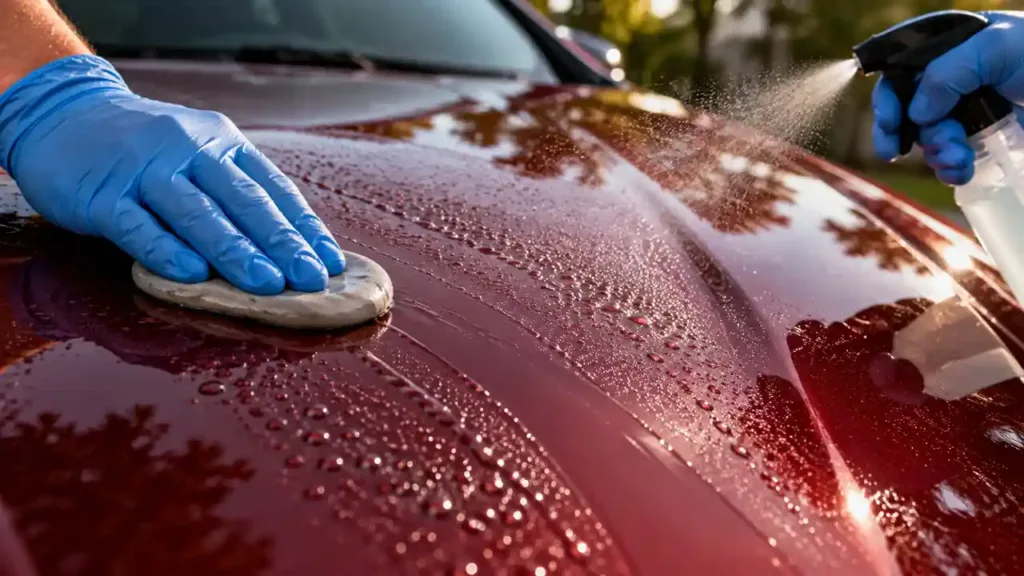
Clay can remove bonded contamination that remains after washing, but friction and dirty media can also leave marks. A compatible lubricant helps the clay glide while you work a small area with controlled pressure. It does not turn an aggressive clay grade or contaminated tool into a risk-free process.
The best clay bar lubricant depends on the clay medium, the surface, and the next detailing step. A low-residue preparation product has a different role from a detail spray that adds gloss. Traditional clay, synthetic mitts, towels, pads, and discs may also have different compatibility requirements.
We compare dedicated lubricants and labeled multipurpose options without inventing dilution ratios. The goal is adequate wet lubrication and easy cleanup, not the strongest fragrance or a promise that claying can never mar paint. These recommendations compare documented product features and current listed configurations, not hands-on test results. Verify the exact model and instructions before purchase. This article contains affiliate links; qualifying purchases may earn the site a commission.
Quick Answer
Start with the first option for the most balanced documented feature set, then use the alternatives below when their particular configuration better matches your job. Compatibility and the stated limitations take priority over the ranking.
- Best Overall: Chemical Guys Clay Luber — Dedicated clay lubricant; trigger-spray format.
- Best for Low-Residue Paint Preparation: GYEON ClayLube — Dedicated clay lubrication; traditional and synthetic media use.
- Best for a Silicone-Free Option: Nanoskin GLIDE — Silicone-free claim; clay-bar use.
Best Clay Bar Lubricant Comparison Table
| Product | Best For | Clay-Media Applications | Formulation / Cleanup Focus | Check Before Buying |
|---|---|---|---|---|
| Chemical Guys Clay Luber | Best Overall | Bars, blocks, synthetic media | Dedicated synthetic lubricant | No guarantee against marring |
| GYEON ClayLube | Best for Low-Residue Paint Preparation | Bars and synthetic media | Low-residue preparation | Not the final coating-prep step |
| Nanoskin GLIDE | Best for a Silicone-Free Option | Clay and Autoscrub | Silicone-free claim | Confirm current ready-to-use or dilution directions |
| Koch-Chemie Clay Spray | Best for Minimal Added Film | Bars, pads, towels | Low residue; silicone-oil-free | Still needs clean microfiber for removal |
| 3D GLW Clay Lubricant | Best for a Dedicated GLW Detailing Step | Traditional clay application | Dedicated GLW lubricant | Not an iron or tar remover |
| McKee's 37 Universal Clay Lubricant | Best for Clay-Residue Cleanup | Bars and mitts | Clay-residue cleanup role | Fragrance may not suit every user |
| Poorboy's World Clay Lube | Best for a Clay-Focused Formula | Bars, blocks, towels | Dedicated clay lubrication | No mixing ratio established from the available listing |
| Pinnacle Clay Lubricant | Best for Several Clay Formats | Bars, discs, towels, mitts | Multiple clay formats | Surface testing is still needed |
| Masterson's Slick Clay Lube | Best for a Multipurpose Detailing Spray | Bars, pads, towels, discs | Multipurpose detail-spray positioning | Check suitability for specialized finishes |
1. Chemical Guys Clay Luber — Best Overall
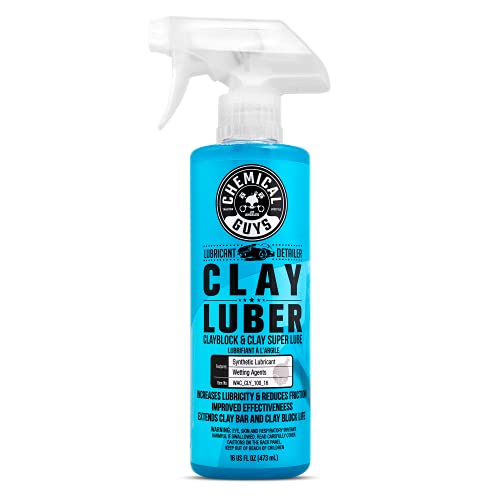
Clay Luber is a straightforward choice when you want a dedicated ready-to-use lubricant rather than mixing a general wash product. Its broad clay-media positioning makes it relevant to both traditional clay and compatible synthetic tools. A 16-ounce trigger bottle keeps the product ready for a localized clay session without preparing another wash mixture. Its listed bar, block, and synthetic-media uses are useful for a garage that changes decontamination tools according to the task. Dedicated lubrication also makes the bottle's role clearer than an unidentified detail spray borrowed from another stage of the wash.
The lubricant reduces friction, but the clay grade, contamination level, pressure, and cleanliness still determine how much marring the process may leave. Chemical Guys is a practical comparison when straightforward application matters more than reducing the number of stored bottles. A concentrate may suit someone already comfortable measuring task-specific mixtures. Check the clay manufacturer's requirements before assuming every synthetic medium accepts the same lubricant. Keep the sprayer working and the label readable so lubrication is applied deliberately rather than guessed from a bottle that happens to look familiar.
Pros
- Dedicated clay lubricant
- Trigger-spray format
- Traditional clay use
- Synthetic block use listed
- Sixteen-ounce configuration
Cons
- No guarantee against marring
- Frequent reapplication may be needed
To buy this product, click here.
2. GYEON ClayLube — Best for Low-Residue Paint Preparation

GYEON suits a buyer thinking ahead to polishing or coating preparation rather than looking for a gloss-enhancing detail spray. Its low-residue positioning is useful in that workflow, but it does not eliminate subsequent cleaning or panel preparation required by the protection product. The 500mL format provides a manageable dedicated product for selective paint preparation. Support for both traditional and compatible synthetic clay media can reduce the need to keep a separate lubricant for every tool. Its low-residue positioning is especially relevant where the owner wants to inspect the finish clearly before deciding on polishing or protection.
Keep claying limited to the areas that need it and check the paint afterward under good light. ClayLube is well suited to a buyer who has planned the steps that follow claying. It is not a substitute for the coating maker's required final surface preparation. Verify the exact mixing and wipe-off directions rather than assuming a ready-looking bottle establishes one fixed use method. Clean and store the clay tools separately so residue from a previous job is not reintroduced through an otherwise appropriate lubricant.
Pros
- Dedicated clay lubrication
- Traditional and synthetic media use
- Low-residue positioning
- Paint-preparation role
- Five-hundred-milliliter configuration
Cons
- Not the final coating-prep step
- Check dilution on the current bottle
To buy this product, click here.
3. Nanoskin GLIDE — Best for a Silicone-Free Option

GLIDE is relevant for a buyer who wants a silicone-free product with both clay and compatible synthetic-media applications. That is a concrete formulation distinction for some paint-work settings. Silicone-free positioning is a concrete detail for a buyer comparing products used around paint work. The listed Autoscrub and clay-bar applications also make the exact media compatibility more useful than the broad term detailer. A spray-and-wipe role can add convenience, but the lubricant still needs to be appropriate for the particular contact tool.
Verify the exact bottle's use instructions, since similarly named professional products can have different mixing requirements. A detailer role should not be confused with permission to clay a dirty, unwashed panel. Nanoskin is especially relevant when that formulation distinction and its supported media match the workflow. A user wanting added wax or protection should not assume those functions from a detail-spray description. Check the actual bottle's concentration instructions before preparing another container. Keep mixed solutions identified by task, because a product with several permitted roles can still be used incorrectly when its label and dilution have been lost.
Pros
- Silicone-free claim
- Clay-bar use
- Autoscrub use
- Spray-detailing role
- Sixteen-ounce bottle
Cons
- Confirm current ready-to-use or dilution directions
- Media compatibility still matters
To buy this product, click here.
4. Koch-Chemie Clay Spray — Best for Minimal Added Film

Koch-Chemie is attractive when the goal is lubrication with minimal added film during decontamination. It supports several types of clay media, making it useful for a detailer who changes tools according to the job. Support for clay bars, pads, and towels gives this Koch-Chemie a defined range of contact-media applications. A silicone-oil-free, low-residue formulation is a useful distinction from a gloss-oriented multipurpose spray. That makes it worth examining where the next step involves evaluating defects rather than trying to mask their appearance with added gloss.
Do not interpret easy wipe-off as an excuse to leave contamination-laden residue on the surface before polishing or applying a coating. Clay Spray suits someone who wants the lubricant's role to remain narrowly focused on controlled decontamination. A clean lint-free towel is still part of removing the used liquid and loosened residue. Follow the product and media instructions instead of assuming that a low-residue formula needs no cleanup at all. Store the bottle away from unlabeled detailing mixtures so a dedicated preparation product is not confused with a later protection spray.
Pros
- Silicone-oil-free claim
- Low-residue formula
- Clay-bar use
- Clay-pad and towel use
- Wipe-off application
Cons
- Still needs clean microfiber for removal
- No protection layer should be assumed
To buy this product, click here.
5. 3D GLW Clay Lubricant — Best for a Dedicated GLW Detailing Step

3D GLW gives buyers a clearly identified clay-lubrication product instead of relying on an unlabeled soap mix. It fits a home-detailing routine where a dedicated spray is preferred for consistency. A named GLW product makes it easier to identify the actual lubricant when several 3D detailing chemicals share the shelf. The spray format is useful for keeping a small section wet without mixing a bucket solely for claying. Its purpose is to reduce friction at the contact area, which is different from dissolving tar or iron contamination chemically.
Its job is to help the clay glide; it does not dissolve all contamination chemically, and it cannot compensate for clay that has picked up abrasive debris or been dropped. GLW is a sensible option for an owner who prefers a dedicated product and a clearly separated preparation step. It contributes less to a job where the surface does not need physical decontamination. Check the clay's condition throughout the work rather than relying on the feel of extra lubrication alone. Keep the sprayer and clay media clean between sessions so a convenient bottle does not encourage reusing a contaminated contact surface.
Pros
- Dedicated clay lubricant
- Spray format
- Paintwork application
- Traditional clay use
- GLW product-line identification
Cons
- Not an iron or tar remover
- Claying can still leave marks
To buy this product, click here.
6. McKee's 37 Universal Clay Lubricant — Best for Clay-Residue Cleanup

McKee's emphasizes both lubrication and removal of clay residue, making it useful when a particular clay leaves traces during the job. Its detail-spray role may add convenience, but residue removal should still use a clean towel and light pressure. The listed bar and mitt applications give McKee's a clear place in a mixed clay-tool kit. Its clay-residue cleanup role is also useful where the user wants one product to handle lubrication and the marks left by that process. A pleasant fragrance may affect working preference, but it should not outweigh compatibility or how the product cleans away.
If the clay repeatedly sticks or breaks down, stop and reassess compatibility rather than continuing to spray more product indefinitely. This is an appealing comparison when residue management is a recurring nuisance during claying. A media problem should still be investigated rather than covered by repeated lubricant application. Check that the bar or mitt is approved for the product before starting a large area. Use clean removal towels and inspect the finish after cleanup, since a surface that feels slick can still carry residue or newly introduced marring.
Pros
- Clay-bar application
- Clay-mitt application
- Clay-residue removal claim
- Detail-spray use
- Wipe-off formula
Cons
- Fragrance may not suit every user
- Follow the media maker's restrictions
To buy this product, click here.
7. Poorboy's World Clay Lube — Best for a Clay-Focused Formula

Poorboy's is a focused choice for someone who wants a named clay lubricant without buying a kit containing more clay bars. Its support for blocks and towels is useful, provided the media manufacturer permits the product. The 16-ounce bottle is a practical size for someone who wants a dedicated clay product without buying another bundled bar. Listed block and towel uses provide additional applications to verify against the tools already owned. The concentration claim is useful only when accompanied by actual directions for the particular bottle, rather than an invented mixing ratio.
The listing's concentration language is not enough to invent a dilution ratio; follow the actual bottle rather than an improvised recipe. Poorboy's suits a buyer who values a focused lubricant and can follow its current preparation instructions. It is less convenient if the intended synthetic medium has no clear compatibility guidance. Confirm the approved mixture before transferring it into another sprayer. Retain the original label and keep the contact tool clean, because neither a familiar brand nor a concentrated formula can make trapped debris safe against paint.
Pros
- Dedicated clay use
- Clay-block application
- Clay-towel application
- Sixteen-ounce bottle
- Lubricity-focused positioning
Cons
- No mixing ratio established from the available listing
- Do not assume all synthetic media are compatible
To buy this product, click here.
8. Pinnacle Clay Lubricant — Best for Several Clay Formats

Pinnacle is a candidate for a garage using several clay formats and wanting one dedicated lubricant. That flexibility can simplify setup, but each tool has a different contact area and contamination-loading behavior. The listed bar, disc, towel, and mitt applications are useful when different clay formats are selected for different areas. A dedicated lubricant can keep that change of contact tool separate from changes in washing or protection chemistry. Its preparation role is most valuable when only the remaining bonded contamination is treated rather than claying every clean panel automatically.
Keep the surface wet, inspect the media frequently, and avoid using the largest clay towel simply to cover more area when only a small section needs treatment. Pinnacle is a reasonable comparison for an owner who wants one lubricant across several approved media types. Check each medium's own restrictions before extending that versatility to an unfamiliar synthetic surface. Work in sections that remain manageable under the product directions. Keep the bottle and media identified after cleanup so a broad compatibility list remains a controlled choice rather than permission to use any old detailing tool.
Pros
- Clay-bar use
- Clay-disc use
- Clay-towel use
- Clay-mitt use
- Dedicated paint-prep role
Cons
- Surface testing is still needed
- Does not replace a wash
To buy this product, click here.
9. Masterson's Slick Clay Lube — Best for a Multipurpose Detailing Spray
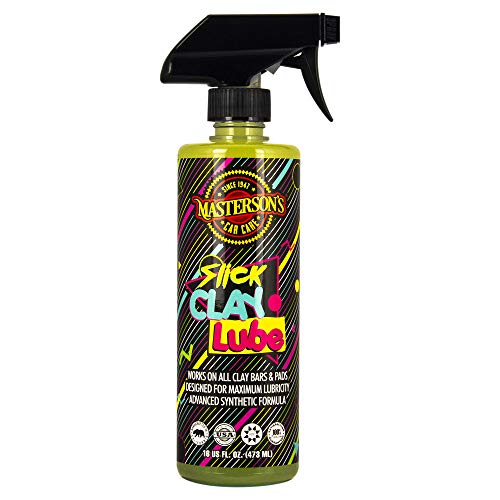
Masterson's offers broad clay-media positioning with a detail-spray style of use. It is useful when you want to compare a multipurpose product with low-residue dedicated options. Its bar, pad, towel, and disc positioning gives Masterson's a broad clay-media role to compare with more narrowly marketed options. Listed paint and glass uses also make surface identification part of the purchase decision. Anti-static positioning is a separate product claim and should not be interpreted as a substitute for washing away loose dirt before claying.
Choose according to the next step in the process: a surface being prepared for a coating has different cleanup requirements from a routine wash where the goal is simply removing a localized bonded deposit. This option makes the most sense where a multipurpose detail-spray role genuinely simplifies the owner's routine. A low-residue preparation product may be the more direct comparison when a coating follows. Check what cleanup the next treatment requires before deciding to leave any detail-spray film in place. Store it distinctly from protection sprays and keep the clay surface clean, so versatility does not obscure the purpose of the current step.
Pros
- Clay-bar and pad use
- Clay-towel and disc use
- Paint and glass applications
- Anti-static positioning
- Sixteen-ounce configuration
Cons
- Check suitability for specialized finishes
- Anti-static claims do not eliminate cleaning needs
To buy this product, click here.
Buying Guide
Check the clay manufacturer's requirements
Verify whether the medium is a traditional clay bar or a synthetic surface, and follow its lubricant guidance. A product advertised for clay does not automatically suit every brand of synthetic rubberized media. If the tool becomes sticky, breaks down, or behaves abnormally, stop and reassess compatibility rather than continuing to add pressure and product.
For related background, see How Does a Clay Bar Work? A Simple Guide.
Use clay only where needed
Wash and assess the surface first. Chemical iron or tar treatment may remove some contamination before physical claying. Select the least aggressive clay grade that suits the remaining problem. A smooth-looking panel does not need repeated claying merely because a lubricant bottle is available, and a heavily contaminated surface should not be tackled with a dirty bar.
Keep the working area lubricated
Follow the stated application amount and work in small sections. Reapply before the medium starts dragging, and use light pressure. Do not allow the lubricant to dry under the tool. A very slick feel is useful, but it cannot compensate for trapped debris, an unsuitable clay grade, or a towel that has picked up abrasive particles.
Choose residue behavior for the next step
If polishing or coating follows, compare low-residue options and the required cleanup process. A multipurpose detail spray may be convenient for routine work but still need removal before a protection product. No clay lubricant alone replaces all coating preparation. Follow the instructions of the polish, panel cleaner, and final protection you intend to use.
For related background, see Clay Bar vs Clay Mitt: Which Is Better?.
Clean up and inspect the finish
Use clean microfiber to remove residue as directed and inspect under suitable light. Claying can leave marring even with good lubrication, especially on softer paint. Keep the clay clean, fold or refresh traditional clay appropriately, and follow replacement rules after contamination or dropping. Assess any marks before deciding whether further correction is needed.
Frequently Asked Questions
Can I use plain water as clay lubricant?
Use the clay maker's recommended compatible lubricant. Plain water may not provide the required glide or compatibility for the particular medium.
Can a rinseless wash replace a dedicated lubricant?
Some products permit that use at a specific dilution. Check both the concentrate and clay-media instructions rather than guessing a ratio.
Does more lubricant make aggressive clay safe?
No. Clay grade, debris, pressure, surface condition, and technique still matter. Lubrication cannot eliminate all marring risk.
Should clay lubricant add wax or gloss?
That depends on the next step. For polishing or coating preparation, residue behavior and cleanup requirements may be more useful than added gloss.
Can I keep using a dropped clay bar?
Follow the media maker's contamination and replacement guidance. Embedded grit can damage paint and is not made safe merely by spraying more lubricant.
Final Verdict
Chemical Guys Clay Luber is our overall choice for a dedicated spray-lubrication step. GYEON ClayLube and Koch-Chemie Clay Spray are especially relevant when low-residue preparation matters. Nanoskin GLIDE offers a silicone-free option. Match the lubricant to the clay medium and next detailing step, and remember that good lubrication reduces friction without eliminating marring risk. Confirm the exact model, included components, compatibility, and current instructions before ordering.