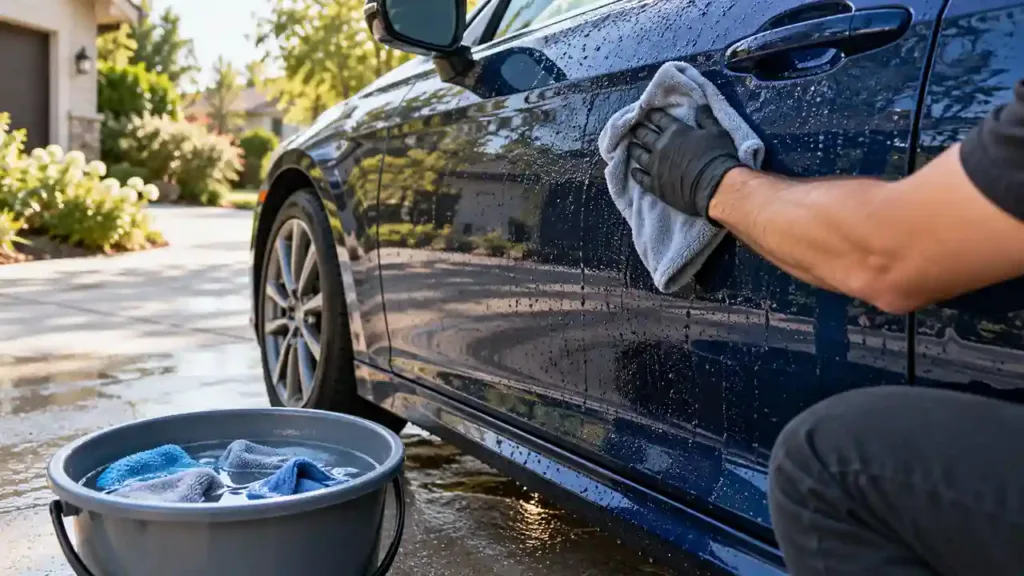
A rinseless wash can make regular car care practical when a hose is inconvenient, water use is restricted, or the garage is the easiest place to work. It still uses water, clean media, and a controlled drying process. It is not a promise that every dirty car can be safely wiped clean without preparation.
The best rinseless car wash depends on how you wash, the contamination level, desired residue behavior, and whether you want a dedicated wash or a multipurpose concentrate. A ready-to-use waterless spray is a different category from the bucket concentrates compared here.
We focus on documented use, dilution clarity, maintenance suitability, and relevant formulation differences. No product is called scratch-proof. The wash method, media cleanliness, and decision to pre-rinse heavy soil are at least as important as which concentrate is on the shelf. These recommendations compare documented product features and current listed configurations, not hands-on test results. Verify the exact model and instructions before purchase. This article contains affiliate links; qualifying purchases may earn the site a commission.
Quick Answer
Start with the first option for the most balanced documented feature set, then use the alternatives below when their particular configuration better matches your job. Compatibility and the stated limitations take priority over the ranking.
- Best Overall: Optimum No Rinse Wash and Shine V6 — Rinseless concentrate; one ounce per two gallons listed.
- Best for a Clear Bucket Dilution: DIY Detail Rinseless Wash T2 — One ounce per two gallons listed; rinseless cleaning.
- Best for a Polymer-Based Routine: P&S Absolute Rinseless Wash — Rinseless concentrate; polymer cleaning system.
Best Rinseless Car Wash Comparison Table
| Product | Best For | Rinseless Mix Information | Formula / Routine Distinction | Check Before Buying |
|---|---|---|---|---|
| Optimum No Rinse Wash and Shine V6 | Best Overall | 1 oz per 2 gallons listed | ONR V6 polymer wash | Needs correct dilution |
| DIY Detail Rinseless Wash T2 | Best for a Clear Bucket Dilution | 1 oz per 2 gallons listed | T2 hybrid-polymer routine | Not intended to replace every heavy-soil wash |
| P&S Absolute Rinseless Wash | Best for a Polymer-Based Routine | Follow current label | Dedicated polymer rinseless wash | Use the label's dilution |
| Griot's Garage Rinseless Wash | Best for a Simple Home-Garage Routine | Follow current label | Low-water garage maintenance | Check current dilution on the bottle |
| McKee's 37 N-914 V2 | Best for a Multipurpose Concentrate | Task-specific dilution | Wash, clay lube, detailer uses | Different tasks require different dilution |
| CLEAN. Rinse-Less Wash | Best for a pH-Neutral Product Positioning | Follow current label | pH-neutral positioning | Check every interior material separately |
| Armour Detail Supply HERO | Best for Avoiding Added Protection | Task-specific dilution | No added protection claim | Not a protective coating |
| Koch-Chemie Rapid Rinseless Wash | Best for a Stated 256:1 Mix | 256:1 listed | Paint, PPF, wrap positioning | Verify suitability for the actual film |
| Yum Rinse Less Wash | Best for a pH-Balanced Alternative | Follow current label | pH-balanced maintenance wash | Check current dilution instructions |
1. Optimum No Rinse Wash and Shine V6 — Best Overall

ONR is a balanced starting point for a regular rinseless routine because its bucket dilution is clearly stated and its use extends beyond a single paint-care scenario. The important advantage is reducing dependence on a hose during light-to-moderate maintenance. The listed one-ounce-to-two-gallon wash mix gives ONR V6 a clear starting recipe for the intended bucket method. Its clay-lubricant role can add usefulness when the correct separate instructions are followed. The version designation matters because an old bottle or online chart for another formulation should not automatically control the current product's dilution.
It does not remove the need to assess contamination, use clean wash media, and stop before dragging visible grit across a panel. Optimum suits a buyer building a repeatable routine around measured concentrate and clean wash media. It can also be relevant where a compatible clay-lubricant use would reduce the number of separate products stored. Label any prepared bottles for their actual task rather than assuming one mixture serves every use. Keep the current directions with the concentrate so a convenient low-water process stays consistent after the first few washes.
Pros
- Rinseless concentrate
- One ounce per two gallons listed
- Polymer cleaning formulation
- Multiple exterior surfaces
- Clay-lubricant use listed
Cons
- Needs correct dilution
- Heavy grit still calls for a pre-rinse
To buy this product, click here.
2. DIY Detail Rinseless Wash T2 — Best for a Clear Bucket Dilution

DIY Detail presents a simple bucket-based process that suits an owner adopting rinseless washing for the first time. Its stated dilution gives a clear starting point instead of requiring guesswork. The explicit one-ounce-per-two-gallon ratio makes preparation easier to plan with a proper measuring tool. A section-by-section method also helps define the size of the working area instead of encouraging a single wipe around the whole vehicle. Its hybrid-polymer description is formulation information, while the visible soil and media condition determine whether continued contact is appropriate.
The product remains only one part of the process: pre-wetting, clean media, light pressure, and timely drying determine whether a maintenance wash is appropriate for the condition of the car. T2 is particularly useful for an owner who wants a clearly described starting routine rather than several improvised spray dilutions. The 16-ounce format is manageable for trying that routine before choosing a larger supply. Measure each batch instead of adding an extra splash by habit. Keep wash and drying media clean between sessions so a repeatable formula ratio is supported by an equally repeatable handling process.
Pros
- One ounce per two gallons listed
- Rinseless cleaning
- Hybrid-polymer description
- Section-by-section method
- Sixteen-ounce configuration
Cons
- Not intended to replace every heavy-soil wash
- Dilution and towel management matter
To buy this product, click here.
3. P&S Absolute Rinseless Wash — Best for a Polymer-Based Routine

Absolute is aimed at buyers who want a dedicated rinseless concentrate for a repeatable maintenance routine. It is easy to overvalue how slick a wash feels while ignoring what is being moved across the paint. A quart configuration offers a defined concentrate quantity for someone maintaining a regular wash routine. Its dedicated polymer-based positioning is useful to compare with a product specifically designed to avoid added protection. The absence of a hose-rinse step changes the workflow, but it does not remove the importance of loosening soil and controlling what remains on the wash media.
Judge the process by soil level and media cleanliness, and compare product concentration and handling rather than assuming any polymer formula makes dirty wash media safe. Absolute suits a buyer who wants a dedicated bucket concentrate rather than a ready-to-use detail spray. Verify the current label instead of borrowing another brand's ratio because both products are called rinseless. Evaluate streaking only after checking concentration, water, and drying towels. Store the concentrate and any prepared mix clearly identified so an old unlabeled spray bottle is not treated as the correct wash solution by default.
Pros
- Rinseless concentrate
- Polymer cleaning system
- Bucket washing application
- No hose rinse required
- Quart configuration
Cons
- Use the label's dilution
- A slick feel is not proof against scratching
To buy this product, click here.
4. Griot's Garage Rinseless Wash — Best for a Simple Home-Garage Routine

Griot's is a practical candidate for an owner already using its detailing products who wants a low-water maintenance option. It can simplify washing in a garage or driveway where hose access is inconvenient. The 16-ounce bottle fits a home-garage routine where a manageable concentrate is preferable to another large container. Its multiple detailing uses may also be convenient for an owner already familiar with preparing labeled spray bottles. Those uses should be compared as separate instructions rather than a claim that one bucket mix is ideal for every exterior task.
The convenience comes from the process, not from making every dirty vehicle suitable for rinseless cleaning. Remove heavy contamination first and keep a separate clean drying towel ready. Griot's is most relevant when simplicity of storage and integration with an existing routine matter. A mobile or high-volume user may want to evaluate how much concentrate is consumed in normal use before choosing a container size. Read the bottle for the particular application being prepared. If the finished panel streaks, work through dilution and towel condition before applying another chemical simply to cover the result.
Pros
- Bucket-based cleaning
- Polymer lubrication claim
- Low-water use
- Multiple detailing applications
- Sixteen-ounce configuration
Cons
- Check current dilution on the bottle
- Requires clean drying towels
To buy this product, click here.
5. McKee's 37 N-914 V2 — Best for a Multipurpose Concentrate
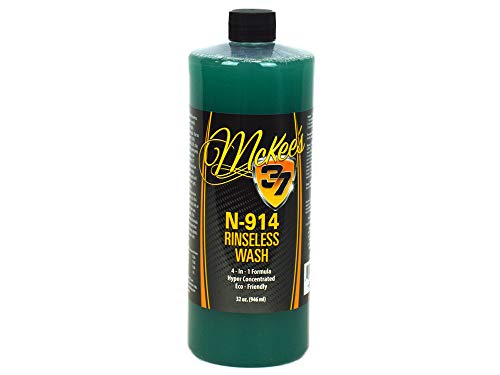
N-914 suits a buyer who wants one concentrate for several specified detailing tasks. That can reduce shelf space, but each task needs the correct mixing instructions rather than one universal spray bottle. The V2 identification is important when comparing the current concentrate with older advice about N-914. Rinseless washing, clay lubrication, and detail-spray use are distinct tasks with potentially different preparation requirements. That versatility is useful when the owner is willing to manage several clearly identified mixtures rather than expecting one universal bottle.
It is particularly relevant when you already manage labeled dilution bottles and clean media carefully. Confirm the current V2 directions instead of relying on an old dilution chart for another version. McKee's fits someone who deliberately wants a concentrate with more than one permitted role. It is less straightforward if measured mixing and labeling are likely to be skipped. Confirm compatibility with the chosen clay medium before assigning it that additional job. Keep the current instructions available and discard assumptions carried over from another version, since a familiar product name does not prove identical preparation directions.
Pros
- Rinseless washing
- Clay-lubricant use
- Quick-detailer use listed
- Concentrated format
- High-lubricity formulation claim
Cons
- Different tasks require different dilution
- Check compatibility with clay media
To buy this product, click here.
6. CLEAN. Rinse-Less Wash — Best for a pH-Neutral Product Positioning

CLEAN. is worth comparing when the buyer prioritizes a pH-neutral rinseless product and wants to examine the ingredient and surface claims closely. Its broad application list is a starting point, not a reason to wipe every interior component with the same mix. Its pH-neutral positioning gives the buyer a specific formulation claim to examine rather than a promise that contact washing cannot damage paint. Listed interior and exterior uses make the actual dilution and material requirements particularly important. A 16-ounce bottle can be useful for evaluating the product within a controlled routine before extending it to several different tasks.
Use the labeled concentration and verify the material requirements before extending an exterior wash product to delicate cabin surfaces. The CLEAN. option is most appropriate when the user will verify each intended application individually. A dashboard surface, painted panel, and glass area should not automatically receive the same mixture and towel. Keep prepared solutions labeled by purpose so broad product positioning does not create confusion later. Assess the cleaned surface and media condition before deciding whether another pass is needed, rather than treating a pH claim as unlimited cleaning permission.
Pros
- pH-neutral claim
- Rinseless format
- Coating-care use listed
- Interior and exterior uses listed
- Sixteen-ounce bottle
Cons
- Check every interior material separately
- Marketing claims do not establish universal safety
To buy this product, click here.
7. Armour Detail Supply HERO — Best for Avoiding Added Protection

HERO is the clearest choice here for someone who specifically wants cleaning without another protective layer. That matters when evaluating an existing coating or preparing for a separate protection step. The stated absence of added protection is a useful distinction when the aim is to observe an existing coating's behavior. Its multiple dilution-based uses also make it relevant to someone who already organizes separate wash and detailing bottles. That versatility is different from a dedicated ready-to-use spray whose concentration never needs to be measured.
Its no-added-protection positioning does not mean no cleaning residue ever remains under poor technique. Follow the dilution and drying process, especially before judging the behavior of a coating underneath. HERO is particularly relevant when unwanted gloss or protection additives would complicate the next detailing step. An owner who specifically wants a wash-and-protect effect may prefer a different product role. Use the instructions for the actual task and avoid treating a stronger mix as an automatic improvement. Keep the drying process controlled so remaining streaks are not confused with the behavior of the coating being evaluated.
Pros
- Rinseless cleaning
- No added protection claim
- No surface-altering polymers claim
- Multiple labeled uses
- Adjustable task-specific dilution
Cons
- Not a protective coating
- Mixing instructions differ by task
To buy this product, click here.
8. Koch-Chemie Rapid Rinseless Wash — Best for a Stated 256:1 Mix

Koch-Chemie's stated ratio makes it easy to plan a labeled wash bucket or application bottle. Its PPF and wrap positioning may be relevant to protected vehicles, but the film manufacturer's care instructions still matter. A stated 256:1 ratio gives the Koch-Chemie a clear measuring target rather than leaving concentration to visual estimation. Its paint, PPF, and wrap positioning is useful to compare with the care instructions for the actual protected vehicle. Bucket application and a permitted spray method also provide different workflows, each of which should follow the product's current directions.
Choose it when its concentration and intended process suit your routine, not because a European detailing brand name alone proves a superior wash result. Rapid Rinseless is a good candidate when that measured ratio and those permitted surfaces fit the owner's routine. A cap approximation is less useful than accurate measurement when preparing a small bottle. Confirm the film maker's restrictions before extending a general wrap-safe claim to a specialized finish. Store the concentrate and mixed solutions distinctly so a convenient multi-method product does not become an unidentified spray at the next wash.
Pros
- 256:1 dilution listed
- Bucket application
- Spray-and-wipe application listed
- PPF and wrap use listed
- Existing wax compatibility claim
Cons
- Verify suitability for the actual film
- Dilution accuracy is important
To buy this product, click here.
9. Yum Rinse Less Wash — Best for a pH-Balanced Alternative

Yum is another dedicated rinseless concentrate for a buyer comparing a pH-balanced maintenance wash. The smaller bottle can be convenient for trying a routine before committing to a larger container. The 500mL configuration is practical for a buyer who wants a relatively compact concentrate on the detailing shelf. Its pH-balanced and coating-care positioning also provides specific claims to compare with the chosen surface's requirements. The product remains a wash chemical rather than an assurance that every oil film or heavily soiled panel can be cleaned by light wiping.
Its role is controlled low-water cleaning; oily deposits, heavy mud, and gritty road film may require a different preparation method before any contact wash begins. Yum suits a maintenance routine where the soil level and available clean media are already being assessed carefully. A smaller bottle also lets the user evaluate the working method without storing a bulk quantity immediately. Confirm the current mix instructions before preparing a bucket or spray. Keep towels and dilution bottles organized so an appealing low-water method remains controlled after the novelty of the first wash has passed.
Pros
- Rinseless format
- pH-balanced claim
- Paint and trim applications
- Coating-care use listed
- Five-hundred-milliliter configuration
Cons
- Check current dilution instructions
- Not a heavy-degreasing wash
To buy this product, click here.
Buying Guide
Decide whether the car suits rinseless washing
Light-to-moderate maintenance soil is a different situation from caked mud, sand, or heavy winter grime. Inspect the vehicle and remove heavy loose contamination with an appropriate pre-rinse when needed. Do not force a low-water method onto a surface that needs a different process. Product lubricity cannot make large grit harmless under a wash mitt.
For related background, see How Often Should You Wash Your Car? Expert Guide.
Measure the correct dilution
Read the current bottle for the exact product version and task. A rinseless-wash ratio may differ from the same concentrate's clay-lubricant or quick-detailer ratio. Label mixed containers and use a suitable measuring method. More concentrate is not automatically safer; an unnecessarily strong mix may leave residue and make drying or glass cleanup harder.
Manage wash media deliberately
Use clean towels, a compatible sponge, or a mitt under an appropriate process. Keep dirty media separate and avoid returning contamination to the next clean panel. Work in manageable sections, use light pressure, and re-wet as required. The ability to use one bucket does not mean a single dirty towel should be dragged around the entire car.
Consider added protection and residue
Some buyers want gloss or a maintenance film, while others want a cleaner that does not add protection. That difference matters when evaluating an existing coating or preparing for another treatment. Do not infer residue behavior solely from the word polymer. Use the actual product description and the required follow-up steps for your detailing goal.
For related background, see Hand Wash vs Automatic Car Wash: Which Is Better?.
Plan drying and suitable conditions
Keep enough clean drying media available and avoid letting wash solution dry uncontrolled on a hot panel. Sun, wind, water hardness, and dilution affect the result. A low-water method is convenient, but local restrictions and runoff rules still apply. If streaks persist, reassess technique, concentration, and towel cleanliness before assuming the product has failed.
Frequently Asked Questions
Is rinseless the same as waterless washing?
No. Rinseless concentrates are commonly mixed in water for a bucket or prepared solution. Ready-to-use waterless sprays use a different product format and process.
Can I use rinseless wash on a muddy car?
Heavy mud or grit needs suitable removal before contact. Do not rely on lubricity to make wiping heavy contamination safe.
Should I add extra concentrate for more protection?
Use the labeled ratio. A stronger mixture may increase residue without improving the intended wash process.
Can the same mix be a clay lubricant?
Only when the product and clay-media instructions permit that use at the specified dilution. Do not assume the wash ratio is the clay ratio.
Will rinseless washing prevent all swirls?
No product can guarantee that. Contamination control, clean media, light contact, and appropriate preparation determine much of the risk.
Final Verdict
Optimum No Rinse V6 is our overall starting point for a clearly defined rinseless bucket routine. DIY Detail T2 provides another explicit mixing approach, while Armour HERO is the option to examine when avoiding added protection is a priority. Match the process to the soil level and use clean media instead of expecting any concentrate to make heavy grit safe to wipe. Confirm the exact model, included components, compatibility, and current instructions before ordering.