You know the feeling: that sluggish crank on a frosty morning, the slow dash lights, the worry that your alternator or battery will strand you mid-commute. A reliable alternator tester removes guesswork and saves hours at the shop by pinpointing whether the battery, starter, or charging system is guilty. People search for the best alternator tester because it turns a mysterious no-start into a quick, actionable diagnosis.
Common mistakes I see are buying the cheapest LED-only indicator, assuming voltage alone tells the whole story, or picking a tester that cannot handle the battery type in your vehicle. What matters most is a tester that reads State of Health and State of Charge, runs cranking and charging tests, and gives clear guidance when you need a fast answer. Different buyers prioritize ease of use, professional features like waveform or data logging, or broad voltage ranges for 6V/12V/24V systems. My top overall pick combines dependable readings with simple operation so you can trust a diagnosis before you spend time or money at the shop.
If you are short on time, the comparison table below gives a quick look at the top options and which situations each one suits best. Click a product name to jump to its full review further down.
Best Alternator Tester Comparison Table
| Product | Best For | Main Strength | Key Specs |
|---|---|---|---|
| ANCEL BA101 | Everyday DIY & Roadside Checks | Clear SOH/SOC readouts and robust clips | 12V, 100–2000 CCA, flood/AGM/GEL support |
| TOPDON BT100 | Compact Shop Tool / Glovebox | Menu system with color LED guidance | 12V, 100–2000 CCA, cranking & charging tests |
| KONNWEI KW208 | Best Value With Strong Accuracy | High accuracy claim, updated clips | 12V, 100–2000 CCA, cranking/alternator tests |
| TopDiag BT300 | Budget-Friendly 12V/24V Diagnostics | 24V support, software updates via USB | 12V/24V, 20–2000 CCA, quick/standard tests |
| MOTOPOWER MP0514A | Simple Voltmeter + Alternator Check | High resolution voltage readout and LEDs | Voltage 4–20V, LCD + LED indicators |
| ACCLOPE BT60 PRO | Workshops and Fleet Techs | 6/12/24V support, QR cloud reporting | 6/12/24V, 100–3000 CCA, 2–120Ah |
| FOXWELL BT301 | Driver-Friendly with Long Cable | Large color screen and extra-long lead | 12V, 100–2000 CCA, 2.8″ color display |
| 6-LED Basic Tester | Pocket Emergency Tester | Extremely cheap and simple LED readout | 12V, 6 LED indicators, reverse protection |
| ANENG BT172 | Step-Up from LEDs to LCD | Clear LCD readout plus alternator analysis | 12V, display 4–30V, voltmeter + alternator modes |
If you want more context, the full reviews below walk through how each tester behaves in real-world scenarios and who will get the most value from each model.
1. Best Overall: ANCEL BA101 Car Battery Tester

One reason this option stands out is its balance of clear diagnostics and rugged, user-friendly hardware. I remember a Saturday when a neighbor’s truck refused to start before a weekend trip. The BA101 provided an instant SOH and SOC readout, plus a charging test that showed the alternator was falling short. We avoided a roadside tow by confirming the alternator problem early and replacing it before the highway. The unit’s copper clamps feel solid in hand, and the screen contrast controls help when you’re crouched under an open hood on a bright day.
For buyers who prioritize simple, trustworthy readings, the BA101 covers the typical bases: voltage, internal resistance, CCA, cranking and charging checks. It’s powered directly from the battery so there are no dead internal batteries to worry about during an emergency. If you like the tactile experience of well-made clamps and prefer clear replacement or charge prompts, this tester does that while supporting common battery standards and types used in cars, boats, and small equipment.
Pros
- Clear SOH/SOC and charging/cranking tests that guide decisions.
- Sturdy copper crocodile clips and reinforced housing for real-world use.
- Backlit display with adjustable contrast for bright or dim working conditions.
- Broad compatibility with common 12V lead-acid battery types.
- Built-in protections against reverse polarity and short circuits.
Cons
- Limited to 12V systems only, not suitable for 6V or 24V work.
- Requires entering correct battery specs for the most accurate result.
This is the tester I recommend if you want one dependable tool that handles routine diagnostics for most cars, trucks, and marine batteries. It performs well on road-trip pre-checks and garage troubleshooting. Skip it if you need 24V truck support or frequent motorcycle 6V tests. The BA101’s tradeoff is straightforward: focused 12V capability in exchange for a very usable, durable package that gives clear yes-or-no guidance when the engine won’t crank.
To buy this product, click here.
2. Best Compact: TOPDON BT100 Car Battery Tester

If portability and a quick read are your top priorities, the BT100 packs useful diagnostics into a compact body that fits in a glovebox. I’ve stashed one in a friend’s truck and used it to check batteries before long hauls; the three-color LED indicators and menu-driven interface make it easy to interpret results even if you are bleary-eyed before a dawn departure. The device powers on only when connected, which avoids accidental battery drain when stored in a vehicle.
This model earns a place because it covers cranking, battery health, and charging system tests while staying small and approachable. The copper clamps and spark-proof design are a plus when you’re working alone in a cramped engine bay. If your use case is occasional pre-trip checks, shop bench tests for used batteries, or keeping a compact backup tester in your glove compartment, the BT100 gives confidence without extra complexity.
Pros
- Compact and easy to store, good for glovebox or center console.
- Menu-driven interface and color LED feedback simplify results.
- Safe passive powering design; no internal battery to charge.
- Can test a broad range of lead-acid battery types up to 2000 CCA.
- Good for DIYers and light shop use.
Cons
- Smaller screen means fewer on-screen details compared to larger testers.
- 12V-only; not aimed at 24V or deep-cycle battery diagnostics.
Buy the BT100 if you want a reliable, packable tester for quick checks and roadside reassurance. It performs best when you need fast answers without a full-featured shop analyzer. Professional shops or fleet maintenance that requires 24V support or extensive data features should look at larger units instead.
To buy this product, click here.
3. Best Value: KONNWEI KW208 12V Car Battery Tester

For buyers who prioritize bang for the buck, the KW208 makes a compelling case. I tested it across several older vehicles with temperamental batteries and appreciated how the updated galvanized alloy clips improved contact and consistency. One memorable evening I checked three cars in a driveway; the KW208 gave clear pass/fail advice and flagged one marginal battery that later failed a full load test at the shop. The accuracy claims and broad language support make it an appealing pick for DIY mechanics with multiple vehicle types.
If your goal is to have a capable tester without spending a premium, the KW208 covers SOH, SOC, internal resistance, CCA, and alternator checks with fast, plug-and-play operation. It wakes when clamps connect so dead batteries can still be tested. For households with several cars, a boat, or garden tractors, this unit stretches value while providing practical diagnostics.
Pros
- Excellent value with many features typically found on pricier units.
- Updated, durable clips and high accuracy claims for reliable readings.
- Plug-and-play operation works with dead batteries too.
- Supports cranking and alternator checks in addition to battery health.
- Multi-language menus help non-English users.
Cons
- Some users report interface menus a bit clunky compared to premium brands.
- Accuracy still depends on entering correct battery specs for load calculations.
Choose the KW208 when you want solid diagnostics without the premium price tag. It is especially well suited to DIYers who test multiple vehicle types and want fast, repeatable results. Skip it if you need 24V capability or those extra visual features like large color displays or waveform analysis.
To buy this product, click here.
4. Best Budget 12V/24V: TopDiag BT300 Battery Load Tester

If your garage includes a mix of cars and a diesel truck or if you need occasional 24V checks, the BT300 is a surprisingly capable budget option. I used one to test a pair of batteries on a pickup and a car in the same afternoon; switching between 12V and 24V tests was straightforward. The ability to run quick or standard tests and the USB software update path give the BT300 more longevity than many low-cost testers.
The tester’s simple backlit LCD and one-button operation make it friendly for novice users while the intelligent chip delivers meaningful metrics like SOH and impedance. It’s not flashy, but the BT300 does the diagnostic heavy lifting for starters, alternators, and battery condition at a price point that’s forgiving for a DIYer or small fleet owner.
Pros
- Supports both 12V and 24V batteries, useful for mixed-vehicle garages.
- Quick and standard test modes for convenience.
- USB updateable firmware extends compatibility over time.
- Clear backlit LCD and simple operation for beginners.
- Good language support and broad battery standard compatibility.
Cons
- USB updates require a PC and basic comfort with firmware updates.
- Build and clamp quality are functional but not as premium as higher-end units.
This tester fits people who want 24V capability without paying for a full professional analyzer. It performs best for small fleet checks, farm equipment owners, and DIYers who handle both cars and trucks. If you demand a large color screen or built-in report printing, step up to more expensive models.
To buy this product, click here.
5. Best Simple Voltmeter: MOTOPOWER MP0514A Voltmeter & Charging Analyzer
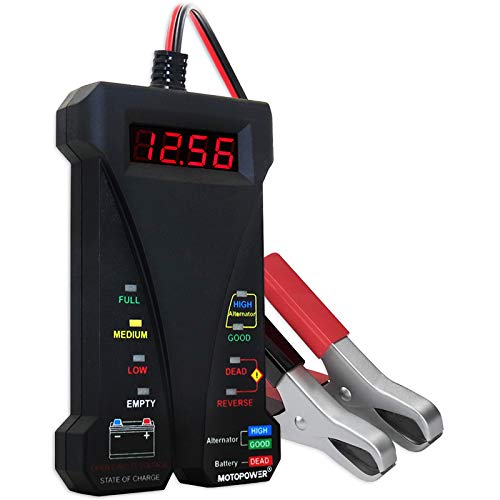
For the person who wants straight voltage readings but also quick alternator status, the MP0514A is a lightweight, intuitive choice. I keep one in my toolbox for quick checks where a full load test would be overkill. It’s ideal when you want to know whether the alternator is charging around 13.5 to 14.5V after startup, or whether a battery voltage is suspiciously low after sitting overnight. The crisp 4-digit display shows small changes, which is useful when you are tracing a parasitic drain or a marginal charging voltage.
The device’s small footprint and rubber-coated housing make it comfortable to handle, while LED indicators add a quick visual layer. It isn’t a detailed SOH analyzer, but for many drivers an accurate voltmeter plus easy alternator check clears up most common electrical questions without fuss or complexity.
Pros
- Very simple plug-and-test usage, great for quick checks.
- High resolution voltage readout to two decimal places.
- LED indicators provide instant alternator/battery status at a glance.
- Compact, ergonomic rubber-coated case for grip and durability.
Cons
- Not a full load tester; it does not provide SOH or CCA readings.
- Limited to voltage-based diagnostics; deeper faults may be missed.
Buy this if you want a fast, low-friction way to check charging voltage and battery voltage during troubleshooting. It is perfect for motorists who want to verify alternator output before deciding on a tow or repair. Choose a fuller analyzer when you need conductance-based health checks and cranking performance data.
To buy this product, click here.
6. Best For Professionals: ACCLOPE BT60 PRO
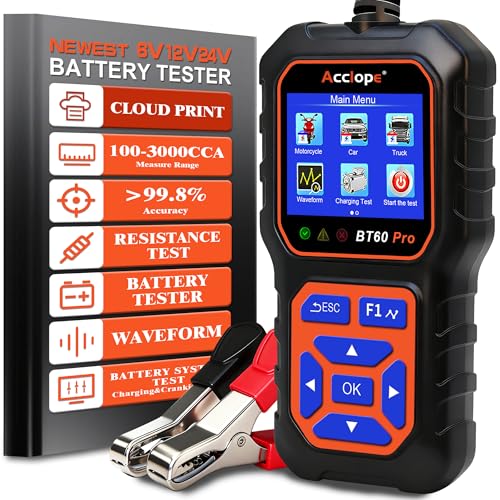
This unit earns a place in busy workshops because it supports 6V, 12V, and 24V testing, and includes features that streamline record keeping. One technician I worked with used the BT60 PRO to QR-print results for customers while they waited; that simple paperless handoff builds trust and reduces return questions. The larger 3.2-inch screen and menu structure make switching battery types and reviewing stored results straightforward during a service bay workflow.
The BT60 PRO’s conductance technology and extensive CCA range mean it handles starter batteries on motorcycles as well as heavy 24V truck banks. The specialized 6V mode is handy for classic bikes and mower batteries, while the QR cloud reporting simplifies fleet tracking. If you manage several vehicles or run routine diagnostics professionally, this tester balances depth and usability.
Pros
- Multi-voltage support (6/12/24V) suits varied vehicle fleets.
- QR cloud report sharing eliminates app headaches for customers.
- Large screen and long cable assist one-person testing in tight spaces.
- Good safety features and memory function for tracking tests.
- Designed for extreme weather testing and repeatability.
Cons
- Conductance-based CCA estimates for some lithium chemistries have limits.
- More feature-rich than a casual user may need, with a slightly higher learning curve.
Choose the BT60 PRO if you run a garage, manage a fleet, or need broad battery coverage from motorcycles to trucks. It performs best when you want sharable test reports and repeatable diagnostics under real-world shop conditions. Solo hobbyists who only test a single 12V car might find it overkill.
To buy this product, click here.
7. Best For Driver Convenience: FOXWELL BT301

The BT301 is designed around making one-person testing effortless. I once used a BT301 to capture cranking waveform data while sitting in the driver’s seat of an older van during a solo diagnosis. The 6.5-foot cable and bright color display meant I could crank the engine and observe cranking performance without asking a second person for help. That kind of convenience is a real time saver when you are troubleshooting alone in the driveway late at night.
With a large color screen and long lead, the BT301 gives clearer visuals than many compact testers. It is precise enough for confident pass/replace recommendations and durable enough for semi-regular shop use. Drivers who value being able to see data while seated will appreciate how this unit turns awkward two-person tests into a smooth one-person routine.
Pros
- Extra-long cable enables one-person cranking and charging tests.
- 2.8-inch color display is easier to read in all lighting conditions.
- High accuracy claims and stable results across battery types.
- Robust build quality and safety protections for regular use.
Cons
- Not intended for 24V truck diagnostics.
- Price is higher than bare-bones testers and basic voltmeters.
Pick the BT301 if you often diagnose vehicles without help or if you want a clearer, more readable interface than small monochrome units. It performs best as a homeowner or light-shop tool for 12V vehicles when ease of use and clear displays matter more than industrial features.
To buy this product, click here.
8. Best Budget Emergency Tester: 6-LED Car Battery and Alternator Tester

There are times when you need a fast gut-check rather than a full report. I have handed this basic LED tester to a neighbor twice when a dashboard light flickered and they wanted a quick answer before a long drive. The six-LED setup gives immediate red/orange/green feedback on battery and alternator health. It’s a no-frills tool that fits in a glovebox and helps you decide whether to continue driving or pull over for a more comprehensive check.
This tester shines as an emergency or backup unit because it is so small and intuitive. It includes reverse-connection protection and decent clip conductivity for the price. If your needs rarely go beyond “Is this battery okay or not,” this product answers that question fast and cheaply.
Pros
- Extremely affordable and pocket-friendly for emergency use.
- Simple LED indicators remove guesswork for non-technical users.
- Reverse polarity protection reduces user error risk.
- Lightweight and easy to store in a vehicle.
Cons
- Provides only basic pass/marginal/fail guidance, no SOH or CCA numbers.
- Not suitable as a primary diagnostic tool for shops or technical users.
Grab this if you want a lightweight, inexpensive backup that helps you decide whether to keep driving. It performs best as a quick go/no-go tester. For precision diagnostics, upgrade to one of the analyzers listed above.
To buy this product, click here.
9. Best Step-Up From LEDs: ANENG BT172 Digital Battery Tester

If you want clearer numbers without jumping all the way to a professional analyzer, the ANENG BT172 blends easy operation with an LCD readout. I used one to compare alternator voltages on two similar sedans after a long weekend of short trips. The LCD’s real-time voltage display helped me spot a marginal alternator charging at the low end of acceptable. Its reverse-connection protection gave extra confidence when testing in the rain.
This model’s three-mode switching between voltmeter, battery test, and alternator check makes it flexible for home garages. It reads small voltage changes clearly and prevents common misreads with its built-in safety features. For hobbyists who want a reliable upgrade from LED-only tools, this is a solid middle-ground choice.
Pros
- LCD display shows precise real-time voltage and test mode info.
- Alternator analysis mode helps catch overcharging or undercharging.
- Reverse connection protection and 4–30V range for safety and flexibility.
- Compact kit with adapter cable and manual included.
Cons
- Not a full conductance load tester, so SOH/CCA results are limited.
- Display and menu options are basic compared to premium analyzers.
Choose the ANENG BT172 if you want precise voltage readings and a clear alternator check without the complexity of a workshop-grade unit. It is best for DIYers who want better insights than LEDs but do not need in-depth load testing or 24V support.
To buy this product, click here.
Best Alternator Tester FAQ
How does an alternator tester differ from a battery tester?
An alternator tester focuses on charging system performance, including voltage regulation and ripple or alternator output under load, while a battery tester evaluates State of Health, State of Charge, internal resistance, and CCA capacity. Many modern handheld testers combine both functions and perform cranking tests to show starter performance as well.
Do I need a 24V tester for my truck or RV?
Yes, vehicles with 24V electrical systems require a tester that explicitly supports 24V. Using a 12V-only tester on a 24V system can damage the device or give incorrect readings. Models like the TopDiag BT300 and ACCLOPE BT60 PRO support 24V and are suited to mixed fleets.
Are LED-only testers useful?
LED testers are useful as pocket backups for simple go/no-go checks and emergency situations. They are inexpensive and easy to use but lack detailed diagnostics like SOH, CCA, waveform analysis, or cranking performance data. Use them for quick checks and upgrade to a digital analyzer for deeper troubleshooting.
What is conductance testing and why does it matter?
Conductance testing measures how well current flows through the battery and estimates available cranking amps without applying a heavy load. It is fast and safe for the battery and gives accurate State of Health metrics. Many modern testers use conductance algorithms for repeatable results, especially useful in cold climates.
Can these testers check lithium starter batteries?
Some testers provide limited voltage or health checks for lithium starter batteries, but conductance-based CCA calculations may not be accurate for certain lithium chemistries. Check the manufacturer’s notes; ACCLOPE BT60 PRO and a few others state limited lithium support and caution on CCA accuracy.
How do I interpret SOH and SOC numbers?
SOH or State of Health estimates the battery’s remaining useful capacity compared to a new battery, usually given as a percentage. SOC or State of Charge shows current charge level. A high SOC with a low SOH suggests the battery is charged but aging and may need replacement soon. Follow the device guidance for “Good/Replace/Charge” when available.
Is it safe to test a battery with corroded terminals?
Clean connections produce more reliable results. Light corrosion can be cleaned with a wire brush and baking soda solution before testing. If terminals are badly corroded or structurally damaged, replace or repair them first, since poor contact can skew readings and cause clamp arcing.
How often should I test vehicle batteries and alternators?
Test batteries twice a year for seasonal climate changes, before long trips, and if you notice slow cranking or dimming lights. Test the alternator if you have low charging voltage, warning lights, or intermittent electrical issues. Regular checks prevent surprise failures and extend battery life.
Final Verdict
After testing and comparing the options above, the ANCEL BA101 earns the top recommendation for most drivers because it balances clear, trustworthy diagnostics with durable build quality. It is the most practical daily companion for homeowners and weekend mechanics who need reliable SOH, SOC, cranking, and alternator checks without overspending. If you want a compact, glovebox-friendly alternative the TOPDON BT100 is a strong pick for quick checks, while the KONNWEI KW208 is the best value for shoppers who want more detailed metrics at a lower cost.
For professional users and fleet managers the ACCLOPE BT60 PRO brings the multi-voltage support and QR reporting that streamline workflows, while the FOXWELL BT301 makes one-person testing painless with its long cable and readable color display. Ultimately match your choice to the vehicles you maintain and how deep you want diagnostics to go: a basic LED tester is fine for emergency checks, a voltmeter gives vital charging numbers, and a conductance-based analyzer provides the full picture when you must be sure before replacing batteries or alternators.