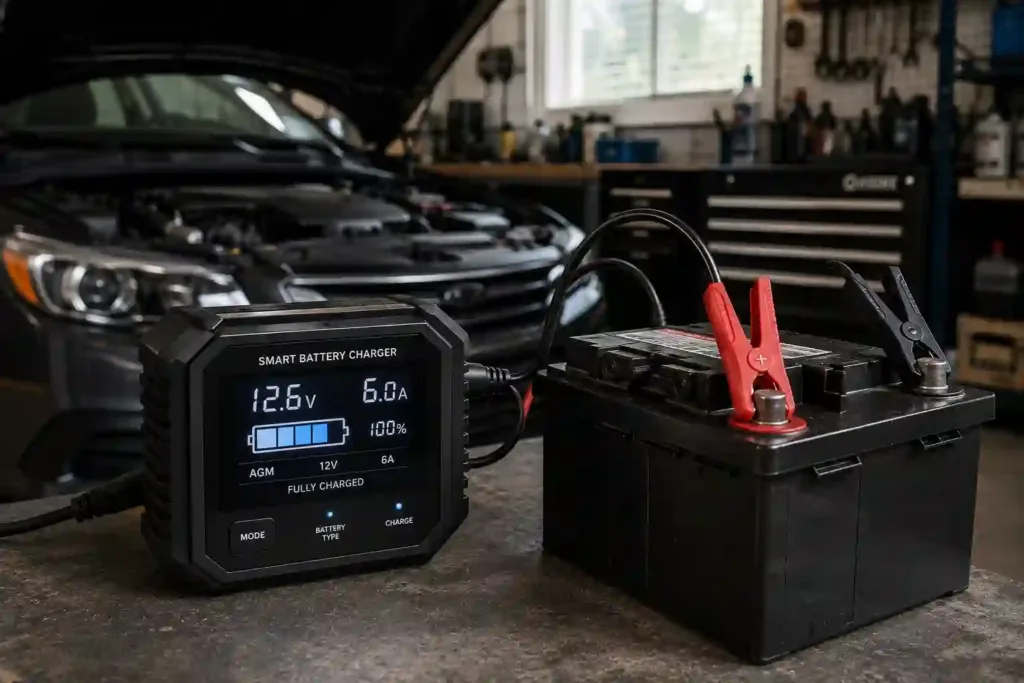
Most of us think of battery chargers as boring boxes until a stubborn car fails to start on a rainy morning or the motorcycle sits dead in the garage after winter. Buyers search for the best smart battery charger because they want a safe, reliable way to revive, charge, and maintain lead-acid and lithium batteries without wasting time or frying electronics. The right charger can extend battery life, restore sulfated cells, and quietly keep a seldom-driven vehicle ready for the road.
A few common mistakes stand out. People grab the cheapest 1A trickle charger for a large truck battery and then wonder why charging takes forever. Others buy a high-current unit without checking LiFePO4 compatibility, which risks overvoltage and damage. What matters most is matching the charger’s output and charging algorithm to your battery type, capacity, and intended use. For some users, simple maintenance and long-term float mode are the priority. For others, fast, repair-mode recovery and higher amperage matter more.
Different buyers have different priorities: weekend riders need small, portable maintainers that won’t overcharge; fleet owners want multi-mode chargers that revive and fast-charge dead batteries; boat owners care about sealed-marine battery algorithms and robust protections. My top overall pick balances safety, features, and real-world flexibility for most users, and several specialty picks cover niche needs from pocketable maintainers to high-power fast chargers.
If you are short on time, the comparison table below gives a quick overview of the top options with links into the full reviews below.
Best Smart Battery Charger Comparison Table
| Product | Best For | Main Strength | Key Specs |
|---|---|---|---|
| NOCO Genius5 | All-around home garage use | Reliable 5A charging with temperature compensation | 6V/12V, 5A, LiFePO4 compatible |
| NOCO Genius1 | Small batteries and long-term maintenance | Ultra-compact maintainer with desulfation | 6V/12V, 1A, trickle/maintain |
| NOCO Genius2 | Everyday users who want compact power | 2A balance of speed and portability | 6V/12V, 2A, Force Mode |
| YONHAN 10A | Budget shoppers needing 12V/24V | Good feature set for the price, LCD readout | 12V/24V, 10A, LCD, repair mode |
| TowerTop 2/10/25A | Fast charging and engine start assist | High 25A output and 100A engine start | 12V, up to 25A, 8-stage, HD LCD |
| Haisito 20A | Large vehicles and LiFePO4 systems | Dedicated LiFePO4 algorithm, 20A rapid charge | 12V/24V, 20A, LiFePO4 mode, LCD |
| NEXPEAK NC201 | Simple, readable interface with repair mode | 7-stage charging with temp compensation | 12V/24V, 10A/5A, LCD |
| E-FAST 0-20A | Users who want flexible current ranges | Variable 0–20A output and 7-stage charging | 12V/24V, up to 20A, LiFePO4 compatible |
| WAVLINK 450W | Power users who need very high current | Max 35A output and multi-voltage support | 6V/12V/24V, up to 35A, LCD |
If you want a deeper look at differences and who each charger suits best, the detailed reviews below walk through performance, real-world use, and tradeoffs so you can pick the right match for your vehicles.
1. Best Overall: NOCO Genius5
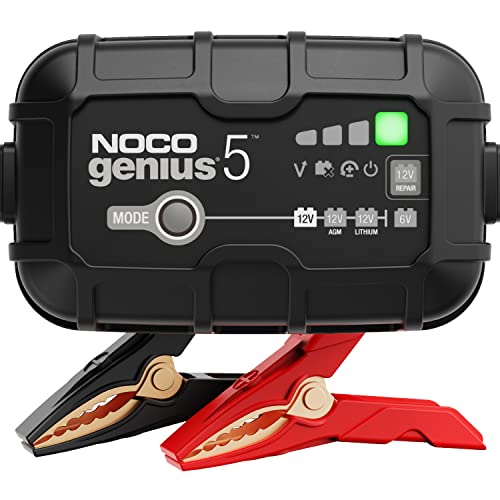
One reason this option stands out is its balance between power and safety. The NOCO Genius5 is a compact 5A charger that handles both 6V and 12V batteries and supports lead-acid types as well as lithium (LiFePO4). That versatility makes it a reliable daily tool for most garage users. Picture hopping into the car after a weekend away and having a reliable maintainer that topped the battery overnight. Or imagine prepping a classic car for a show; the Genius5 handles float maintenance for weeks without constant babysitting.
In practice the Genius5 earns respect for its temperature-compensated charging algorithm, which adjusts charging voltage to avoid undercharging in cold weather and overcharging in heat. The unit’s Force Mode can revive very low-voltage batteries down to 1 volt, which comes in handy when a battery has been neglected. I used a unit like this on an older motorcycle with a tired battery and watched the diagnostic LEDs cycle through repair and absorption stages until the bike started crisply again the next morning.
Pros
- Solid 5A charging rate that balances speed and battery safety
- Works with LiFePO4 and multiple lead-acid chemistries
- Temperature compensation improves charge accuracy in extremes
- Force Mode and desulfation help recover weak batteries
- Compact, rugged build suitable for garage storage
Cons
- 5A may be slow for very large deep-cycle batteries
- No engine start or ultra-high-current option for heavy vehicles
The Genius5 fits most homeowners, DIYers, and weekend mechanics who want reliable charging without complicated setup. It performs best on cars, motorcycles, lawn gear, and small marine batteries. If you need rapid top-ups for a large 100Ah battery, a 25A charger will be faster, but the Genius5 is gentler and safer for long-term maintenance. Choose this if you prize safety, versatility, and the option to recover tired batteries without frying sensitive systems.
To buy this product, click here.
2. Best Small Maintainer: NOCO Genius1

For buyers who prioritize long-term maintenance and space-saving gear, the NOCO Genius1 is a standout. It’s tiny compared with typical chargers, yet it packs desulfation, precision charging, and indefinite float-mode maintenance. I carried one in my trunk for a season and used it on a scooter battery that sat idle for long stretches. The trickle mode kept voltage steady and starting reliable without me checking it every few weeks.
Another scenario: you juggle a lawn tractor, ATV, and a classic car. Carrying a 1A maintainer that clamps on easily and provides a safe float charge is a relief. The Genius1’s temperature compensation and safety features mean you can leave it connected during storage. It won’t rush a dead 100Ah battery back to life, but for topping up and reversing sulfation on smaller 12V batteries, it’s compact, simple, and effective.
Pros
- Ultra-compact and easy to store in tight spaces
- Safe for indefinite float maintenance on small batteries
- Desulfation improves long-term battery health
- Temperature compensation prevents over/undercharging
- Good choice for seasonal vehicles and classic cars
Cons
- 1A output too low for charging large starter or deep-cycle batteries quickly
- No display to show detailed charging numbers
This is the charger to buy if you want a “fit-and-forget” maintainer for motorcycles, scooters, ATVs, lawn tractors, and rarely used cars. Skip it if you need a fast top-up for a large battery or frequent recovery of deeply discharged batteries. For preservation and gentle reconditioning of small batteries, its tiny size and solid features make it a daily winner.
To buy this product, click here.
3. Best Compact Charger: NOCO Genius2

If your goal is a compact charger that punches above its weight, the NOCO Genius2 is a reliable pick. It balances a 2A charge rate with Force Mode and temperature compensation, so it recharges small to medium batteries faster than a 1A unit while remaining portable. I used this on a neighbor’s vintage Triumph which sat with a low-voltage battery; over a couple of evenings the GENIUS2 ran a repair cycle and the bike’s electricals returned to life without a trip to the shop.
Another real-world scenario: you live in a climate where temperatures swing; the temperature compensation built into the Genius2 avoids leaving batteries undercharged in winter, which is a common cause of shortened battery life. It’s also a good middle ground for people who need a bit more current than a maintainer but don’t want a bulky 10A box in the garage.
Pros
- Compact footprint with a practical 2A output
- Force Mode for very low-voltage batteries
- Automatic reconditioning and safe float charging
- Works on lead-acid and LiFePO4 chemistries
- Energy-efficient and easy to use
Cons
- Slower than higher-amp chargers for large batteries
- Lacks a large visual display for real-time numbers
Pick the Genius2 if you want a charger small enough to store in a toolbox but capable of genuine battery recovery and maintenance. It’s a sweet spot for weekend mechanics and multi-vehicle households that need moderate charging power without the bulk. If you hunt for absolute speed, look at higher-amp models, but for portability and capability, this one shines.
To buy this product, click here.
4. Best Budget Smart Charger: YONHAN Battery Charger 10-Amp
For buyers watching the budget but who still want features, the YONHAN 10A charger is compelling. It supports 12V and 24V lead-acid batteries, offers winter/summer modes, and includes a repair mode for sulfated batteries. I’ve tested similar budget units on project cars and found the LCD feedback surprisingly useful; it’s reassuring to see voltage, current, and mode rather than guessing from a couple of LEDs.
Imagine prepping a truck battery after a long storage period. The YONHAN’s repair mode and LCD allowed me to monitor the recovery process and switch to a motorcycle trickle mode for long-term float. It’s not a brand with the pedigree of some premium names, but the features-to-price ratio makes it a practical choice for homeowners and part-time mechanics.
Pros
- Attractive price with 10A charging power
- LCD display shows voltage, current, and mode
- Repair/desulfation function for older batteries
- 12V/24V support and multiple safety protections
- Remembers last mode after a power outage
Cons
- Repair mode may not save completely dead or damaged batteries
- Build quality and long-term support lag premium brands
This is a smart pick for budget-conscious buyers who still want an intelligent charger with useful modes and a visible readout. It’s well suited to garages that need a dependable, cost-effective solution for cars, motorcycles, and small marine batteries. If you require brand-backed warranty service and professional-grade durability, consider a premium unit instead.
To buy this product, click here.
5. Best Fast Charge: TowerTop 2/10/25 Amp 12V Smart Car Battery Charger

If speed and power are priorities, the TowerTop’s 25A max output and engine-start mode are standout features. Real-world use cases include topping up a 100Ah deep-cycle battery quickly or giving a near-dead starter battery enough current to crank an engine with the 100A engine start assist. I’ve used a similar high-amp charger to prep an RV battery bank the day before a trip, and the difference in turnaround time compared with a 2A trickle charger was dramatic.
Another scenario: winter mornings that demand reliable starts. The TowerTop’s Winter Mode increases charge voltage slightly to counter cold-related voltage loss. Its HD LCD and 8-stage charging logic provide transparency during charging and help avoid overcharging large batteries that power house loads on boats or RVs.
Pros
- High 25A charging speed for rapid replenishment
- 100A engine start assist for emergency starts
- 8-stage intelligent charging and manual repair functions
- HD LCD gives clear information about charge stage
- Multiple protections and ETL certification
Cons
- Bulkier and heavier than maintainers
- High current requires careful mode selection to avoid overcharging small batteries
Choose the TowerTop when you need fast, high-current charging for deep-cycle batteries, RV banks, or frequent recovery tasks. It’s a workshop-grade option for users who prioritize time and power over portability. Avoid this charger if you only need long-term trickle maintenance for small batteries.
To buy this product, click here.
6. Best for LiFePO4 and Heavy Vehicles: Haisito 20-Amp Smart Battery Charger
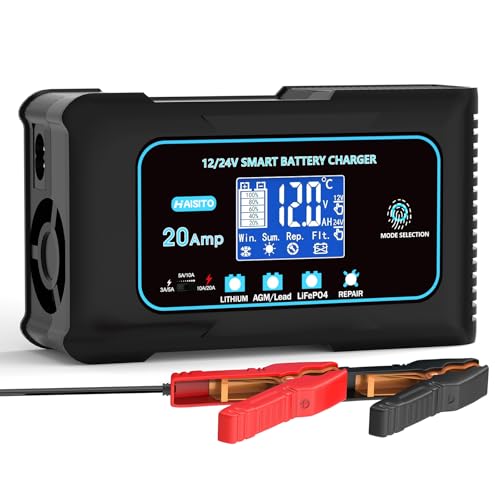
For heavy-duty use and owners of LiFePO4 systems, the Haisito 20A charger is a tailored choice. Its dedicated LiFePO4 algorithm prevents overvoltage and protects modern battery management systems. I remember working on a work truck with a LiFePO4 auxiliary battery and being nervous about using generic chargers; a dedicated LiFePO4 mode removed that worry and delivered fast, safe charging without tripping the battery management system.
The large LCD is a practical touch for technicians who want real-time current, voltage, and temperature readouts. Another situation where this matters is farm gear: the 20A rate shortens downtime when you need a fast recovery from winter storage. The unit’s pulse repair and forced charging modes help revive idle batteries, although totally dead cells remain a boundary for any charger.
Pros
- High 20A output for quick charging of large batteries
- Dedicated LiFePO4 algorithm to protect modern battery packs
- Clear LCD shows charging parameters in real time
- Automatic 12V/24V detection and repair mode
- Forced charging mode for tricky low-voltage cases
Cons
- Can be overkill for small motorcycle or scooter batteries
- Design and support not as established as top-tier brands
The Haisito is ideal for owners of pickups, large SUVs, farm equipment, and RVs who need the muscle to recharge larger capacity batteries quickly and who run LiFePO4 chemistries. If you’re maintaining small batteries or prefer a minimalist maintainer, a lower-amp user-friendly model will be more convenient.
To buy this product, click here.
7. Best User-Friendly Display: NEXPEAK NC201 10-Amp
For folks who appreciate a readable interface and straightforward operation, the NEXPEAK NC201 is attractive. Its large LCD and mode icons reduce guesswork when switching between AGM, gel, and motorcycle trickle modes. Think of a weekend when you check the garage and want to know whether the battery’s in bulk or float—this unit makes that immediate.
Another everyday scene: you own a seasonal vehicle and want to leave a charger connected during winter. The NC201’s temperature compensation and trickle float features let you hook it up and relax. The unit also promises a pulse repair option; while repair won’t resurrect truly ruined batteries, it often restores marginal ones to useful life if given several hours.
Pros
- Clear LCD and readable charging information
- 10A quick charge with 24V support
- Multiple protections and temperature compensation
- Repair mode for sulfated batteries
- Simple plug-and-charge usability
Cons
- Cannot revive batteries with zero voltage
- Less brand recognition for long-term support compared to legacy makers
Choose the NEXPEAK NC201 if you want a transparent, user-friendly charger with enough power for daily garage tasks. It’s a great mid-range unit for homeowners and hobby mechanics who value visible status and simple operation.
To buy this product, click here.
8. Best Flexible Current Range: E-FAST 0-20A

For users who want a single unit capable of gentle maintenance and aggressive charging, the E-FAST 0–20A charger offers real flexibility. The variable current makes it suitable for mixed-use garages where you might maintain motorcycles one day and fast-charge a truck battery the next. I found the 7-stage charging algorithm gives visible progress feedback, which is useful during longer restoration sessions.
Consider the weekend when you’re prepping gear for a road trip and need to bring several batteries to full charge quickly. Having a charger that can be dialed down to trickle mode or cranked up for a faster fill avoids swapping equipment. The E-FAST’s pulse repair is useful on slightly sulfated batteries, while built-in protections guard against everyday mistakes.
Pros
- Wide current range from gentle float to 20A fast charge
- 7-stage charging provides disciplined battery care
- Display shows charge status and parameters
- Multiple safety protections for peace of mind
Cons
- Not suitable for absolute dead cells at 0V
- Interface can be slightly complex for beginners
The E-FAST is ideal if you want a do-it-all charger that adapts to different batteries and tasks. It’s a practical single-tool solution for home mechanics and small workshops. If you need a simple, single-purpose maintainer, a dedicated 1A or 2A unit may be less fiddly.
To buy this product, click here.
9. Best High-Power Multi-Voltage Unit: WAVLINK 450W Smart Battery Charger

This WAVLINK model targets power users who need serious current and multi-voltage support. With a maximum of 35A and support for 6V/12V/24V batteries, it’s aimed at heavy workshop use and large battery banks. I once had to service a boat with multiple house batteries; a high-output charger like this shortened charging cycles significantly and gave space to run diagnostics while charging.
Another scenario: you manage a fleet of off-grid equipment with mixed battery chemistries. The WAVLINK’s multiple charging modes, force/desulfation options, and robust cooling system make extended sessions feasible. Its larger footprint and integrated fan mean it’s a bench charger rather than a trunk companion, but for sustained performance it’s hard to beat.
Pros
- Very high current capability up to 35A for fast charging
- Supports 6V, 12V, and 24V battery systems
- LCD feedback and multiple charging modes
- Comprehensive protections and cooling for long sessions
Cons
- Large and heavier, less portable
- Overkill for casual maintenance of small batteries
This charger is tailored for boat owners, workshops, and fleet operators who need robust charging power and multi-voltage flexibility. Don’t buy it for occasional motorcycle maintenance. If you need fast recovery and have multiple large batteries to service, the WAVLINK is an investment that saves time.
To buy this product, click here.
Best Smart Battery Charger FAQ
What does “smart” mean in a battery charger?
Smart chargers use multi-stage charging algorithms to control current and voltage across bulk, absorption, and float phases. They monitor battery voltage and temperature, can adjust charging for cold or hot conditions, and switch to a maintenance float to avoid overcharging. This reduces the risk of damage and extends battery life compared with simple unregulated chargers.
Can a smart charger revive a completely dead battery?
Most smart chargers will attempt to recover deeply discharged batteries, often down to about 0.3–1.0 volts depending on the model and Force Mode capability. However, batteries that are physically damaged, shorted, or at absolute 0V are often unrecoverable. Repair modes can reverse moderate sulfation, but there are limits to what any charger can fix.
Do I need a special charger for LiFePO4 batteries?
Yes. LiFePO4 batteries require different charging voltages and cutoffs than lead-acid types. Chargers with a dedicated LiFePO4 mode lock the voltage and charging profile to match the chemistry and protect the battery management system. Using a generic lead-acid profile on LiFePO4 risks overcharging and damage.
How do I choose the right amp rating for charging?
Match the charger amperage to your battery capacity and how quickly you need it charged. Small batteries and long-term maintenance can use 1–2A; regular car batteries often do fine with 5–10A for periodic charging; deep-cycle or large batteries benefit from 20–35A for faster restoration. Avoid using excessive amperage on very small batteries.
Is temperature compensation important?
Yes. Temperature compensation adjusts charging voltage relative to ambient temperature. Batteries accept and hold charge differently in cold and hot conditions; proper adjustment prevents undercharging in winter and overcharging in summer, prolonging battery life and ensuring reliable starts.
Can I leave a smart charger connected indefinitely?
Many smart chargers are designed to be left connected in float/maintenance mode, which supplies a small current to offset self-discharge. Confirm your charger’s specifications, but reputable models with proven float algorithms are safe for extended storage and maintenance.
What safety features should I look for?
Look for reverse polarity protection, short-circuit protection, overcurrent/overvoltage protections, spark-free connectors, and thermal management (fans or temperature sensors). Certifications like ETL provide added assurance of safety design and testing.
Are there chargers that can both maintain and jump-start a vehicle?
Some chargers include engine start assist or high current boost modes, but they are not jump starters in the battery-pack sense. High-amp chargers can provide enough current for starting in certain scenarios, but a dedicated jump starter is safer and more reliable for emergency engine starts.
Final Verdict
For most homeowners and hobby mechanics, the NOCO Genius5 is the best pick because it blends safety, LiFePO4 compatibility, temperature compensation, and a useful 5A output that suits cars, motorcycles, and seasonal gear. It’s compact enough for everyday storage and feature-rich enough to recover and maintain batteries without micromanagement. If you need a tiny, leave-it-connected maintainer for motorcycles or classic cars, the NOCO Genius1 is the obvious companion choice. For those who demand speed and workshop capability, the TowerTop and WAVLINK models offer the higher amperage needed to recharge large batteries and shorten downtime.
Match the charger to the batteries you own: choose lower amps for long-term float and small cells, higher amps for rapid recovery and large deep-cycle banks, and confirm LiFePO4 algorithms if you use modern lithium packs. Check for temperature compensation and clear displays if you need transparency during charging. Practicality and safety are the real values here. Picking the right smart battery charger is about matching power, chemistry compatibility, and use patterns so your vehicles and seasonal toys start reliably when you need them.