The first time you shop for a smart EV charger, it feels weirdly simple. Wall box, cable, plug, app. Done, right? Then you start reading spec sheets at 11:30 p.m., staring at terms like NEMA 14-50, hardwired, 48A, J1772, NACS, WiFi bands, load limits, and weather ratings while your coffee goes cold. That is why buyers look for the best smart EV charger in the first place. They want faster home charging, cleaner scheduling, better energy tracking, and fewer annoying surprises once the electrician shows up.
The common mistakes are painfully predictable. People buy more amperage than their panel can support, choose a plug style that does not match the outlet in the garage, or assume every “smart” charger has a polished app and stable connectivity. Others focus too much on max speed and forget cable length, weather sealing, certification, and how the charger actually fits daily life. A charger can look great on paper and still be a hassle if the app is flaky, the cable gets stiff in the cold, or the unit requires more installation work than expected.
What matters most is matching the charger to your vehicle, electrical setup, and routine. Some drivers need a simple plug-in unit that works tonight. Others want a hardwired 48-amp station with scheduling, utility-rate optimization, and room to grow into a bigger EV later. For most buyers, the sweet spot is a reliable 40A or 48A smart charger from a brand that balances strong app control with solid hardware. In this lineup, the EVIQO 40 Amp plug-in model stands out as the top overall pick because it nails that balance without making installation feel like a project that drags on for weeks.
If you want the short version first, the quick picks and comparison table below make it easy to narrow the field fast.
Quick Picks
- Best Overall: EVIQO Level 2 EV Charger 40 Amp Plug-In
- Best Budget Pick: AIXINE Level 1&2 EV Charger 16A
- Best Premium Option: EVIQO Level 2 EV Charger 48 Amp Hardwired
- Best Value Choice: TLE LEVEL Level 2 EV Charger 40 Amp
Best Smart EV Charger Comparison Table
| Product | Best For | Main Strength | Power & Setup |
|---|---|---|---|
| EVIQO Level 2 EV Charger 40 Amp Plug-In | Most buyers | Strong app features with easy home setup | 40A, 9.6kW, NEMA 14-50 plug-in |
| EVIQO Level 2 EV Charger 48 Amp Hardwired | Maximum performance | Higher output and hardwired stability | 48A, 11.5kW, hardwired |
| ChargePoint HomeFlex Level 2 Hardwired | Established app ecosystem | Trusted smart platform and large charging network tie-in | Up to 50A class, electrician install |
| Emporia Level 2 EV Charger NEMA 14-50 | Energy tracking | Great data visibility and flexible installation path | 40A plug-in or 48A hardwired capable |
| EVIQO NACS Charger for Tesla 40 Amp | Tesla owners | Native NACS connector with smart controls | 40A, NEMA 14-50 plug-in |
| TLE LEVEL Level 2 EV Charger 40 Amp | Value seekers | 40A charging at a more approachable cost | 40A, 9.6kW, NEMA 14-50 plug-in |
| AIMILER Level 2 EV Charger 32A | Adjustable charging | Good amperage control and app scheduling | 16A to 32A, NEMA 14-50 plug-in |
| EVDANCE Level 1 & 2 Portable EV Charger | Travel and backup charging | Portable dual-level design with app control | 12A Level 1 / 16A Level 2, portable |
| AIXINE Level 1&2 EV Charger 16A | Lowest-cost smart-ish flexibility | Compact portable design with scheduling basics | 16A, 3.68kW, NEMA 6-20 + 120V adapter |
If you want the fuller story, the reviews below show where each charger shines, where it stumbles, and who will actually be happy living with it every day.
1. Best Overall: EVIQO Level 2 EV Charger 40 Amp Plug-In

One reason this option stands out is how cleanly it fits the real life of home charging. A lot of drivers do not need the absolute highest amperage available. They need a charger that mounts neatly in the garage, reaches the car without a daily cable wrestling match, and gives them app control that feels useful instead of gimmicky. This EVIQO hits that lane beautifully with 40A output, a 25-foot cable, a NEMA 14-50 plug-in setup, and WiFi scheduling for off-peak charging.
It also feels thoughtfully built. The IP66 and NEMA 4 protection matter if your charger lives near a drafty garage door or out on a driveway wall where rain blows sideways in winter. The fluorescent holster is the kind of detail that sounds minor until you come home late, the garage is dim, and you can actually see where the connector goes without fumbling around like you dropped your keys at a campsite. For non-Tesla J1772 drivers, this is a particularly clean fit. Tesla owners can still use it with an adapter, which gives it a wider appeal without muddying its main purpose.
Pros
- Strong balance of charging speed, app control, and easy plug-in installation
- 40A output is plenty for overnight charging for most EV households
- 25-foot cable gives helpful reach across larger garages and driveways
- UL, ETL, FCC, and Energy Star credentials add confidence
- Weatherproof housing is well suited to indoor or outdoor mounting
Cons
- Requires a proper EV-ready NEMA 14-50 outlet
- App features depend on stable 2.4GHz WiFi
- Non-Tesla focus means Tesla drivers need an adapter
This is the charger I would point most people toward first. It suits homeowners who want faster charging without jumping straight into a hardwired installation project. It also makes sense for families with one EV now and the realistic possibility of another later, because 40A covers a lot of ground without pushing the electrical setup too hard. Skip it if you want the fastest possible home charging and already know your panel can support a 48A hardwired station. Otherwise, this one lands in that sweet, satisfying middle ground where performance, convenience, and day-to-day usability all click.
To buy this product, click here.
2. Best Premium Option: EVIQO Level 2 EV Charger 48 Amp Hardwired

For buyers who prioritize faster charging and a more permanent installation, this EVIQO 48A model is the heavy hitter in the group. The jump from a plug-in 40A charger to a hardwired 48A unit is not tiny in real life. If you drive a lot, have a larger battery pack, or share charging duties between two EVs, those extra amps can shave meaningful time off your overnight routine. It is the kind of upgrade that feels especially good after a long commute when you know the car will be ready again by morning without cutting it close.
The smart features are also more than window dressing. You get app-based current adjustment from 6A to 48A, scheduling for lower utility rates, remote updates, and a side reset button that is refreshingly practical. Nobody dreams about reset buttons, but the first time a fault pops up and you do not need to open the housing or kill power at the breaker, you will appreciate the thought that went into it. Add the IP66 weather resistance, 25-foot cable, and solid certifications, and this becomes a premium pick that earns its status through substance rather than flashy branding.
Pros
- Higher 48A output suits larger EV batteries and heavier driving schedules
- Hardwired installation supports a cleaner, more permanent setup
- Useful smart controls for scheduling, amperage adjustment, and cost tracking
- Strong weather sealing and certification package
- Three-year warranty and U.S.-based support add reassurance
Cons
- Requires licensed electrician installation
- Needs a properly sized circuit, which can raise total install cost
- More charger than some casual or low-mileage drivers actually need
Buy this if your garage setup is ready for a serious long-term charger and you want close to the top end of what many homes can reasonably support. It is especially appealing for drivers of larger EVs, busy households, and anyone who hates the feeling of “almost enough” power. Skip it if your main goal is low upfront hassle or if you rent and cannot hardwire. This one makes sense for owners who want to install once, do it properly, and move on.
To buy this product, click here.
3. Best For App Ecosystem: ChargePoint HomeFlex Level 2 Hardwired

If your goal is a charger backed by a familiar name and a mature software experience, ChargePoint keeps earning attention for good reason. Plenty of smart chargers can start and stop sessions from an app. Fewer feel connected to a broader charging life beyond your own garage. ChargePoint’s app ties home charging data into a huge public charging network, which can be handy if you already use ChargePoint on the road and like seeing more of your charging picture in one place.
This unit is also built for buyers who want flexibility through electrician installation. The HomeFlex line has long been popular with EV owners who care about dependable charging and a cleaner long-term home setup. The cold-resistant cable is a practical touch for winter climates, where some cheaper chargers start to feel like you are dragging a frozen garden hose across the concrete. For J1772 vehicles, compatibility is broad, and Tesla owners can still make it work with an adapter. The overall vibe here is polished and established, which matters if you are wary of lesser-known brands promising the moon.
Pros
- Strong brand reputation and broad public charging network integration
- App is feature-rich and familiar to many EV drivers
- UL-certified design supports peace of mind
- Good fit for indoor or outdoor installation
- Cold-resistant cable helps in harsher climates
Cons
- Usually best suited to buyers comfortable with electrician-installed hardware
- Tesla charging still needs an adapter
- App-dependent experience may feel excessive for drivers who want pure simplicity
This is a strong pick for drivers who already know and trust the ChargePoint ecosystem. It suits commuters who bounce between home charging and public stations and want one app to keep tabs on both worlds. Skip it if you mainly care about raw value or want a more budget-conscious charger with fewer ecosystem extras. For the right buyer, though, that software polish and brand trust go a long way.
To buy this product, click here.
4. Best For Energy Tracking: Emporia Level 2 EV Charger NEMA 14-50
This model earns a place because it combines a smart-home feel with real charging muscle. Emporia has built a reputation around energy monitoring, and that DNA shows here. If you are the type who checks utility rates, watches usage graphs, or already has a house full of smart energy gear, this charger makes a lot of sense. It can run as a NEMA 14-50 plug-in setup up to 40A or be converted to hardwired for up to 48A, which gives buyers a little breathing room as their needs change.
That flexibility is one of its biggest strengths. A lot of shoppers are somewhere between “I want this working soon” and “I might upgrade the circuit later.” Emporia speaks directly to that middle ground. The 25-foot cable is garage-friendly, the app gives access to scheduling and energy data, and the unit is compatible with a wide range of North American EVs, including Tesla according to the product listing. Picture a homeowner trying to cut charging costs by shifting sessions after midnight, then checking the app over breakfast to see how much energy actually went into the car. That is exactly the sort of use this charger fits.
Pros
- Excellent choice for buyers who care about energy data and charging analytics
- Flexible setup path with plug-in or hardwired capability
- Up to 48A potential gives room to grow
- UL listed and Energy Star certified
- Broad compatibility across many EV models
Cons
- App features rely on 2.4GHz WiFi
- Some buyers may never use the deeper energy-tracking features
- 48A operation still requires hardwiring and proper electrical support
Choose this one if smart charging to you means more than a timer and an on/off button. It is a particularly good fit for homeowners who want visibility into energy use and appreciate a charger that can start simple, then step up later. Skip it if you want the most stripped-down setup possible or do not care about usage data. For data-minded EV owners, though, this is one of the more compelling options in the group.
To buy this product, click here.
5. Best For Tesla Owners: EVIQO NACS Charger for Tesla 40 Amp

If you drive a Tesla or another NACS-based vehicle, this is one of the easiest smart-home fits in the lineup. Native connector support matters. It means fewer adapters, less clutter, and a more seamless nightly routine. Pull in, press the button, plug in, done. That smoothness is exactly why this EVIQO version deserves a dedicated spot rather than being treated as a footnote under the J1772 models. It is tailored to Tesla owners first, which makes everyday use feel cleaner from the jump.
The rest of the package is familiar in a good way. You get 40A charging, a 25-foot cable, WiFi app control, off-peak scheduling, weatherproof construction, and the same thoughtful fluorescent holster concept that helps in low-light garages or outdoor setups. The built-in Tesla port-opening button is a nice practical perk, the kind of little convenience that quickly becomes part of your rhythm. If you have ever come home in the rain, with groceries in one hand and a tired brain, small touches like that suddenly feel very big.
Pros
- Native NACS connector is ideal for Tesla owners
- 40A output covers typical overnight charging well
- Smart app supports scheduling, current adjustment, and reminders
- Weatherproof enclosure suits indoor and outdoor mounting
- Useful Tesla-style convenience features, including port button support
Cons
- J1772 vehicles need an adapter instead of Tesla drivers needing one
- Still requires a proper NEMA 14-50 outlet
- Buyers with mixed-vehicle households may prefer a J1772-first charger
This is the smart pick for Tesla households that want a dedicated home charger without messing around with adapters every day. It works best for owners who value ease and a native fit over maximum installation flexibility. Skip it if your garage regularly serves both Tesla and non-Tesla vehicles, unless you are comfortable using an adapter for the second vehicle. For a Tesla-first setup, though, it feels very well judged.
To buy this product, click here.
6. Best Value Choice: TLE LEVEL Level 2 EV Charger 40 Amp

This charger goes after a very specific kind of buyer. Someone who wants real 40A Level 2 performance, smart scheduling, a 25-foot cable, and weather resistance, but does not want to spend premium-brand money to get it. That is a crowded lane, yet this TLE LEVEL model looks competitive because the core specs are genuinely useful: 9.6kW output, adjustable current settings, NEMA 14-50 plug-in setup, and a tough IP66/NEMA 4 build for garages or outdoor walls.
There is a simple appeal here. Imagine getting home after work, plugging in while dinner is on the stove, and knowing the car will be topped up by the time your next morning starts. That is the kind of practical speed buyers are chasing, and 40A charging hits a comfortable point for many homes. The included storage bag also hints at another use case. This can be a home charger that occasionally goes with you, whether that means a second property, a road trip stop with a compatible outlet, or just extra flexibility beyond a permanently mounted wall unit.
Pros
- 40A charging performance at a more affordable tier
- Adjustable current settings help match different circuit capacities
- NEMA 14-50 plug-in setup is straightforward for many homeowners
- 25-foot cable improves parking flexibility
- Weather-resistant build broadens placement options
Cons
- Brand is less established than ChargePoint or Emporia
- Display-driven controls may feel simpler than deeper app ecosystems
- Tesla still requires an adapter
This is the value play for buyers who care most about charging speed per dollar and do not need a big-name badge to feel good about the purchase. It is especially appealing for first-time EV owners who want an upgrade over Level 1 charging without turning the project into a whole-house electrical saga. Skip it if software refinement or long-term ecosystem confidence matters more than raw value. Otherwise, this one punches above its class.
To buy this product, click here.
7. Best For Adjustable Charging: AIMILER Level 2 EV Charger 32A

If your home electrical setup is a little more complicated than “plug it in and forget it,” the AIMILER 32A earns attention. Its main appeal is control. You can adjust amperage from 16A to 32A and use either the onboard controls or the app to shape how the charger behaves. That makes it useful in garages where the circuit is more limited, where the panel is already carrying a lot, or where the buyer simply wants a little more say in how aggressively the charger pulls power.
The touchscreen and app combo also make it feel more interactive than bare-bones chargers in the same general tier. You can picture a buyer installing it in a shared garage at home, dialing the current down at first, then bumping it later after confirming the circuit is happy and stable. The 25-foot cable, ETL certification, and NEMA 14-50 plug all add practical appeal. The setup notes are a bit more demanding than with some simpler products, so this is not the most carefree pick in the group. Still, for buyers who actually want those controls, it has a clear job to do.
Pros
- Adjustable amperage is useful for varied circuits and charging needs
- App scheduling and charging history add welcome smart features
- Touchscreen display gives at-a-glance information
- 25-foot cable helps with less-than-perfect parking alignment
- ETL-certified with strong weather resistance on paper
Cons
- Setup and reset process can be less intuitive than premium models
- App pairing may require more patience on 2.4GHz WiFi
- 32A is slower than the stronger 40A and 48A options here
Buy this one if flexibility matters more than top-end speed. It suits homeowners with moderate charging needs, plug-in hybrids, smaller-battery EVs, or electrical situations where full 40A charging is not the smartest move. Skip it if you want a smoother brand experience or if you already know a 40A or 48A unit fits your home comfortably. For measured, adjustable charging, this is a respectable fit.
To buy this product, click here.
8. Best For Travel And Backup Charging: EVDANCE Level 1 & 2 Portable EV Charger
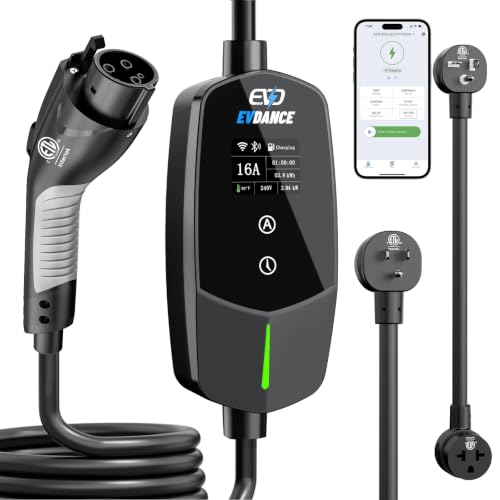
This model is not trying to replace a full-power 40A or 48A home station for everybody, and that is exactly why it belongs here. Smart EV charging is not always about raw speed. Sometimes it is about flexibility. The EVDANCE portable unit gives you Level 1 and Level 2 capability, app control over WiFi and Bluetooth, real-time charging data, and a carrying case that makes it easier to stash in a trunk for road trips or keep as an emergency charger at home.
That portability is the whole story. Think of a plug-in hybrid owner staying with family for a weekend, or an EV driver keeping a backup charger on hand in case the main wall unit is down for a few days. This kind of charger shines in those moments. The 25-foot TPE cable should also be easier to handle than the stiff, plasticky cords that make cold mornings extra miserable. With ETL listing, leakage protection, and NEMA 4 weather resistance, it brings more seriousness than many cheap portable chargers that feel like temporary gadgets rather than dependable tools.
Pros
- Dual-level charging is great for travel, backup use, and flexible home setups
- WiFi and Bluetooth app control adds convenience
- Portable design with carrying case is easy to store in the vehicle
- TPE cable should stay more manageable in colder weather
- Good safety package with ETL listing and protection features
Cons
- 16A Level 2 output is much slower than fixed 40A and 48A chargers
- Better as a travel or light-duty solution than a primary charger for big-battery EVs
- Tesla still needs a separate adapter
This is a smart buy for apartment-adjacent living, travel-heavy owners, PHEV drivers, or anyone who wants a trustworthy backup in the cargo area. Skip it if your goal is to install one charger and blast through large overnight refills at maximum speed. For portability and versatility, though, this one makes a lot of practical sense.
To buy this product, click here.
9. Best Budget Pick: AIXINE Level 1&2 EV Charger 16A

If the main thing standing between you and home charging is budget, the AIXINE gets the nod. This is a lower-cost portable charger with Level 1 and Level 2 capability, a 25-foot cable, scheduling support, and a storage-friendly design that can live in the trunk or on a garage hook without drama. For many plug-in hybrid owners and lower-mileage EV drivers, that may be enough. No theatrics, no oversized claims about transforming your life, just a more affordable way into smarter charging.
The IP67 rating is a nice surprise in this tier, and the inclusion of both a NEMA 6-20 plug and a 120V adapter helps broaden where you can use it. There is a certain freedom in a charger like this. Maybe your living setup is temporary, maybe you split time between locations, or maybe you simply do not want to invest heavily until you know how your charging habits shake out. This kind of portable unit gives you room to experiment. It is slower, yes, but sometimes slower and simpler is exactly the right answer for the first year of EV ownership.
Pros
- Accessible entry point for buyers watching their spending closely
- Dual-level flexibility supports both 120V and 240V use
- Portable format is easy to store and travel with
- 25-foot cable helps in real-world parking situations
- IP67 durability rating is attractive for the category
Cons
- 16A charging is slow for larger EV batteries
- Smart features are more basic than on full-size wall units
- Best suited to lighter-duty use rather than heavy daily mileage
Choose the AIXINE if you want a low-cost way to start charging smarter at home or on the go. It is a sensible fit for PHEVs, second-home use, temporary living setups, and buyers who simply are not ready to commit to a bigger wall-mounted station yet. Skip it if you drive a long daily route in a large-battery EV and need fast overnight recovery. As a budget-first option, though, it does its job well.
To buy this product, click here.
How To Choose The Right Smart EV Charger
Match The Charger To Your Electrical Setup
The biggest buying mistake is chasing the highest amperage without checking the garage first. A 48A charger sounds fantastic until you realize your panel, wiring, or outlet situation is better suited to 32A or 40A. A plug-in NEMA 14-50 charger can be wonderfully convenient if the outlet is already installed correctly. If it is not, the “easy” option can still turn into a service call, permit, and extra cost. Think about your home first, then your wish list.
Choose Between Plug-In And Hardwired
Plug-in chargers are attractive because they are easier to swap, easier to move, and often less intimidating for first-time buyers. Hardwired chargers look cleaner, can unlock higher amperage, and tend to feel more permanent. If you own the home and expect to keep the charger for years, hardwired can be a smart long-term move. If you rent, may move, or want the freedom to take the charger with you, plug-in often feels less stressful.
Think About Your Actual Driving Routine
Be honest here. If you drive 20 to 40 miles most days, a solid 32A or 40A unit may already be more than enough. If you drive a long commute, regularly arrive home nearly empty, or manage two EVs in one household, stepping up to 48A starts to look a lot more sensible. Plenty of people overspend on charging speed they rarely use, while others buy a portable 16A unit and then wonder why the battery still feels half asleep by morning.
Do Not Ignore Cable Length And Weather Rating
A charger can have brilliant app features and still annoy you every single night if the cable barely reaches the port. A 25-foot cable is often the sweet spot for garages where cars back in one day and nose in the next. Weather resistance matters too. Outdoor setups, damp garages, and freezing winters are tough on cheap hardware. Ratings like IP65, IP66, NEMA 4, or better give extra confidence if the charger will live in rougher conditions.
Look Closely At Smart Features
Some smart chargers give you real value: off-peak scheduling, amperage adjustment, charging history, and energy tracking. Others basically offer an app for the sake of having an app. Ask yourself what you will actually use. A commuter on time-of-use electricity pricing may save real money with scheduling and usage data. A weekend driver may care only that charging starts when the cable clicks in. Better features are helpful, but only if they fit your routine.
Check Connector Compatibility First
J1772 is still common across many non-Tesla EVs, while NACS is now central for Tesla owners and increasingly relevant across the market. Buying the wrong native connector adds adapter hassle every single day. In a mixed garage, it may still make sense to choose the connector type that matches the primary vehicle and use an adapter for the occasional second car. That tiny decision can make your nightly charging routine feel smooth or faintly irritating for years.
Buy For Reliability, Not Spec Sheet Drama
The charger lives in your garage, not in a comparison chart. Reliable connectivity, clear status info, decent support, and sane installation requirements usually matter more than one extra feature that sounds flashy online. A charger should feel boring in the best way. You plug in, it works, the app behaves, and the car is ready in the morning. That is the win.
Best Smart EV Charger FAQ
What makes an EV charger “smart”?
A smart EV charger usually connects to an app through WiFi or Bluetooth and lets you control or monitor charging remotely. Common features include scheduled charging, amperage adjustment, charging history, energy tracking, and reminders. The better smart chargers make these features genuinely useful, especially for off-peak charging and household energy management.
Is a 40A charger enough for home charging?
For many drivers, yes. A 40A Level 2 charger is a strong sweet spot for overnight charging and works well for daily commuting, school runs, errands, and typical suburban driving. Buyers with very large battery packs, long daily mileage, or multiple EVs may benefit more from a 48A hardwired charger.
Should I choose a plug-in charger or a hardwired charger?
Choose plug-in if you want easier installation, easier replacement, or the option to move the charger later. Choose hardwired if you want a cleaner permanent setup and access to higher charging power in many cases. Hardwired models also tend to suit homeowners planning a long-term installation.
Do Tesla vehicles need a different charger?
Usually, yes, if you want the cleanest experience. Tesla and other NACS-based vehicles work best with a native NACS charger. A J1772 charger can still work with the proper adapter, and many Tesla owners do that successfully. It just adds one more piece to manage each day.
How much do smart charger apps really matter?
They matter most if your utility uses time-of-use rates, if you want to track charging costs, or if you like managing things from your phone. If your routine is simple and you only charge overnight, a basic timer might cover most of your needs. Still, a good app can make ownership smoother, especially if you like seeing charging data at a glance.
Can I use a portable 16A charger as my main home charger?
You can, but it depends on your driving habits. For plug-in hybrids, shorter commutes, and lighter daily mileage, a 16A charger may be enough. For larger EVs and heavier driving, it will feel slow compared with a 32A, 40A, or 48A wall unit. Portable chargers are often best as travel, backup, or lighter-duty solutions.
Does weather resistance matter if the charger is in a garage?
Yes. Garages can still be damp, dusty, hot, or drafty. A stronger weather rating usually means better protection against moisture and temperature swings, which can help long-term durability. It matters even more if the charger is mounted outdoors or near an exposed driveway wall.
Do I need an electrician for every smart EV charger?
No. Many plug-in chargers can use an existing, properly installed EV-ready NEMA 14-50 outlet. Hardwired chargers do require electrician installation, and some plug-in buyers still need an electrician if the outlet does not already exist or if the existing circuit is not appropriate for EV charging. That is why checking your electrical setup before buying saves so much hassle.
Final Verdict
Across these 9 picks, the EVIQO Level 2 EV Charger 40 Amp Plug-In is the easiest recommendation for most shoppers. It has the right mix of speed, smart scheduling, weather resistance, cable reach, and straightforward installation potential. It feels like the charger that most people will install, use for six months, and then quietly stop thinking about because it simply fits. That is high praise for a home charging product. If you want more performance and have the wiring to support it, the EVIQO 48 Amp Hardwired is the stronger premium move. If cost matters most, the AIXINE 16A gives budget buyers a practical on-ramp, while the TLE LEVEL 40A does a nice job of hitting value without feeling too stripped down.
The best smart EV charger is the one that matches your car, your electrical reality, and your daily rhythm. Check your outlet or circuit first, confirm whether you need J1772 or NACS, and think honestly about how quickly you actually need to recharge. A big, powerful charger looks exciting, but the right fit feels better at 7 a.m. on a Tuesday when the battery is full and your garage setup is doing exactly what it should. That is the target, and these 9 chargers cover that target from budget portability to premium home performance.