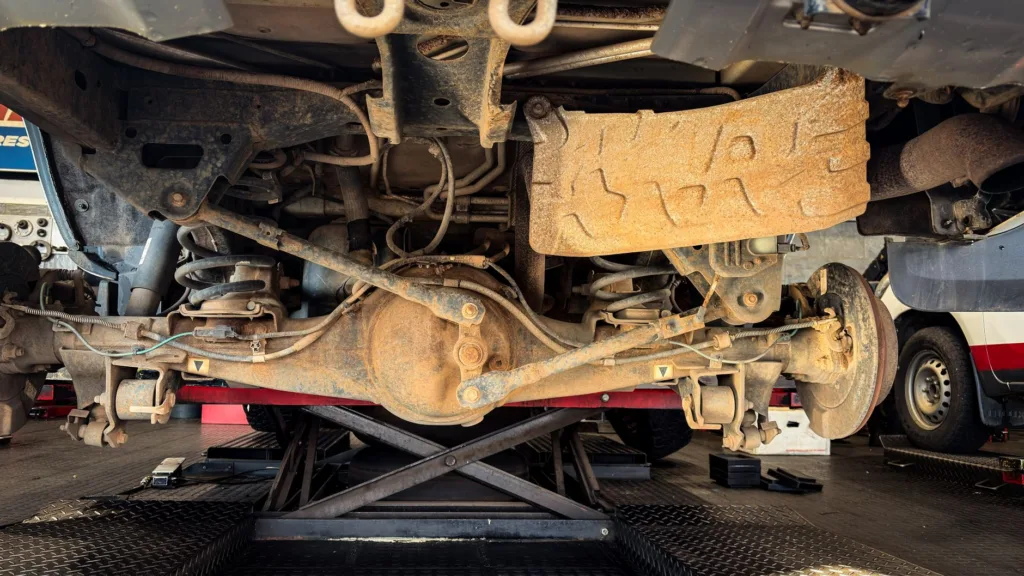
If differential fluid is low, the gears and bearings inside the differential lose the lubrication and cooling they need. That can lead to whining or howling noises, overheating, accelerated wear, poor drivetrain operation, and eventually major internal damage. In mild cases, topping off and fixing the leak may prevent further problems. In severe cases, a low-fluid differential can destroy bearings or gear teeth and require an expensive rebuild or replacement.
This matters because the differential is one of those components many drivers rarely think about until it starts making noise. Unlike engine oil, differential fluid is often out of sight and easy to forget. But when fluid level drops too far, damage can happen gradually at first, then get expensive quickly.
Understanding what low differential fluid does, what symptoms to watch for, and how urgently to act can help you avoid turning a simple fluid service into a major drivetrain repair.
What the differential does and why fluid matters
The differential transfers power from the driveshaft or transaxle to the wheels while allowing the left and right wheels to rotate at different speeds during turns. Without that speed difference, tires would scrub and the vehicle would handle poorly.
Inside the differential are gears, bearings, and sometimes clutch packs or electronically controlled components, depending on the design. These parts operate under heavy load. Differential fluid creates a protective film between moving metal surfaces, reduces friction, carries away heat, and helps prevent corrosion.
When fluid is low, that protective film becomes insufficient. Metal parts can begin to contact each other more directly, which raises temperature and wear. If this continues, small wear particles contaminate the remaining fluid and make the problem worse.
Common types of differentials
- Open differential: The most common basic design in passenger vehicles.
- Limited-slip differential: Uses clutches or other mechanisms to improve traction. Some require a specific fluid or additive.
- Locking differential: More common in trucks and off-road vehicles.
- Front and rear differentials: Found on many AWD and 4WD vehicles. Some vehicles also have a transfer case, which uses a separate fluid.
The exact fluid type and service procedure vary by vehicle, which is why checking the owner’s manual or service information is important.
What happens mechanically when differential fluid is low
Low differential fluid does not usually cause an immediate breakdown the moment the level drops slightly. The risk depends on how low it is, how long it has been low, how heavily the vehicle is used, and whether the fluid is simply low or also badly degraded.
Still, the general chain of events is usually predictable.
Lubrication becomes inadequate
Ring and pinion gears rely on a coating of gear oil to reduce metal-to-metal contact. When the level drops enough, gear teeth may no longer receive consistent lubrication, especially at highway speeds or under load.
That leads to scoring, pitting, and abnormal wear patterns. Once gear wear starts, noise often follows.
Bearings begin to overheat
Differential bearings support rotating shafts and gears. Low fluid reduces their ability to stay cool and lubricated. Bearings often develop a whine, growl, or rumble before they fail completely.
If a bearing deteriorates enough, it can create excess play in the gear assembly. That can affect gear mesh and lead to even more damage.
Heat builds up faster
Differential fluid does more than lubricate. It also helps move heat away from critical parts. When the level is low, internal temperatures rise. Heat breaks down fluid faster, lowers its protective qualities, and accelerates wear.
Vehicles used for towing, hauling, spirited driving, off-roading, or long highway trips are especially vulnerable because the differential works harder under those conditions.
Gear wear accelerates
Once lubrication and cooling drop off, ring and pinion gears can wear unevenly. That often creates a whining or howling sound during acceleration, deceleration, or cruising. Gear damage is rarely self-correcting. It usually gets worse over time.
Internal failure can occur
In the worst cases, low fluid can lead to broken gear teeth, seized bearings, or severe overheating. A failed differential may produce loud grinding, clunking, binding, or loss of drive to the wheels. At that point, a fluid top-off is no longer enough.
Symptoms of low differential fluid
Low differential fluid often announces itself through noise or leaks before a complete failure happens. The exact symptoms vary depending on whether the issue is in the front differential, rear differential, or both.
| Symptom | What it may mean | How urgent it is |
|---|---|---|
| Whining or howling from rear or front of vehicle | Gear wear, low fluid, bearing issues | High |
| Growling or rumbling while driving | Bearing wear or poor lubrication | High |
| Clunking on acceleration or turns | Excessive internal wear, backlash issues | High |
| Burnt smell from gear oil | Overheating fluid | High |
| Visible gear oil leak | Seal or gasket failure causing low fluid | Moderate to high |
| Vibration from drivetrain area | Advanced wear, bearing issues, gear damage | High |
Whining or howling noise
This is one of the most common signs. A low-fluid differential may start with a faint whine at certain speeds, then progress to a louder howl. The noise may change under acceleration or deceleration.
Many drivers notice it most clearly on the highway with the radio off. If the sound comes from underneath the vehicle rather than the engine bay, the differential is one possible source.
Grinding or growling
Grinding or growling is more serious than a light whine. It often suggests that the fluid has been low long enough for bearings or gears to wear significantly. Continuing to drive this way can turn a repairable issue into a major one.
Leaks around the differential
If fluid is low, there is usually a reason. Common leak points include axle seals, pinion seals, differential cover gaskets, and housing seals. Gear oil often has a strong sulfur-like smell, which can help distinguish it from engine oil or transmission fluid.
On many rear-wheel-drive vehicles, you may see oily residue on the differential housing or inside the wheel area if an axle seal is leaking.
Vibration or roughness
As bearings or gears wear, you may feel vibration through the floor or drivetrain. This symptom is less common in early stages but can appear as damage worsens.
Binding or chatter in turns
Limited-slip differentials can behave poorly if the fluid is low or incorrect. You may feel shuddering, grabbing, or chattering during tight turns. This can also happen when the fluid is old, contaminated, or missing the required friction modifier.
Can you drive with low differential fluid?
You can sometimes drive a short distance with slightly low differential fluid, but it is not a good idea to keep driving normally once you suspect a problem. The risk depends on the severity.
Situations that may be less urgent
- A small leak was just discovered
- No noise is present yet
- Fluid is only slightly below the proper level
- The vehicle will only be driven a short distance to service
Even in these cases, the problem should be addressed quickly. Low fluid does not improve on its own.
Situations that are more urgent
- The differential is whining, growling, or grinding
- You smell burnt gear oil
- There is a large visible leak
- The vehicle shudders, clunks, or vibrates from the drivetrain
- You tow, haul, or drive long distances at highway speed
In these cases, continued driving can cause severe internal damage. If the noise is loud or the vehicle feels unstable, towing it to a repair facility is the safer choice.
How low differential fluid affects different types of vehicles
The consequences are similar across vehicles, but the symptoms and repair path can vary depending on drivetrain layout.
Rear-wheel-drive vehicles
On rear-wheel-drive vehicles, the rear differential is a separate housing near the rear axle. Low fluid here often causes noise from the back of the vehicle. Since this differential usually handles all rear axle power delivery, damage can quickly affect drivability.
Front-wheel-drive vehicles
Most front-wheel-drive vehicles do not have a separate rear differential. Instead, they use a transaxle that combines transmission and differential functions. If the differential portion inside the transaxle is low on fluid, the consequences can overlap with transmission-related problems.
The exact fluid may be transmission fluid or gear oil depending on design, so correct identification matters.
All-wheel-drive and four-wheel-drive vehicles
AWD and 4WD systems may have a front differential, rear differential, and transfer case. Some also use electronically controlled couplings. A low-fluid issue in one component can create noises or drivability problems that are easy to confuse with another drivetrain part.
Because there are multiple fluid-filled components, it is important not to assume they all use the same fluid or share the same maintenance interval.
How quickly can damage happen?
There is no universal timeline. A differential that is only slightly low may survive for quite a while if the vehicle is lightly used and the fluid condition is still good. A heavily loaded truck with a major leak can suffer damage much faster.
Several factors influence how quickly things go bad:
- How low the fluid is: Slightly low is very different from nearly empty.
- Vehicle use: Towing, off-roading, and highway use create more heat and stress.
- Differential type: Limited-slip units can be more sensitive to fluid condition.
- Ambient temperature: Hot weather can increase operating temperatures.
- Existing wear: An older differential with worn bearings may fail sooner.
A practical rule is simple. If you hear noise, assume damage may already be starting. The earlier the issue is corrected, the better the chance of avoiding major repair.
What causes differential fluid to get low?
Differential fluid usually gets low because it leaks or because service has been neglected for a long time. Unlike engine oil, a differential does not normally consume fluid in regular operation.
Common causes of low differential fluid
- Axle seal leaks: Common on many vehicles, especially as seals age.
- Pinion seal leaks: Found where the driveshaft connects to the differential.
- Differential cover gasket leaks: More common on serviceable rear differentials with removable covers.
- Housing damage: Possible after off-road impacts or road debris.
- Poor previous service: Incorrect fill level, loose drain plug, or sealing issue after fluid change.
- Worn vent system: A clogged vent can raise internal pressure and encourage leaks.
Sometimes the first sign is just a damp housing. Other times, fluid reaches the brake area or drips onto the driveway.
What to do if you think your differential fluid is low
If you suspect low differential fluid, the best response is to confirm the level and inspect for leaks as soon as possible. Do not ignore noises and assume they will go away.
Step 1: Look for external leaks
Check the differential housing, axle ends, and the area around the pinion yoke. Gear oil often leaves a thick, dark coating and has a very distinct smell.
If you see fluid around the inside of a wheel, an axle seal may be leaking. If the housing itself is oily, the cover gasket or sealant may be the source.
Step 2: Listen for new noises
A whine during acceleration, a howl at speed, or a growl on deceleration should not be dismissed. Try to note when the sound occurs, because that can help with diagnosis.
Step 3: Check the fluid level if appropriate
Many differentials have a fill plug on the housing. On many designs, proper level is at or just below the bottom of the fill hole when the vehicle is level. However, procedures vary, and some vehicles require specific service methods.
If you are not comfortable working under the vehicle safely, have a shop inspect it instead.
Step 4: Use the correct fluid only
Differentials can require different viscosity grades and formulations, such as 75W-90 or 75W-140 gear oil. Limited-slip units may require a compatible fluid or additive. Using the wrong fluid can cause noise, chatter, or reduced protection.
Always verify the specification in the owner’s manual or service information. If you are handling the service yourself, a funnel set for automotive fluids can make it easier to transfer gear oil cleanly when the fill location allows it.
Step 5: Fix the cause, not just the level
Topping off the fluid without repairing the leak only delays the problem. The fluid will drop again, and you may not notice until damage starts.
Typical repair outcomes and costs
The cost of low differential fluid problems depends heavily on how early the issue is caught. A simple leak repair and fluid refill is much cheaper than replacing gears or rebuilding the entire unit.
| Repair scenario | What is usually involved | Typical cost range |
|---|---|---|
| Fluid service only | Drain and refill with correct fluid | $80 to $200+ |
| Minor leak repair | Seal, gasket, or plug repair plus fluid | $150 to $500+ |
| Axle or pinion seal replacement | Seal replacement and refill | $200 to $700+ |
| Bearing or gear repair | Internal teardown and setup | $600 to $1,500+ |
| Full rebuild or replacement | Rebuild or install replacement differential | $1,200 to $3,000+ or more |
These are broad estimates and vary by vehicle, labor rates, and whether the differential is front, rear, or part of a more complex AWD system. Trucks, performance vehicles, and luxury models often cost more.
Common mistakes drivers make when differential fluid is low
Low differential fluid problems often become expensive because the early warning signs are missed or misunderstood.
Ignoring a small whine
Many people continue driving for weeks or months with a faint howl, assuming it is tire noise. Sometimes it is. But if the sound is coming from the differential, that delay can turn a fluid service into gear damage.
Confusing the leak with another fluid
Gear oil leaks can be mistaken for engine oil or road grime. The strong smell is often the clue. If you notice oily buildup near the differential or axle area, it deserves inspection.
Using the wrong fluid
This is especially common on limited-slip differentials and modern AWD systems. The wrong viscosity or missing friction modifier can cause noise and poor operation even if the level is correct.
Only topping off and not fixing the leak
This is a temporary measure at best. If the leak continues, the fluid will keep dropping. You may also lose track of how much has leaked out.
Assuming no warning light means no problem
Most differentials do not have a dedicated low-fluid warning light. You often have to rely on noise, leak detection, and maintenance checks.
How to prevent low differential fluid problems
Differential problems are not always preventable, but regular inspection and timely service reduce the odds of major damage.
Follow the maintenance schedule
Some manufacturers list differential fluid changes under normal or severe service intervals. Severe use can include towing, repeated short trips, extreme temperatures, off-roading, or frequent heavy loads.
If your driving fits those conditions, fluid changes may be needed sooner than you expect.
Inspect for leaks during routine service
Whenever the vehicle is on a lift for tire rotation, brake work, or oil service, it is a good time to inspect the differential housing and seals. Catching a seep early is much easier than dealing with a dry differential later.
Pay attention to new noises
Drivetrain noises rarely fix themselves. A new whine, growl, or clunk should be checked before it becomes an internal failure.
Service AWD and 4WD components separately
Owners sometimes stay on top of engine oil and transmission fluid but forget the front differential, rear differential, and transfer case. If your vehicle has multiple drivetrain fluid reservoirs, each one matters.
Low differential fluid versus worn-out differential fluid
Low fluid and old fluid are related but not identical problems. Both can damage a differential, but they do so in slightly different ways.
| Condition | Main issue | Possible result |
|---|---|---|
| Low differential fluid | Insufficient lubrication quantity | Overheating, bearing and gear wear |
| Old or contaminated fluid | Reduced lubrication quality | Increased wear, poor limited-slip performance |
| Low and old fluid | Too little fluid and poor fluid condition | Highest risk of rapid damage |
If the fluid level is low and the fluid also looks dirty, burnt, or metallic, the differential may already be suffering internal wear.
When a fluid top-off may not be enough
Sometimes owners discover low differential fluid early and avoid lasting damage. Other times, topping off is only the first step because internal wear has already started.
Signs the differential may already be damaged
- Noise remains after fluid is restored
- Fluid contains visible metal particles
- Burnt smell is strong
- Vehicle still clunks or vibrates
- Leak has clearly been present for a long time
In these situations, a professional inspection is wise. Gear setup and bearing preload are precision jobs, and internal differential repairs are not simple beginner maintenance tasks.
Maintenance tips for everyday drivers
You do not need to become a drivetrain expert to avoid most low differential fluid problems. A few habits go a long way.
- Check your owner’s manual for differential fluid service intervals.
- Ask for differential inspection during routine underbody service.
- Do not ignore oily residue around the axle or differential housing.
- Investigate new whining, howling, or growling noises promptly.
- If you tow or drive off-road, inspect more often and service sooner.
- Use only the specified fluid type and required additives.
For many drivers, the best time to think about differential fluid is before there is a problem, not after the gears start making noise.
Frequently asked questions
How do I know if my differential fluid is low?
Common clues include whining or howling from the drivetrain, visible gear oil leaks, a burnt smell, and sometimes vibration or clunking. The only way to confirm it is to inspect the fluid level according to the vehicle’s service procedure.
Will low differential fluid cause a noise?
Yes. Low differential fluid often causes whining, howling, growling, or grinding noises as gears and bearings lose lubrication.
Can low differential fluid cause transmission problems?
On vehicles with separate differentials, low differential fluid does not directly cause transmission problems, though the symptoms can feel similar. On transaxle designs, the differential may share fluid with the transmission, so the issue can overlap depending on vehicle design.
How long can you drive with low differential fluid?
There is no safe standard distance. A slightly low differential may survive a short trip to a repair shop, but driving long with low fluid risks expensive damage, especially if there is already noise.
Can I just add fluid instead of changing it?
You can top it off temporarily if the fluid is otherwise in good condition and you are correcting a small loss, but you still need to fix the leak. If the fluid is old, burnt, or contaminated, a full service is usually the better approach.
What does bad differential fluid smell like?
Gear oil normally has a strong sulfur-like odor. If it smells especially burnt or overheated, that may indicate the differential has been running too hot.
Is low differential fluid an emergency?
It can be. If there is loud whining, grinding, vibration, or a major leak, it should be treated as urgent. A small seep with no symptoms is less severe but still needs prompt attention.
Can low differential fluid damage axle seals or bearings?
Low fluid is more likely to result from a leaking seal than to cause the seal leak itself, but once fluid is low, bearings and gears are at real risk of damage from poor lubrication and heat.
Final takeaway
If differential fluid is low, the differential can overheat, wear out faster, and eventually fail. The earliest signs are often leaks and drivetrain noise, especially whining or howling. Catching it early may mean nothing more than fixing a seal and replacing fluid. Waiting too long can mean bearings, gears, or the entire differential need major repair.
The practical next step is simple. If you suspect low differential fluid, inspect for leaks, verify the fluid level with the correct procedure, and address the issue quickly. Differential repairs get far more expensive once noise and internal wear begin.