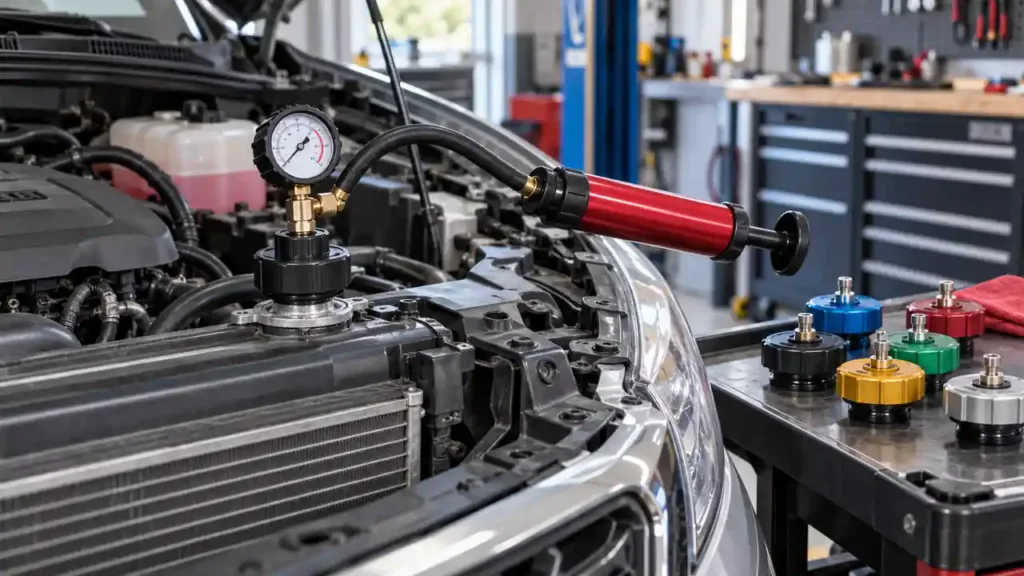
Coolant can disappear without leaving an obvious puddle under the car. A cooling-system pressure kit helps check for leaks on a cold system without waiting for the engine to reach operating temperature. The most useful kit is the one that seals your radiator or expansion tank correctly and gives you controlled pressure, not simply the one with the most colored caps.
This roundup separates pressure-only tools from combination kits that also refill under vacuum. Those are different jobs with different equipment requirements. A hand pump can perform a cold pressure test, while the vacuum-refill equipment commonly needs a suitable compressed-air supply.
We compare documented adapters, gauge range, pressure control, refill hardware, and storage. Always follow the vehicle's specified test pressure. A gauge reading up to 35 psi is a measuring range, not an instruction to pump every cooling system to 35 psi. These recommendations compare documented product features and current listed configurations, not hands-on test results. Verify the exact model and instructions before purchase. This article contains affiliate links; qualifying purchases may earn the site a commission.
Quick Answer
Start with the first option for the most balanced documented feature set, then use the alternatives below when their particular configuration better matches your job. Compatibility and the stated limitations take priority over the ranking.
- Best Overall: Mishimoto MMTL-CPT-28 — Pressure testing and vacuum filling; 17 vehicle adapters.
- Best for Organized Cap Selection: Astro Tools 78585 — Pressure and vacuum tools; color-coded test caps.
- Best for Refill-Valve Design: BILITOOLS 28-Piece Kit — Hand-operated test pump; vacuum refill tool.
Best Cooling System Pressure Test Kit Comparison Table
| Product | Best For | Service Functions | Adapter Configuration | Check Before Buying |
|---|---|---|---|---|
| Mishimoto MMTL-CPT-28 | Best Overall | Pressure + vacuum refill | 17 vehicle adapters; 3 test caps | Vacuum filling needs a suitable air supply |
| Astro Tools 78585 | Best for Organized Cap Selection | Pressure + vacuum refill | Color-coded test caps | Air supply needed for vacuum operation |
| BILITOOLS 28-Piece Kit | Best for Refill-Valve Design | Pressure + vacuum refill | 17 color-coded caps | Compressed air needed for vacuum refill |
| Orion Motor Tech 33-Piece Master Kit | Best for a Larger Adapter Assortment | Pressure + vacuum refill | 22 specific + 1 universal | Large case for occasional use |
| KOOPOOL 30-Piece Kit | Best for Dual Gauge Scales | Pressure + vacuum refill | 17 caps; 3 test covers | Vacuum filling needs external air |
| DISEN 33-Piece Master Kit | Best for a Multi-Make Tool Cart | Pressure + vacuum refill | 23 listed adapters | More storage space than a single-car kit |
| Orion Motor Tech 19-Piece Pressure Kit | Best Pressure-Only Option | Pressure testing only | 15 radiator adapters | No vacuum refill tool in this configuration |
| VEVOR 31-Piece Kit | Best for Metal-Adapter Inclusion | Pressure + vacuum refill | Includes 3 metal adapters | Air supply needed for refill mode |
| CXPRO 28-Piece Radiator Pressure and Refill Kit | Best for Comparing a Complete Basic Bundle | Pressure + vacuum refill | Check supplied cap chart | Less clearly identified product family |
1. Mishimoto MMTL-CPT-28 — Best Overall

Mishimoto combines the two jobs buyers often need after a cooling-system repair: checking whether the system holds pressure and refilling it under vacuum. That makes this a more complete choice than a pressure-only pump for a garage replacing radiators or hoses. Seventeen vehicle adapters and three test caps provide a defined inventory to compare with the cars being maintained. Keeping vacuum refill equipment in the same case is useful when leak diagnosis is followed by a compatible coolant replacement job. The listed 0–35 psi range describes the instrument's capability, while the vehicle procedure determines the actual pressure to apply.
Its adapter inventory is useful, but the cap chart still matters more than the total piece count. This combination is attractive for someone who expects to use both service functions repeatedly. A household seeking only an occasional cold leak check may not need the refill hardware. Confirm that the available compressor meets the vacuum tool's requirements before assigning value to that feature. Check the seals and put the adapter chart back in the case after service so coverage remains identifiable next time.
Pros
- Pressure testing and vacuum filling
- 17 vehicle adapters
- Three test caps
- 0–35 psi listed range
- Molded storage case
Cons
- Vacuum filling needs a suitable air supply
- No universal cap-fit guarantee
To buy this product, click here.
2. Astro Tools 78585 — Best for Organized Cap Selection
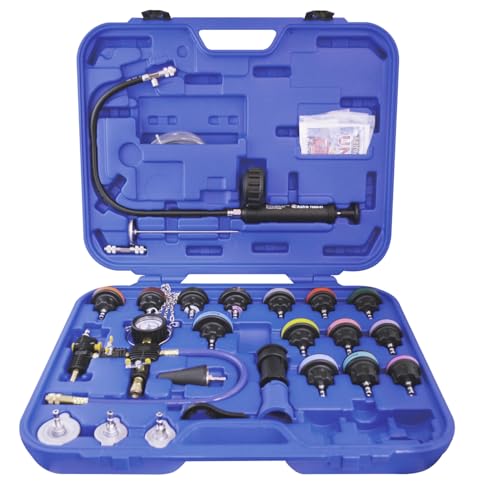
The Astro is an appealing alternative for buyers who value an established kit layout with visibly differentiated caps. Color coding helps return an adapter to the right place and speeds up the next setup. The pressure pump and refill arrangement make this a two-stage service kit rather than an assortment of caps alone. Its molded case helps keep the larger vacuum components from becoming separated from the testing equipment. Domestic and import coverage is useful only when the actual cap connection appears in the supplied application information.
That is an organizational advantage, not evidence that a similarly colored cap from another brand will seal the same filler neck. Astro is a sensible comparison for a workshop where different people use the same cooling-service case. Clear organization can reduce setup mistakes when similar caps are returned after a job. Inspect the selected seal before interpreting a falling gauge as a vehicle leak. The refill tool also needs the specified air supply, so a color-coded case cannot compensate for an unsuitable compressor.
Pros
- Pressure and vacuum tools
- Color-coded test caps
- Domestic and import applications
- Refill connection supplied
- Blow-molded case
Cons
- Air supply needed for vacuum operation
- Check the current application chart
To buy this product, click here.
3. BILITOOLS 28-Piece Kit — Best for Refill-Valve Design

BILITOOLS is notable for its metal refill valve, a concrete construction detail to compare with inexpensive combo sets. The included thermometer and color-coded caps make it useful for a garage that wants one organized cooling-service package. A metal filling valve is a specific construction choice that is more informative than a general durability claim. Seventeen color-coded caps provide a usable starting point for checking vehicle coverage. The additional thermometer is a supporting diagnostic accessory, while the hand pump and vacuum unit handle different parts of the service process.
Buy it for the documented tool configuration, rather than treating seller claims about preventing overheating as a guarantee of the repair outcome. This kit is worth considering when refill-valve construction is an important comparison point. It still needs the correct adapter and an appropriate air supply for the pneumatic function. Keep the thermometer's role in perspective rather than using one reading as permission to open a recently hot system. After service, inspect the cap seals and follow the cleaning instructions for the coolant-contact parts before storage.
Pros
- Hand-operated test pump
- Vacuum refill tool
- Metal refill valve
- 17 color-coded caps
- Probe thermometer supplied
Cons
- Compressed air needed for vacuum refill
- Thermometer does not replace a cold-engine check
To buy this product, click here.
4. Orion Motor Tech 33-Piece Master Kit — Best for a Larger Adapter Assortment

The larger OMT kit is intended for a garage serving multiple makes. The extra adapters may save a separate purchase when a less common expansion tank arrives, but they add little for a household maintaining one known vehicle. The inventory separates 22 specific adapters from the additional universal adapter, making the contents more meaningful than a single headline number. Marked storage positions help when those parts are used across several makes. Included US and EU air fittings also give buyers a reason to check how the refill assembly will connect to their existing equipment.
Check whether the specific additional neck you need is present before choosing it over the smaller pressure-only OMT below. The master format benefits a garage whose coverage needs genuinely extend beyond a few familiar vehicles. It is less persuasive when most of its caps will never be used. Match the needed neck to the chart rather than assuming that one of 23 options must fit. Keep spare O-rings and the reference information together, because a broad kit becomes difficult to use when its small service parts are missing.
Pros
- 22 specific adapters and universal adapter
- Pressure and vacuum functions
- Probe thermometer
- EU and US air fittings
- Marked storage case
Cons
- Large case for occasional use
- Extra adapters may be irrelevant to your vehicles
To buy this product, click here.
5. KOOPOOL 30-Piece Kit — Best for Dual Gauge Scales

KOOPOOL offers a clearly described pairing of pressure and vacuum gauges, which helps buyers distinguish the two operating modes. It suits someone who wants to monitor both phases without changing to a separate service tool. Separate pressure and vacuum scales make it easier to recognize which measurement belongs to each stage of the job. The 17 caps and three test covers are also a clearer inventory than a broad claim of universal fitment. A metal filling valve is relevant to handling during repeated coolant changes, but it does not independently establish the quality of every seal.
A vacuum reading is useful during filling, but it does not by itself prove that a repaired system will hold pressure when hot. KOOPOOL suits buyers who want the two functions visibly organized in one service case. Check the supplied hose and air connection before assuming it will plug into the garage setup immediately. A successful vacuum draw and a successful positive-pressure hold answer different questions. Inspect the selected cap after use and store it clean so dried residue does not complicate the next connection.
Pros
- 0–35 psi pressure range
- Vacuum scale to minus 30 inHg
- 17 color-coded caps
- Metal filling valve
- Three test covers
Cons
- Vacuum filling needs external air
- Cap seals require inspection
To buy this product, click here.
6. DISEN 33-Piece Master Kit — Best for a Multi-Make Tool Cart
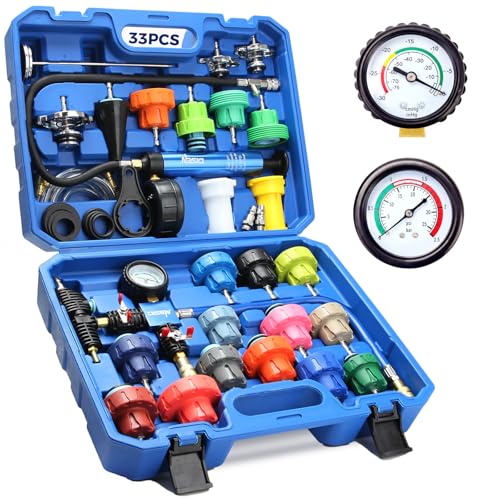
DISEN is another broad-assortment option for a shared garage. Its case keeps the refill equipment with the pressure adapters, reducing the chance that part of the setup gets borrowed and lost. The 23-adapter listing is useful for a repair cart that regularly encounters different expansion-tank necks. Having the thermometer, refill hoses, and air fittings together also reduces the number of separate items needed at the car. Those benefits come from a complete and organized configuration, rather than evidence that every extra adapter improves diagnostic accuracy.
Compare its exact contents and replacement-seal availability with the OMT master set; the recommendation does not rest on assuming that a larger count means better sealing. DISEN is most relevant when the exact additional cap applications appear on the garage's workload. A single-car owner should compare that coverage with a smaller kit before choosing the larger case. Verify the condition of the actual cap seal before deciding that pressure loss originates inside the vehicle. Keep the instructions with the kit so the pressure and vacuum procedures are not confused by the next person using it.
Pros
- 23 listed radiator adapters
- Pressure-test equipment
- Vacuum refill equipment
- Air intake fittings
- Case and thermometer
Cons
- More storage space than a single-car kit
- Verify adapter chart before purchase
To buy this product, click here.
7. Orion Motor Tech 19-Piece Pressure Kit — Best Pressure-Only Option

This OMT earns a separate place because it removes the vacuum-refill hardware, rather than merely changing the case color. It is the more focused option when you only need to investigate a cold-system pressure loss. The 2.5-inch protected gauge and 15-adapter inventory concentrate the set on cold pressure testing. Removing the vacuum hardware also removes an air-supply requirement from that particular task. This makes the package easier to justify when diagnosis is being done now and coolant replacement will be handled separately.
Buying a refill package adds little if you do not have shop air or do not intend to perform coolant replacement yourself. The smaller assortment should be assessed against known neck connections rather than the master set's larger count. It can be a complete purchase when the needed cap is included. The probe thermometer remains an accessory and should not replace following the vehicle's cold-system requirements. Check the hand-pump hose and adapter seal before each test, since a pressure-only kit can still leak at its own connections.
Pros
- 15 radiator adapters
- Hand-operated pump
- 2.5-inch protected gauge
- Up to 35 psi scale
- Probe thermometer
Cons
- No vacuum refill tool in this configuration
- Smaller cap assortment than master sets
To buy this product, click here.
8. VEVOR 31-Piece Kit — Best for Metal-Adapter Inclusion

VEVOR's inclusion of metal adapters is the distinguishing detail to investigate. Metal can be useful at a frequently serviced connection, although the correct thread and sealing surface still determine whether it belongs on your vehicle. Three listed metal adapters give this VEVOR a more specific hardware distinction than another color-coded plastic assortment. The numbered arrangement can help connect an adapter to its application information when the case is open beside the car. Pressure testing and vacuum filling remain separate functions even though their components share the same package.
This is a reasonable comparison candidate for buyers who want pressure testing and vacuum filling together with more explicit adapter construction information. Choose this configuration when the metal adapters and other listed caps cover real jobs you expect to perform. A metal fitting with the wrong thread or sealing geometry is still the wrong fitting. Confirm the refill tool's air requirements before purchasing for coolant replacement. Clean the coolant-contact components as directed and inspect both metal and plastic sealing surfaces before returning them to storage.
Pros
- Three metal adapters listed
- Pressure pump
- Vacuum fill tool
- Numbered adapter organization
- Universal tapered adapter
Cons
- Air supply needed for refill mode
- Metal adapter count alone does not establish fit
To buy this product, click here.
9. CXPRO 28-Piece Radiator Pressure and Refill Kit — Best for Comparing a Complete Basic Bundle

This bundle belongs on a shortlist only after the labeled adapter contents match the vehicle and the seller provides adequate instructions. It offers the main pressure and vacuum functions without a named professional tool platform. The listed pressure pump, pneumatic refill unit, hose, and thermometer cover the main component categories expected in a combination kit. That makes the bundle worth assessing by its actual inventory rather than dismissing or endorsing it solely by brand familiarity. The important missing decision is still whether the cap chart covers the vehicle's exact neck.
The tradeoff is purchasing confidence and support clarity; do not infer universal compatibility from a tapered adapter or from the number printed on the case. CXPRO is a more conditional purchase when clear replacement-part support and instructions are priorities. Ask the actual product documentation to resolve those points before relying on broad compatibility language. Keep the pressure test within the vehicle limit rather than the gauge's full scale. Inspect and organize the caps after use, because uncertain part identification is especially inconvenient in a broad accessory bundle.
Pros
- 0–35 psi pressure pump
- Pneumatic vacuum refill tool
- Rubber hose
- Thermometer
- Multiple caps and adapters
Cons
- Less clearly identified product family
- Universal-adapter language needs careful checking
To buy this product, click here.
Buying Guide
Verify the exact cap connection
Compare the kit's application chart with the vehicle's radiator or expansion-tank neck. Threaded caps, bayonet caps, and adapters that look similar can seal differently. Color coding helps organize the kit but is not a universal fitment system. If the wrong adapter leaks, the test may falsely suggest a vehicle problem before any coolant-system component has been assessed.
For related background, see How Long Does a Water Pump Last: Mileage, Signs, Replacement.
Separate pressure testing from vacuum filling
Pressure testing checks whether the sealed system holds the specified positive pressure. Vacuum filling uses a different arrangement to draw in coolant and reduce air pockets during an approved refill. Buying both functions is sensible after certain repairs, but a refill tool is unnecessary for an owner who only needs a cold-system leak check and has no shop air.
Use the vehicle test pressure
Find the specified pressure and procedure before pumping. Do not exceed the permitted limit to make a small leak easier to see. Start with a fully cooled system and verify the tool connection itself. A pressure drop is a finding to investigate, not an automatic diagnosis of a head gasket or any single component.
Check air-supply requirements
For combination kits, read the vacuum tool's required air pressure and consumption, connector type, and coolant pickup instructions. A tiny compressor may not support the intended operation just because its maximum pressure looks adequate. Plan the coolant supply container and hose routing before beginning so the pickup remains submerged as required during the refill.
For related background, see Signs of a Bad Thermostat: Common Symptoms and Causes.
Consider seals and future support
O-rings and cap seals are working parts, not decorative accessories. Inspect them before testing and find out whether replacements or additional adapters are available. A compact pressure-only kit may be easier to maintain for one household vehicle, while a larger charted assortment makes more sense for a multi-make garage. Preserve the adapter chart with the case.
Frequently Asked Questions
Can I test a hot cooling system?
Start only under the vehicle's safe service procedure, normally with the system fully cold. Opening a hot pressurized cooling system can release scalding coolant.
Does a falling gauge prove a head-gasket leak?
No. Check the adapter, hose, and tool seals first, then investigate the vehicle. A pressure loss has several possible causes and does not identify the failed component by itself.
Do vacuum refill kits need a compressor?
Many do. Check the exact model's pressure, flow, and connector requirements. The manual pressure-test pump and pneumatic vacuum tool are separate functions in a combination set.
Is the highest piece count best?
Not necessarily. Some counts include hoses, thermometers, and spare seals. Compare the actual cap applications needed for your vehicles rather than the total on the package.
Can vacuum filling replace all bleeding steps?
Follow the vehicle procedure. Some systems require additional steps, special equipment, or electronic pump activation even after vacuum filling.
Final Verdict
Mishimoto MMTL-CPT-28 is our overall pick for a garage needing both pressure testing and vacuum refill equipment. Astro 78585 is a strong alternative for organized cap selection. Choose the OMT 19-piece set instead when you only need pressure testing and its adapters match the vehicle; vacuum hardware adds little without the appropriate air supply and refill task. Confirm the exact model, included components, compatibility, and current instructions before ordering.