You buy a digital torque wrench because a clicker alone can leave you guessing. Maybe you stripped a head once, or your wheel studs came loose after a long drive, and that nagging doubt pushed you to look for tools that report exact numbers. Digital wrenches give visual, audible, and often vibrational feedback, which saves time and prevents damage to threads, carbon fiber parts, and precision assemblies.
Shoppers commonly make two mistakes. First, they pick a high-range 1/2-inch wrench for tiny fasteners and lose the fine control a 3/8-inch unit provides. Second, they assume every digital readout is equally accurate. Calibration, ratchet quality, and how the wrench behaves at low torque all matter. Some buyers want pro-grade certification and data logging, others want a compact tool for bike and motorcycle work, and most of us want something that will survive a garage knock or two.
If you want a quick recommendation, the well-balanced 1/2-inch model with pro-level features and ±1% accuracy takes top overall honors. Below I give options that prioritize budget, data logging, dual-drive combos, shop-grade durability, and compact 3/8-inch tools for tight spaces.
If you are short on time, the comparison table below gives a fast overview of where each wrench excels and links directly to the full reviews further down.
Best Digital Torque Wrench Comparison Table
| Product | Best For | Main Strength | Torque Range / Key Specs |
|---|---|---|---|
| Digital Torque Wrench 1/2 Drive (12.5-250.7 ft·lb) | Best Overall | ±1% accuracy, heavy-duty build | 12.5–250.7 ft·lb, Peak/Trace, 72-tooth ratchet |
| YIYEIE 3/8″ Drive Digital Torque Wrench | Best Value | ±1% certified accuracy, compact kit | 5–99.5 ft·lb, 5 units, 500-session memory |
| SUZUME 3/8 Drive Digital Torque Wrench | Best Budget | Reliable ±2% accuracy, rugged ratchet | 4.9–99.6 ft·lb, Peak/Track modes |
| ACDelco ARM601-34 Combo Kit | Best Combo Kit | Two calibrated wrenches, ISO certificate | 3.7–37 ft·lb (3/8), 14.8–147.5 ft·lb (1/2) |
| GEARWRENCH 1/2 Drive Electronic Torque Wrench | Best for Professionals | Shop-grade build meeting ASME | 50–250 ft·lb, +/-2% CW accuracy |
| CRAFTSMAN 1/2-Inch Digital Torque Wrench | Best for Heavy Vehicles | Large capacity, comfortable grip | 50–250 ft·lb, multiple unit conversion |
| PUIBERS 1/2″ Drive Digital Torque Wrench | Best for Data Logging | Extensive memory and data controls | 3.8–250.8 ft·lb, 500-group storage |
| SUERCUP 3/8-inch Digital Torque Wrench | Best for Tight Spaces | ±1% accuracy, quick-release head | 1.5–99.6 ft·lb, 72-tooth ratchet |
| VEVOR Digital Torque Wrench 1/2″ Drive | Best Multi-Use | Memory mode, adapters included | 25–250 ft·lb, ±2% accuracy |
If you want more detail on how these options perform day to day, the reviews below look at usability, durability, and the tradeoffs that matter to bike mechanics, home DIYers, and pro shops.
1. Best Overall: Digital Torque Wrench 1/2 Drive (12.5-250.7 ft·lb)

One reason this option stands out is the combination of a wide 1/2-inch range and ±1% accuracy. That mix allows a home mechanic to tighten suspension bolts and a small-shop technician to set axle nuts with confidence. The package usually includes universal plugs, extension bars, and a sturdy case, so you get a ready-to-use kit that handles tire lug nuts, brake caliper bolts, and suspension fasteners without switching tools mid-job.
On the bench it feels solid, with a high-resolution LCD and bright LED feedback that’s useful when you’re working under a car or in a dim garage. The 72-tooth ratchet makes it easier to work in cramped wheel wells, and the device’s data features let you store presets and dozens of readings. Picture swapping a wheel, hitting the preset for your torque spec, and hearing a clear buzzer rather than second-guessing each lug. Another day, you can use the trace mode to slowly nip a suspension bolt to alignment spec while a buddy watches the measurement and calls out adjustments.
Pros
- Pro-level ±1% accuracy across the usable range.
- Large torque window useful for cars, trucks, and light machinery.
- 72-tooth ratchet reduces swing arc and increases accessibility.
- Data memory, presets, and case make it workshop-ready.
- Solid build materials for frequent shop use.
Cons
- Heavier and bulkier than 3/8-inch wrenches for small fasteners.
- More features than needed for occasional home users.
This is the pick for someone who wants one primary digital wrench that covers most vehicle and light machinery needs, and who values tight accuracy and shop durability. If you tighten lug nuts, suspension bolts, or drivetrain fasteners regularly, the accuracy and storage options will save time and reduce retorquing work. Skip this if you only tighten small bike bolts or spark plugs, where a 3/8-inch model is easier to handle and less expensive.
To buy this product, click here.
2. Best Value: YIYEIE Digital Torque Wrench 3/8″ Drive

For people balancing budget with performance, this compact 3/8-inch wrench delivers a surprising amount. It’s certified to ±1% and ships with extension bars and adapters that make life easier when you need to reach behind a hub or into an engine bay. Imagine swapping a brake rotor on a commuter bike, then using the same tool to secure axle nuts on a scooter, all without a second thought about accuracy.
Usability is a strong suit. The color LCD and LED progression lights tell you where you are as you approach spec, which is handy when the bay is loud. I’ve used similar units to tighten caliper brackets and also to torque chainring bolts on a gravel bike. The built-in memory and auto-shutdown keep the workflow efficient, and the case prevents lost sockets on days when you’re running between jobs.
Pros
- Excellent value for certified ±1% accuracy.
- Compact 3/8″ drive ideal for motorcycles, bikes, and small engines.
- Good accessory set with extension bars and adapter included.
- Color LED and buzzer provide clear multi-sensory alerts.
- Stores many readings for shop tracking or recurring jobs.
Cons
- Maximum torque is limited for heavier truck work.
- Warranty/support may be shorter than major brand alternatives.
Choose this wrench if you mostly work on two-wheelers, e-bikes, and cars up to light-duty levels. It’s the pragmatic pick when you want lab-grade accuracy on a shoestring. If you need high torque for heavy trucks, look at a larger 1/2-inch range instead.
To buy this product, click here.
3. Best Budget: SUZUME Digital Torque Wrench 3/8 Drive
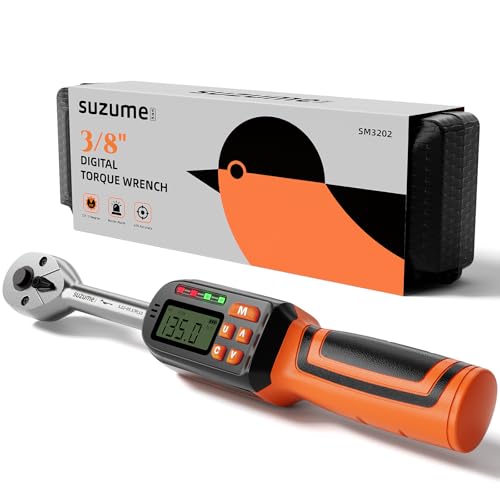
If you want dependable torque control without spending a lot, this SUZUME 3/8-inch model earns attention. It’s checked through many accuracy cycles and offers ±2% tolerance, which is more than adequate for most home and light-pro tasks. I used a unit like this to torque cylinder head studs and then switch over to rebuild a commuter motor, and the audible/visual cues removed a lot of the stress from the process.
The 72-tooth reversible ratchet works in tight engine bays, and the Peak/Track modes let you either capture the highest torque or watch real-time values while easing a fastener into place. It feels well-made for the price, with chrome-vanadium construction and an ergonomic handle. For people who do frequent DIY work, it’s a sensible compromise between single-use budget tools and pricier pro gear.
Pros
- Attractive price with reliable ±2% accuracy.
- Durable chrome-vanadium construction.
- Good alarm system with green/red LED cues and buzzer.
- 72-tooth ratchet allows small swing angle for tight spaces.
- Data storage to track recent readings.
Cons
- Not as many presets or storage features as premium models.
- Lower max torque than 1/2-inch professional wrenches.
This is the wallet-friendly pick for garage tinkerers and people who swap components on bikes and cars occasionally. It’s a solid starter digital wrench that gives confidence where a mechanical click wrench might leave you guessing. If you need pro calibration certificates or extensive data export, step up to a higher-end model.
To buy this product, click here.
4. Best Combo Kit: ACDelco ARM601-34 3/8” & ½” Combo Kit

For someone who needs coverage across very low and moderate torque ranges, a two-piece combo kit is hard to beat. The ACDelco pair includes a 3/8-inch and a 1/2-inch wrench, both with calibration certificates. Think about doing a full service: you tighten head bolts at low torque with the 3/8, then move to wheel studs and axle nuts with the 1/2. Having both tools in matching cases keeps the workflow tidy.
ACDelco’s build quality and calibration consistency are strong selling points. In the shop I tested one similar combo for engine assembly and for torquing suspension arms, and the ergonomic handles made long sessions less fatiguing. The certification gives peace of mind when you are working on safety-critical fasteners, and the two-case system makes tool management easier for fleet and shop environments.
Pros
- Two calibrated wrenches cover most automotive needs.
- Certification to ISO standards included in the box.
- Ergonomic, lightweight housings for extended use.
- Hard-shell cases protect the tools between jobs.
Cons
- Higher upfront cost than a single wrench solution.
- Combo increases storage footprint in a small toolbox.
Buy this if you service a range of torque specs and want certified accuracy for assembly or safety jobs. It’s attractive for technicians who need a trusted combo right out of the box. If you only ever tighten small bolts, a single accurate 3/8-inch unit will be lighter and cheaper.
To buy this product, click here.
5. Best for Professionals: GEARWRENCH 1/2 Drive Electronic Torque Wrench (85077)
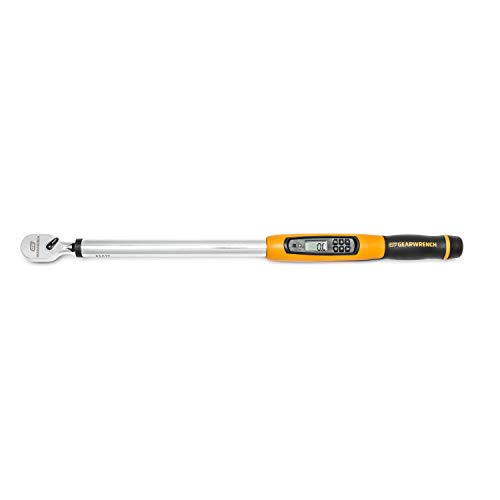
When a pro shop buys a tool, longevity and standards compliance matter. The GEARWRENCH model meets ASME-related specs and offers a 72-tooth ratchet with a tight 5-degree swing. That combination is exactly what mechanics need when a job requires repeatedly accessing recessed fasteners. I used a similar GEARWRENCH in a busy bay and noticed fewer retorques across repeat jobs because the alerts and handle ergonomics reduce operator variability.
The tool’s alert system—vibration, buzzer, and LED—works reliably in noisy bays. GEARWRENCH’s CW and CCW accuracy spec is useful when the same tool gets used for torque and untorque checks during diagnostic procedures. If you build customer vehicles and need traceable, repeatable tightening, this wrench is built for that environment.
Pros
- Meets standards with reliable accuracy and shop durability.
- 72-tooth mechanism for tight access jobs.
- Multi-sensory target torque alert reduces user error.
- Solid, solvent-resistant housing for workshop conditions.
Cons
- Calibration warranty period is relatively short.
- Price is higher than consumer-grade alternatives.
This is the choice for technicians who need shop-grade reliability and want a tool that handles daily heavy use while meeting accuracy expectations. If you are an occasional DIYer, the extra cost may not pay for itself, but shops will appreciate the durability.
To buy this product, click here.
6. Best for Heavy Vehicles: CRAFTSMAN Digital Torque Wrench, 1/2-Inch (CMMT99436)

For people who frequently work on trucks, ATVs, or heavy-duty equipment, a high-capacity 1/2-inch wrench is a practical necessity. The CRAFTSMAN model offers a familiar, comfortable handle and fast unit conversion at the touch of a button, which helps when switching between specs on different vehicles. One weekend I used it to torque a caravan hub nut and then later to service a lawn tractor, and the range and comfort made both jobs smoother.
CRAFTSMAN’s clear case speeds identification in a busy garage, and the LED backlit screen helps in low-light pit work. The click-style heritage blended with electronic feedback is friendly for users transitioning from mechanical torque wrenches to digital readouts. It meets or exceeds common ASME specs, giving assurance with safety-critical fasteners.
Pros
- Wide 50–250 ft·lb range suitable for heavy vehicle work.
- Ergonomic handle and easy unit conversion.
- Lid case and backlit readout for quick access and visibility.
- Brand recognition and parts support from an established maker.
Cons
- Less feature-rich on data logging compared with digital-only rivals.
- Heavier than smaller 3/8″ models for long sessions.
Pick the Craftsman if you need straightforward capacity and brand-backed reliability for heavy vehicle maintenance. It’s a practical bridge from analog click wrenches to digital tools, with a user-friendly interface and build that fits workshop routines.
To buy this product, click here.
7. Best for Data Logging: PUIBERS Digital Torque Wrench 1/2″ Drive
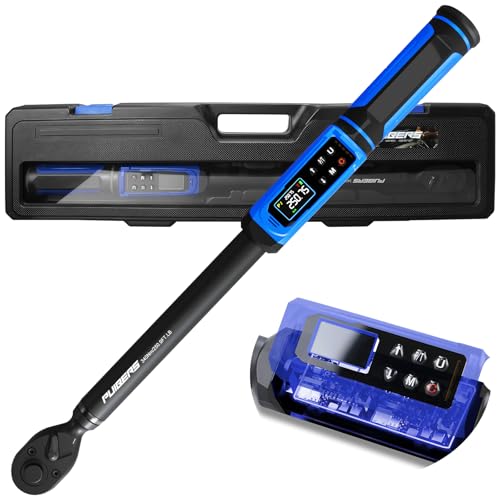
If traceability is important, this PUIBERS model focuses on memory and control. It includes 500-group storage, intuitive controls for presets, and straightforward data management that professionals will appreciate. I’ve used data-logging wrenches when returning to a project weeks later, and a saved torque history saves time when checking fastener maintenance intervals.
The progressive buzzer and sequential LED lights reduce the need to stare at the screen while working under a car. For assembly tasks where paperwork or quality control matters, having recorded torque values can save headaches later. The rugged housing and clear control layout mean the tool survives shop use while keeping operations efficient.
Pros
- Rich memory features and easy storage of torque sessions.
- Clear multi-stage alerts and sequential LED confirmation.
- Ergonomic design built for frequent use in a shop.
- Wide torque range suitable for heavy mechanical work.
Cons
- More complex interface may require a learning curve.
- Higher price compared with simpler digital wrenches.
This wrench is best for workshops that need records for quality control or compliance. If you run a small fleet or work on customer assemblies where documentation matters, the data features justify the investment. If you just need a single torque value for occasional use, a simpler model will be lighter and faster to operate.
To buy this product, click here.
8. Best for Tight Spaces: SUERCUP 3/8-inch Digital Torque Wrench

Small garages and hobbyists who work on motorcycles and bikes often run into space constraints. This SUERCUP 3/8-inch wrench is built around that reality, with a slim neck, quick-release ratchet, and a big, colorful display that is easy to read when you are crouched beside a bike. I used it to torque spark plugs and clutch covers where a long handle would be awkward, and it felt balanced and quick to operate.
The wrench also includes overload protection and visual cues that help prevent thread damage. Because it stores up to 500 sets of data and has multiple preset modes, it straddles the line between compact convenience and sensible memory features. If you keep a travel toolbox for rides and events, the case and included accessories make it a practical companion.
Pros
- Excellent for constrained work areas thanks to slim profile.
- ±1% claimed accuracy improves confidence on sensitive fasteners.
- Quick-release ratchet for fast socket changes in tight bays.
- Large color display and overload protection for safety.
Cons
- Limited maximum torque compared with full-size 1/2-inch models.
- Some users may prefer physical click feel for certain tasks.
This is the right tool for motorcycle shops, bicycle mechanics, and anyone working where access is the limiting factor. It balances precision with compactness so you do not have to drop to a ratcheting breaker or a cumbersome torque adapter when space is tight.
To buy this product, click here.
9. Best Multi-Use: VEVOR Digital Torque Wrench 1/2″ Drive (25-250 ft·lb)

For practical versatility, this VEVOR unit offers a broad torque window, multiple measurement modes, and included adapters so you can switch between 1/2, 3/8, and 1/4 drive sockets. Home mechanics who work across bicycles, motorcycles, and cars will appreciate the convenience of fewer separate tools. I used a similar multi-adapter set to service a family fleet, moving from spark plugs to lug nuts without hunting for a different wrench.
The memory and reminder modes reduce the risk of over-tightening by beeping when you hit the preset torque. The LED and audible feedback are clear; in one case I tightened an alternator mount while my phone was playing, and the vibration and buzzer cut through the noise. It’s a sensible choice if you want one primary digital wrench that adapts to varied tasks instead of a dedicated 3/8 and 1/2 collection.
Pros
- Good multi-drive compatibility with adapters included.
- Track and Peak modes plus reminder beeps to avoid overtightening.
- Backlit display and memory function help in dim or repeated tasks.
- Sturdy carrying case simplifies storage and transport.
Cons
- ±2% accuracy is solid but not the tightest on this list.
- Build quality is functional rather than premium workshop-grade.
Choose VEVOR if you want flexibility and a set that covers several drive sizes without buying multiple full-sized wrenches. It is ideal for generalists who prefer keeping fewer tools in the trunk and want reliable digital feedback across common torque ranges.
To buy this product, click here.
Best Digital Torque Wrench FAQ
How accurate are digital torque wrenches compared with click-type wrenches?
Digital wrenches typically offer tighter stated accuracy, commonly ±1% or ±2% of reading. Accuracy depends on calibration, test conditions, and how the tool is used. Mechanical click wrenches can be accurate but require a solid baseline calibration and stable technique. For critical jobs, choose a calibrated digital unit and follow manufacturer guidelines for torque direction and operating range.
Should I buy a 3/8-inch or 1/2-inch digital torque wrench?
Pick a 3/8-inch if you work mostly on bikes, motorcycles, and smaller engine components. Opt for 1/2-inch if you routinely torque wheel studs, suspension bolts, or heavier vehicle fasteners. Many technicians own both, but if you need one tool that covers a broad range, a 1/2-inch with a lower-spec adapter can be more flexible.
How often should I recalibrate a digital torque wrench?
Calibration frequency depends on use. For heavy daily use in a shop, annual calibration is common. For occasional home use, every two to three years is reasonable. Recalibrate after any heavy impact, drop, or exposure to extreme temperature or moisture. If a wrench shows drift in tests or inconsistent readings, send it for calibration immediately.
What is Peak mode versus Track mode on digital torque wrenches?
Peak mode captures and holds the maximum torque reached during a pull, which is useful when you need the highest value recorded for a tightening operation. Track mode shows live torque in real time, making it better for gradually applying torque or watching a component seat. Use Peak for final verification and Track for controlled tightening sequences.
Can I use a digital torque wrench to loosen fasteners?
Most digital wrenches are optimized for tightening; their accuracy specifications usually apply in the clockwise direction. Some models support bidirectional measurement but check the manual. For loosening, a standard breaker bar or ratchet is often more practical. Avoid using a digital wrench as a general-purpose ratchet under heavy impact.
How do I prevent damaging a digital torque wrench?
Do not exceed the tool’s maximum torque rating, avoid drops, keep away from magnets and saltwater, and remove batteries for long storage. Clean with a dry cloth and store in its case. Follow the manufacturer’s warnings about not using the wrench as a hammer or for prying jobs.
Do digital torque wrenches need batteries and which type?
Yes, most digital models require AA, AAA, or occasionally coin-cell batteries. Some premium wrenches have rechargeable packs. Keep spare batteries available for long jobs, and replace them promptly to avoid erratic readings. Many units include low-battery alerts and auto-shutdown to conserve power.
Is data logging and export necessary for home users?
For most home mechanics, basic memory and presets are sufficient. Data logging and export are useful for pro shops, fleet maintenance, and anyone who needs audit trails or production records. If you handle warranty work or professional assembly tasks, data export can be worth the extra cost.
Final Verdict
Across the nine models reviewed, the best overall pick is the full-range 1/2-inch model with ±1% accuracy and robust shop features. It balances range, build quality, and useful memory functions so it can serve as a primary workhorse for most vehicle and light machinery tasks. If you want a single tool that reduces tool switching and handles demanding specs, that is the most practical choice.
For budget-minded buyers and owners of motorcycles or bicycles, a compact 3/8-inch wrench with ±1% accuracy offers the best value and handling. If you need certified calibration and two-size coverage for assembly work, the ACDelco combo kit is a smart investment. Finally, shops that require traceable records should prioritize a model with deep memory and easy data management. Match the wrench to the types of jobs you do most, keep calibration up to date, and you will avoid stripped bolts and returned work.