
Running out of battery power at the worst possible moment is a small disaster that feels huge. People look for the best car battery charger to avoid mornings spent banging a hood, weekends wasted at the tow shop, and long trips ended by a dead accessory battery. Shoppers are trying to balance ease-of-use, the right charging speed for their battery type, and safety features that protect expensive electronics. Some buyers want a compact maintainer that lives in the garage for long-term storage, while others need a high-amp charger that can bring a deeply discharged battery back to life quickly.
Common mistakes include choosing a charger by price alone, assuming every charger works with lithium chemistry, or buying a high-amp unit without thinking about battery capacity and heat. What matters most is matching the charger’s features to how you use the car. Are you maintaining a classic that sits for months, rescuing farm equipment in frigid weather, or topping up a modern LiFePO4 pack? The right charger is the one that fits your routine, the battery chemistry, and the climate you drive in. For most drivers who want reliable, all-around performance, a mid‑power smart charger with temperature compensation and desulfation routines is the safest bet — the NOCO Genius5 is a strong pick for that role.
If you’re short on time, the comparison table below gives a quick way to scan the top choices and jump straight to the review that matters to you.
Best Car Battery Charger Comparison Table
| Product | Best For | Main Strength | Key Specs |
|---|---|---|---|
| NOCO Genius5 (Genius5) | Everyday Garage Use | Reliable multi-chemistry smart charging | 5A, 6V/12V, LiFePO4 & lead-acid |
| NOCO Genius1 (Genius1) | Small Batteries & Budget Maintainer | Compact, safe trickle maintainer | 1A, 6V/12V, fits motorcycles & cars |
| TowerTop 2/10/25 Amp 12V Charger | Fast Charging / Engine Start | High current, 8-stage charging, engine start | 25A max, 12V, 8-stage, engine-start mode |
| YONHAN 20A 12V/24V | LiFePO4 & Faster Charges | 20A outputs, LiFePO4 support, big LCD | 12V 20A / 24V 10A, 7-stage charging |
| Schumacher SC1280 | Seasonal Maintenance & Revives | Trusted brand, 15A rapid charge + desulfation | 15A, 6V/12V, multi-stage, auto-detect |
| PCHH 12V/24V Heavy Duty | Workshop/Heavy-Duty Use | Rugged build, 12.2 lb copper coil construction | 0–15A auto, 12V/24V, repair mode |
| E-FAST 25A Smart Charger | Rapid Charging for Large Batteries | 25A output, aluminum housing, booster mode | 25A, 12V/24V, 5 current levels, booster |
| YONHAN 10A 12V/24V | Compact Garage Maintainer | Good feature set for price, winter mode | 10A, 12V/24V, LCD, repair mode |
| Schumacher SC1281 | Charger + Engine Starter Combo | Boost/start capability plus diagnostics | 6A charge / 100A engine start, 5-in-1 |
If you want a closer look at each option, the full reviews below explain what each charger does best and who should consider it.
1. Best Overall: NOCO GENIUS5
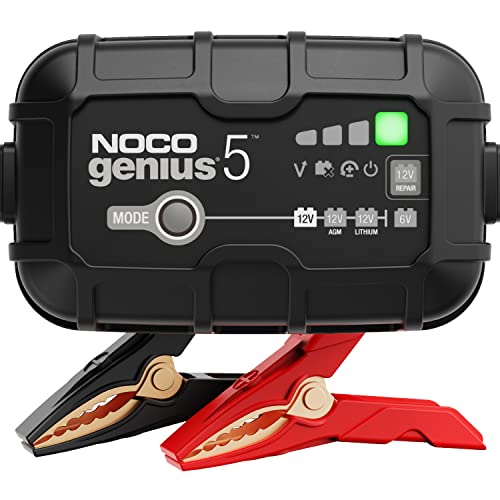
One reason the Genius5 earns a top spot is its balance. It is compact enough to store in a garage shelf, while powerful enough for maintenance and moderate charging tasks. The integrated thermal sensor adjusts the charge by temperature, which is a practical advantage if you park outdoors in winter or leave a battery on the charger during summer. In day-to-day use it feels like a precision tool rather than a blunt instrument: the 5A output charges most car batteries overnight without stressing the cells, and the diagnostic/memory modes simplify repeated use.
For owners of mixed fleets — a commuter car and a weekend motorcycle, or a classic car you keep seasonally — the Genius5 lives up to the “one device for many jobs” idea. It supports both lead-acid types and LiFePO4, and the desulfation/pulse routines help revive batteries that have been neglected. Picture a weekend where you bring a project car back to life and then use the same charger to top up your snowblower battery without swapping gear; that kind of flexibility is why many garages choose this model.
Pros
- Trusted brand with reliable performance and safety features.
- Works with multiple chemistries including LiFePO4 and lead-acid.
- Thermal compensation keeps charging accurate across temperatures.
- Compact footprint and easy mounting options.
- Good balance between charge speed and battery care.
Cons
- 5A is slower than 20–25A units for very large batteries.
- No built-in high-amp engine-start function.
The Genius5 is aimed at drivers who want dependable, smart charging without a steep learning curve. If you maintain a few vehicles and value battery health over raw speed, this charger is hard to beat. Skip it if you need to rapidly recharge very large deep-cycle banks or require on‑demand engine-start capability. The unit performs best as a garage workhorse and long-term maintainer, especially where lithium compatibility matters.
To buy this product, click here.
2. Best Budget: NOCO GENIUS1

For buyers who prioritize simplicity and a tiny footprint, the Genius1 answers the call. It’s a one-amp maintainer that comfortably handles bikes, lawn tractors, classic car batteries, and trickle maintenance for a commuter car between uses. The plug-in design and integrated eyelet terminals make it easy to install semi-permanently, and the unit monitors and maintains battery voltage so you can forget it without fear of overcharging. Imagine leaving your winter bike battery on the charger for a month; the unit will compensate for temperature and hold the battery at safe float levels.
If your typical scenario is a battery that needs occasional topping up rather than full restoration, the Genius1 gives more safety and intelligence than a dumb trickle charger without demanding space or investment. The compact size wins in garages where shelf real estate is at a premium, and the price-to-performance ratio is excellent for a basic, reliable maintainer.
Pros
- Very compact and easy to store or mount.
- Charges down to low voltages and has Force Mode for dead batteries.
- Temperature compensation protects against over/under charging.
- Good for motorcycles, ATVs, lawn equipment and long-term storage.
- Backed by NOCO’s reputation and warranty support.
Cons
- 1A is too slow for full car battery recharges.
- Not suitable when quick recovery of a deeply discharged battery is required.
Choose the Genius1 if you want a “set and forget” maintainer for small batteries or a winter storage solution. It’s also ideal as a second charger for seasonal equipment. Avoid it if you need a single charger that will rapidly charge multiple car batteries in a garage rotation; for that, step up to a 5–25A model.
To buy this product, click here.
3. Best Fast Charger: TowerTop 2/10/25 Amp 12V Smart Car Battery Charger

If your priority is speed and utility, this TowerTop model is built around that idea. The 25A maximum current will refill large automotive or marine batteries quickly, and the unit claims an efficient, eight-stage charging algorithm that moves from desulfation through bulk and into float maintenance. For someone who services multiple vehicles or wants rapid top-offs before a long trip, the higher current makes a noticeable difference. Picture running a weekend full of test drives with several project cars; a 25A charger reduces downtime dramatically compared with trickle chargers.
It also adds conveniences that are useful in colder climates: a dedicated winter mode that nudges voltage up for better low-temperature charging, and an engine-start mode that provides a short, high-current surge to crank a stalled vehicle. The large LCD gives visibility into charging stages, and the repair/desulfation buttons can help bring sulfatized batteries back to usable condition when other chargers fail.
Pros
- 25A high-current option significantly speeds up charging on large batteries.
- Eight-stage charging with an LCD gives clear feedback and better battery care.
- Includes engine-start mode and manual repair/desulfation features.
- Memory of last settings and automatic detection add convenience.
Cons
- Larger, heavier unit that requires more storage space.
- Some repair modes cannot revive completely dead batteries.
This TowerTop unit is for owners who need faster turnarounds and occasional engine assist capability. It trades portability for power, which works well in a home garage or small workshop. If your priority is battery preservation over speed, a gentler multi-stage charger may be preferable; if uptime and quick recoveries matter more, this model delivers.
To buy this product, click here.
4. Best for LiFePO4 Compatibility: YONHAN 20A 12V/24V
If you’re migrating to modern lithium batteries like LiFePO4 for tighter weight and cycle-life benefits, picking a charger that explicitly supports that chemistry matters. The YONHAN 20A model lists LiFePO4 compatibility and delivers a much faster 20A charge for 12V systems, which is handy when you have a larger battery pack in an RV or marine setup. Think of a weekend camping trip where you need to top the house battery quickly between drives; a 20A charger gets you back to full capacity faster.
The extra-large LCD makes monitoring convenient in bright sunlight, and the built-in repair routine gives a chance to recover slow-draining or sulfated lead-acid batteries. For mixed fleets where both lithium and lead-acid are present, the clear chemistry support and fast charging make this unit practical. One real-world scenario: a boater who added a LiFePO4 house bank and keeps a lead-acid start battery can use the same charger on multiple circuits as long as they select the correct mode.
Pros
- Explicit LiFePO4 support with higher current for faster charging.
- Large, readable screen that shows status and modes.
- Repair mode and multi-stage charging protect battery health.
- Automatic switch to trickle/float once charging completes.
Cons
- Not intended as a standalone jump starter; wall power required.
- Can be overkill for owners who only need a small maintainer.
This charger fits users who have upgraded to lithium house batteries or who run larger deep-cycle banks. It performs best where speed and chemistry compatibility are important. If you only have a single commuter car and no lithium packs, the extra capacity is useful but not essential.
To buy this product, click here.
5. Best Garage Workhorse: Schumacher SC1280

Schumacher is a name many mechanics trust, and the SC1280 is the model that fits a busy garage needing a reliable 15A device. The unit’s microprocessor control simplifies operation while delivering enough power to quickly recharge run-down batteries. For people who rotate vehicles through a single charger — think a commuter, a truck, and a seasonal golf cart — the SC1280 offers a mix of speed and battery-care features like desulfation and auto-detection between 6V and 12V systems.
One homeowner anecdote: after winter storage a neighbor’s lawn tractor struggled to crank; a 15A Schumacher brought it back in a few hours and then held it on float until it was needed. Another scenario is a DIY mechanic who uses the built-in revive function to nurse older batteries to a few more months of service while deciding on replacement timing. In short, the SC1280 is built for routine, repeatable tasks under varied conditions.
Pros
- Trusted brand with proven durability in shop environments.
- 15A rapid charge reduces waiting time on multiple vehicles.
- Auto-detect and multi-stage charging help avoid user error.
- Includes desulfation to extend battery life.
Cons
- Bulkier than pocket-size maintainers and needs a dedicated spot.
- Not optimized for LiFePO4 chemistry unless specified by model.
The SC1280 suits workshop owners, hobby mechanics, and anyone who needs a solid mid-power charger day after day. It’s less appropriate for ultralight portable use or where lithium chemistry support is mandatory. If you want a reliable, slightly heavy-duty charger that keeps batteries healthy and ready, this is a sensible pick.
To buy this product, click here.
6. Best Heavy Duty: PCHH 12V/24V Heavy Duty

This PCHH unit leans into toughness. It’s heavier than most portable chargers and built with copper coil components and a metal/ABS housing. The solid construction is obvious when you lift it, and that ruggedness pays off in workshops, farms, and garages where equipment gets moved around. The charger auto-detects voltage and offers repair modes to bring idle batteries back toward health, which is valuable when you have seasonal vehicles that sit for months.
Real-world use cases include a rural property owner who keeps tractor and ATV batteries healthy through winter, or a small fleet operator who needs something that can take knocks and survive a messy garage environment. The LCD and winter mode add practical convenience, and the unit’s comprehensive protection suite reduces the risk of accidental damage during frequent connections.
Pros
- Robust, heavy-duty build designed for frequent, rough use.
- 12V/24V compatibility and repair modes for a wide range of batteries.
- Auto shutoff and maintenance mode prevent overcharging.
- Clear LCD display shows charging percentage, current and voltage.
Cons
- At over 12 lbs, it is not something you’ll toss in a trunk for roadside emergencies.
- More expensive than small maintainers and overpowered for single-bike owners.
Choose this charger if durability and occasional heavy lifting are part of the job. It performs best in garages and farms where units get used often and must survive imperfect handling. For light, occasional home use, the extra weight and cost might be unnecessary.
To buy this product, click here.
7. Best 25A Rapid Charger Value: E-FAST 25A Smart Charger

If the TowerTop model felt like an express lane, the E-FAST hits similar notes with an aluminum housing and active cooling to manage heat during high-amp charging. The unit offers multiple manual current selections and an Auto mode that tries to pick the right charge rate. For larger batteries such as those in pickups, SUVs, and small marine banks, 25A capability makes a tangible difference when time is limited.
A real scenario: a weekend warrior who loads a boat, runs the battery low during a day on the water, and needs to top it before the next outing will value the shorter charge windows. The built-in booster mode also functions as an emergency jump-assist if you discover a dead starter battery before a long drive. The metal shell and cooling fan help sustain performance under repeated heavy loads.
Pros
- 25A rapid charging with multiple current options for flexibility.
- Durable aluminum housing and active cooling for longer heavy use.
- Booster mode offers jump-start assist for emergencies.
- Repairs and maintenance modes extend battery life.
Cons
- Higher amp modes demand careful matching to battery capacity to avoid stress.
- Louder fan noise during heavy charging sessions.
Pick the E-FAST 25A if you frequently need to recharge large batteries quickly but don’t want to pay premium prices. The tradeoff is a heavier, noisier box and the requirement that the operator understands which amp setting fits which battery size.
To buy this product, click here.
8. Best Small Maintainer: YONHAN 10A 12V/24V
For shoppers who want a feature-rich maintainer without spending a lot, this YONHAN model packs an attractive set of functions. The 10A output is strong enough to handle most car batteries for routine charging and light recovery. Its backlit LCD gives instant feedback on voltage, current, percentage charged and temperature, which turns a routine top-up into a transparent process. One homeowner example is keeping a weekend car ready for spontaneous drives; the YONHAN unit takes the guesswork out of whether the battery is healthy before you leave.
The unit’s winter mode and trickle options are helpful if you store vehicles for seasonal periods, and the repair mode can sometimes restore marginal batteries enough to avoid immediate replacement. For a compact shop or homeowner garage, it’s a practical blend of convenience and capability at a friendly price.
Pros
- Good balance of power and portability at a modest cost.
- Backlit LCD provides useful diagnostics during charging.
- Winter mode and repair/desulfation options for seasonal care.
- 12V/24V versatility for small fleet or marine owners.
Cons
- Not a substitute for a dedicated high-amp shop charger in heavy use environments.
- Repair modes have limits and cannot revive completely dead batteries.
This charger is a smart pick for homeowners who want more than a trickle maintainer but don’t need workshop-grade equipment. It suits seasonal vehicles, second cars, and small boat owners who value clear information during the charge cycle.
To buy this product, click here.
9. Best All-In-One Starter + Charger: Schumacher SC1281

The SC1281 blends charger and engine-start features in a compact, user-friendly package. With a 100A engine start capability and boost charge between 12A and 30A, it’s ideal for users who want the convenience of jump-start assist plus multi-stage charging. In practical terms, it can be the difference between calling a neighbor for a jump or getting back on the road after a weekend of infrequent starts. The built-in alternator and battery tester also help diagnose whether a weak battery is the root cause of problems.
Imagine prepping a car for a long trip: the SC1281 can test the battery and alternator, then give a boost charge if needed, and finally hold the battery on a smart maintenance mode. That kind of all-in-one workflow saves time and reduces trips to the parts store. It’s a comfortable middle ground for people who want occasional engine-start power without a separate jump pack.
Pros
- Integrated engine-start capability with diagnostic functions.
- Smart trickle charging prevents overcharging during storage.
- Reconditioning/desulfation can extend battery life.
- Works with multiple battery types and vehicle types.
Cons
- Lower continuous charging current than dedicated 20–25A chargers.
- Engine-start function requires the unit to be plugged in during use.
Pick the SC1281 when you want diagnostics and jump-start capability built into your charger. It’s especially useful for small repair shops, seasonal drivers, and backyard mechanics who like having diagnostic feedback before committing to battery replacement. If you require very fast bulk charging for large banks, a 20–25A dedicated charger is a better match.
To buy this product, click here.
Best Car Battery Charger FAQ
What charger amp rating is right for my car battery?
Match the charger amp rating to how quickly you want to restore charge and the battery’s amp-hour (Ah) capacity. Small maintainers (1–5A) are ideal for long-term maintenance and trickle charging. Mid-range chargers (6–15A) balance speed and battery care for most passenger cars. Higher amp chargers (20–25A) reduce recharge time for large batteries and workshops but demand careful use to avoid overheating. Use lower amps for gradual charging when in doubt.
Can a smart charger overcharge my battery if I leave it connected?
Most modern smart chargers include float or maintenance modes that prevent overcharging by reducing current when the battery is full. Look for multi-stage charging and explicit float/maintenance modes in the specs. Even with smart chargers, follow manufacturer guidance for long-term connections, and use models with temperature compensation in extreme climates.
Do I need a charger that supports lithium batteries?
If you have or plan to use LiFePO4 or other lithium chemistries, buy a charger with explicit lithium settings. Lithium batteries require different charge voltages and charging profiles than lead-acid types. Using a charger without lithium support risks incomplete charging or battery damage.
What is desulfation or repair mode and when should I use it?
Desulfation pulses the battery with controlled charge patterns to break up sulfate crystals that form on lead-acid plates in undercharged batteries. Use repair mode for batteries that show reduced capacity after long storage or slow cranking, but don’t expect it to resurrect physically damaged or completely dead cells. Repeated repair cycles sometimes extend usable life, giving you time to replace a failing battery.
Can a charger jump-start my car?
Chargers are not the same as portable jump starters. Some chargers include engine-start or booster modes that deliver a short high-current surge while plugged in, which can help start an engine. For roadside emergencies where no mains power is available, a portable jump starter pack is the proper tool.
How important is temperature compensation?
Temperature affects charging voltage and battery behavior. Chargers with temperature compensation adjust the charge profile based on ambient temperature, reducing the risk of undercharging in cold weather and overcharging in heat. This feature is especially valuable where seasons are extreme or batteries are stored outdoors.
Is it safe to leave a charger connected overnight?
With a modern smart charger that offers maintenance/float mode, leaving the charger connected overnight is generally safe and common practice. Confirm that the charger has automatic float and overcharge protection, and follow the manufacturer’s instructions for prolonged connection.
How do I decide between portability and power?
Portability matters if you want to store a charger in your trunk or use it roadside. Power matters if you need fast recharges for large batteries or repeated workshop use. Choose a compact maintainer for seasonal storage and a heavier 15–25A unit for frequent, fast recharges in a garage setting.
Final Verdict
Choosing the best car battery charger comes down to matching the tool to your routine. For most drivers who want a reliable, versatile, and safe option, the NOCO Genius5 stands out as an excellent all-around pick. It combines multi-chemistry support, thermal compensation, and user-friendly multi-stage charging in a compact package that is well-suited to the garage that services a few vehicles or seasonal toys.
If you’re on a strict budget or only need a small maintainer for motorcycles and lawn gear, the NOCO Genius1 is a simple, dependable choice. For users who need faster turnaround or workshop-level power, the 20–25A chargers from TowerTop, E-FAST, and YONHAN deliver real time savings and heavier-duty performance. Finally, if you want diagnostics plus occasional engine-start capability, the Schumacher SC1281 balances those needs without forcing you to buy multiple devices. Match the charger’s amp output, chemistry support, and portability to how you actually use your vehicles, and you’ll avoid most regrets.