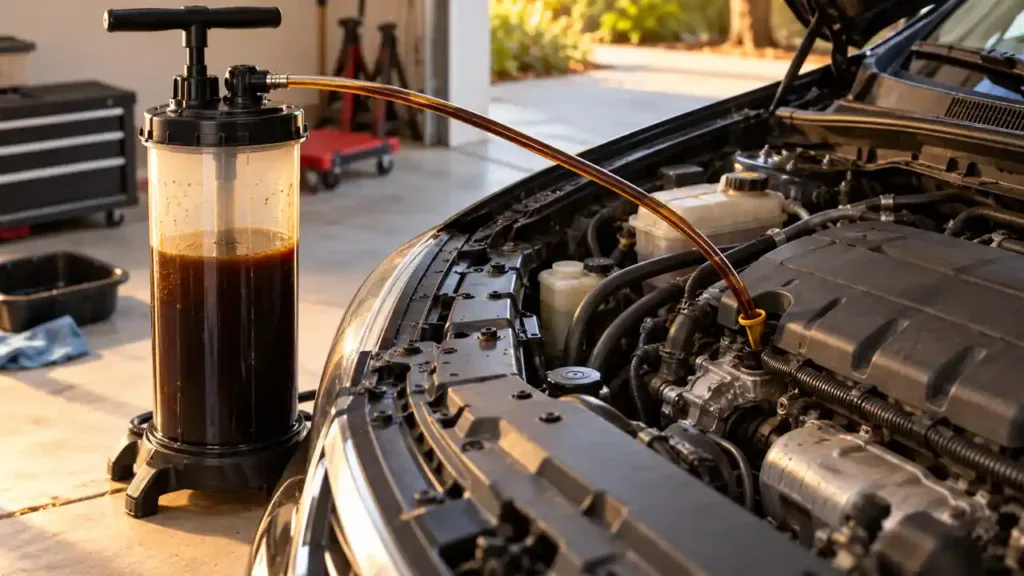
An oil extractor can make a compatible dipstick-tube oil change cleaner and easier, especially when the drain plug is awkward to reach. It is not suitable for every engine, and the smallest transfer pump is not equivalent to a self-contained collection tank. Choosing the right design starts with the vehicle's approved service method.
The best oil extractor pump for oil change use depends on sump access, oil capacity, tube dimensions, available power, and where the used oil will go. Manual tanks, pneumatic/manual tanks, and battery-powered transfer pumps solve that problem differently.
We compare those operating designs rather than ranking pumps by unverified speed claims. A flow figure for warm diesel does not describe the same job as drawing engine oil through a narrow tube. Confirm oil temperature limits, liquid compatibility, and duty cycle before beginning. These recommendations compare documented product features and current listed configurations, not hands-on test results. Verify the exact model and instructions before purchase. This article contains affiliate links; qualifying purchases may earn the site a commission.
Quick Answer
Start with the first option for the most balanced documented feature set, then use the alternatives below when their particular configuration better matches your job. Compatibility and the stated limitations take priority over the ranking.
- Best Overall: Mityvac 7201 Fluid Evacuator Plus — Manual operation; extraction and dispensing modes.
- Best for Switching Between Home and Shop: EWK 6.5L Pneumatic/Manual Extractor — 6.5-liter tank; manual and pneumatic modes.
- Best for a Smaller Manual Reservoir: OEMTOOLS 24389 — 5.3-liter collection tank; hand-pump operation.
Best Oil Extractor Pump for Oil Change Comparison Table
| Product | Best For | Operating Method | Collection Arrangement | Check Before Buying |
|---|---|---|---|---|
| Mityvac 7201 Fluid Evacuator Plus | Best Overall | Manual; extract and dispense | 2.3-gallon reservoir | Larger footprint than a small electric pump |
| EWK 6.5L Pneumatic/Manual Extractor | Best for Switching Between Home and Shop | Manual / pneumatic | 6.5-liter reservoir | Compressor needed for pneumatic mode |
| OEMTOOLS 24389 | Best for a Smaller Manual Reservoir | Manual | 5.3-liter reservoir | Too small for some full oil fills |
| Harpy Eagle 12/24V 100W Extractor | Best for Dual-Voltage Battery Power | 12/24V electric | Separate waste container | Separate waste-oil container required |
| Amarine Made 12V 60W Oil Pump | Best for a Compact Battery-Clamp Pump | 12V electric | Separate waste container | No integral collection tank |
| DURATECH 6.5L Extractor | Best for Included Tube Accessories | Manual / pneumatic | 6.5-liter reservoir | Compressor needed for powered mode |
| VEVOR 6.5L Dual-Mode Extractor | Best for a Multi-Tube Tank Kit | Manual / pneumatic | 6.5-liter reservoir | Does not fit every dipstick passage |
| DasMarine 12V Oil Extractor | Best for Explicit Operating Limits | 12V electric | Separate waste container | Needs cooling breaks under its instructions |
| OEMTOOLS 24937 Dual-Mode Extractor | Best for a Documented Air Connection | Manual / pneumatic | 6-liter reservoir | Compressor needed for pneumatic mode |
1. Mityvac 7201 Fluid Evacuator Plus — Best Overall
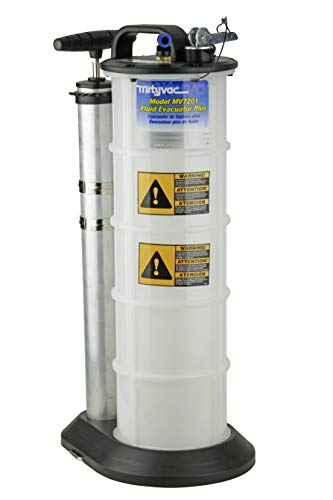
The Mityvac stands out because it can both remove and dispense fluid, giving the reservoir a second job beyond collecting used oil. Manual operation also avoids tying the service to a battery or compressor. The 2.3-gallon reservoir gives the collected fluid a defined destination instead of requiring a separate open container. Its automatic overflow prevention is a useful safeguard when attention shifts between the tube and the tank. The dispensing function is a genuine capability difference from an extractor that can only pull liquid into its reservoir.
It is a practical main-garage choice when you want one contained unit, provided your engine allows extraction through the dipstick tube. Mityvac is particularly relevant when several compatible fluid-service tasks justify keeping a larger manual unit. For a small engine and limited shelf space, the reservoir may be more tool than necessary. Maintain separation between incompatible fluid jobs and follow the unit's cleaning requirements before changing use. Check the suction tubing and the engine's approved extraction route, because tank capacity cannot solve a passage the tube cannot reach.
Pros
- Manual operation
- Extraction and dispensing modes
- 2.3-gallon reservoir
- Chemical-resistant polyethylene
- Automatic overflow prevention
Cons
- Larger footprint than a small electric pump
- Requires hand pumping
To buy this product, click here.
2. EWK 6.5L Pneumatic/Manual Extractor — Best for Switching Between Home and Shop

EWK suits an owner who sometimes works at a driveway and sometimes has access to shop air. The manual mode means the tool remains usable away from a compressor, while pneumatic operation reduces hand pumping on a compatible setup. The 6.5-liter tank gives this EWK a contained collection system in either operating mode. Extended suction tubes are useful when the approved service passage sits farther below the access point. Switching to shop air changes how vacuum is generated without changing the need for a correctly positioned tube and sufficient tank capacity.
The actual extraction rate still depends on oil temperature, viscosity, tube dimensions, and the engine's internal passage. This is a practical arrangement for someone who wants one extractor to remain useful in two different workspaces. The manual option also means a compressor problem does not automatically prevent a compatible oil-removal task. Check the air connection and operating requirements before using the pneumatic mode. Inspect and store the narrow tubing carefully so damage or a kink does not become the limiting part of the next extraction.
Pros
- 6.5-liter tank
- Manual and pneumatic modes
- Extended suction tubes
- Contained collection
- No electricity needed for hand mode
Cons
- Compressor needed for pneumatic mode
- Tank capacity must exceed the planned extraction
To buy this product, click here.
3. OEMTOOLS 24389 — Best for a Smaller Manual Reservoir

The 24389 is a contained option for engines whose oil capacity fits comfortably inside its reservoir. It avoids the loose waste container required by small transfer pumps and needs neither electricity nor compressed air. A five-foot hose gives some flexibility in positioning the tank beside the vehicle. The overflow shutoff supports contained collection, although the marked capacity still needs to be respected. Included dipstick adapters are useful only where the engine has a compatible passage, making that fit check more important than the simplicity of hand pumping.
The smaller tank is a useful storage advantage only when it will not force you to interrupt a larger oil change to empty the unit. OEMTOOLS' smaller manual tank is most persuasive for an owner who knows the oil capacity of the engine being serviced. Its lack of an air or electrical requirement makes preparation straightforward. Plan where the collected oil will be transferred after extraction rather than treating the tank as long-term waste storage. Keep the adapters and hose clean and identifiable, particularly if the unit serves more than one approved fluid application.
Pros
- 5.3-liter collection tank
- Hand-pump operation
- Five-foot hose
- Dipstick adapters
- Overflow shutoff valve
Cons
- Too small for some full oil fills
- No pneumatic mode
To buy this product, click here.
4. Harpy Eagle 12/24V 100W Extractor — Best for Dual-Voltage Battery Power

Harpy Eagle is aimed at buyers who prefer an electric transfer pump over a hand-operated collection tank. Its stated dual-voltage support is a meaningful difference for mixed equipment, rather than a reason to connect any pump to a 24V vehicle. The stated 100W motor and battery-powered format remove the hand-pumping step from the process. Four-foot hoses give the inlet and outlet their own working reach instead of combining extraction and storage in one tank. That layout can suit a workspace where the collection container is already positioned independently of the pump.
Plan the outlet container and hose route before starting so a powered pump does not turn into an unattended spill. The dual-voltage specification should be checked against the actual supplied unit before connecting power. It is an advantage only when those supported systems are part of the owner's real workload. Secure the outlet container and observe the listed operating limits rather than expecting every oil viscosity to move at the same rate. Keep the hoses with the pump after cleanup so a compact stored unit is still a complete service setup.
Pros
- 12V and 24V compatibility listed
- 100W motor
- Four-foot hoses
- Battery-powered transfer
- Portable case format
Cons
- Separate waste-oil container required
- Confirm voltage and duty-cycle instructions
To buy this product, click here.
5. Amarine Made 12V 60W Oil Pump — Best for a Compact Battery-Clamp Pump

This compact pump is attractive when storage is limited and a suitable used-oil container is already available. Battery clips remove the need for an AC outlet, but the pump still depends on a healthy compatible supply. The 60W rating identifies a small powered transfer arrangement rather than a reservoir extractor. Separate inlet and outlet hoses let the pump sit between the engine access point and a suitable collection container. That can be convenient in a crowded garage, but it adds connections that should be checked before power is applied.
Its small size should not be mistaken for an all-fluid design: follow the specific temperature, liquid, and operating-time limits supplied with it. Amarine Made is most relevant when compact storage matters and the owner accepts a separate collection setup. A self-contained tank is the better format to compare if handling loose containers is undesirable. Verify the approved liquid and temperature range instead of treating the battery clips as proof of universal automotive use. Clean and store the tubing according to the supplied instructions, with particular attention to keeping residual oil contained.
Pros
- 12V DC operation
- 60W listed motor
- Battery clips
- Separate inlet and outlet hoses
- Small transfer-pump body
Cons
- No integral collection tank
- Not approved for every automotive fluid
To buy this product, click here.
6. DURATECH 6.5L Extractor — Best for Included Tube Accessories

DURATECH is worth comparing when included tube accessories matter as much as the reservoir. The extension tubes provide options for reaching compatible service passages, while the spare rings are useful consumables. The 6.5-liter reservoir and dual operating modes give the kit a complete contained-extraction layout. Three extension tubes provide options where compatible service passages differ in depth or diameter. Spare rubber rings are practical service parts, because a vacuum tool depends on small seals as well as the main tank.
If you use the extra hose for a separate brake-fluid job, maintain strict separation from engine oil; shared pumping equipment does not make cross-contamination acceptable. The additional brake-bleeding hose is useful only when the owner understands and follows the separate approved procedure. It should not encourage sharing oil-contaminated tubing with a brake-fluid task. Label and segregate the relevant accessories so their intended roles remain clear after storage. Before buying, compare the tube inventory with the actual engines being serviced rather than assuming several tubes guarantee access to every sump.
Pros
- Manual and pneumatic operation
- 6.5-liter reservoir
- Three extension tubes
- Brake-bleeding hose supplied
- Replacement rubber rings
Cons
- Compressor needed for powered mode
- Keep fluid-service hoses segregated
To buy this product, click here.
7. VEVOR 6.5L Dual-Mode Extractor — Best for a Multi-Tube Tank Kit

The VEVOR package is most interesting for its tube assortment, since the tube that can actually reach the sump determines whether extraction works at all. It is a contained alternative to electric transfer pumps for a garage with different engine layouts. A 6.5-liter reservoir keeps collection close to the pumping mechanism and reduces dependence on a loose receiving vessel. The listed tube dimensions provide a more useful fitment check than a claim that the pump works on many vehicle types. Included sealing rings also make the accessory inventory relevant to continued vacuum performance.
Measure the available passage and check the tube dimensions instead of assuming the smallest tube can be forced into place. VEVOR is a reasonable comparison when the supplied tube combination solves more than one known service access problem. Tube choice should be deliberate, with enough clearance to follow the approved passage without forcing it. Confirm that the reservoir has sufficient working capacity before starting a full removal. After use, check the tubing for damage and keep the rings with the kit instead of separating small service parts from the main unit.
Pros
- 6.5-liter tank
- Manual and pneumatic modes
- Multiple tube sizes
- Two sealing rings
- Collection and pumping in one unit
Cons
- Does not fit every dipstick passage
- Empty the tank before exceeding capacity
To buy this product, click here.
8. DasMarine 12V Oil Extractor — Best for Explicit Operating Limits

DasMarine provides more useful operating detail than many small transfer-pump listings, including oil-temperature guidance and continuous-use limits. That makes it easier to decide whether a slow extraction suits your job. The 12V motor and supplied hose clamps establish a conventional battery-clamp transfer setup. Its overload-protection claim is relevant to the motor, but it is not a reason to ignore blockage or unsuitable liquid. The published oil-temperature and runtime guidance gives buyers operating conditions to evaluate before choosing this design.
Its recommendation is for a patient owner with compatible oil and a secure container, not someone expecting the advertised diesel-flow figure to apply to thick engine oil. DasMarine suits a user willing to monitor the transfer and allow the specified breaks. It is less appropriate when the expectation is an unattended high-volume service machine. Plan the container capacity and hose support before the pump begins moving oil. Once the job is complete, follow the cleanup instructions and keep the small clamps with the tubing so the next setup does not rely on an improvised connection.
Pros
- 12V 60W motor
- Inlet and outlet hoses
- Battery clamps
- Motor overload protection listed
- Hose clamps included
Cons
- Needs cooling breaks under its instructions
- External waste container required
To buy this product, click here.
9. OEMTOOLS 24937 Dual-Mode Extractor — Best for a Documented Air Connection

The 24937 differs from the manual-only OEMTOOLS by offering an air-powered mode and a documented shop-air connection. That is useful for a garage wanting to verify its existing fittings before purchase. The six-liter reservoir combines collection with the choice of manual or pneumatic suction. A five-foot main hose and the listed dipstick extensions give buyers concrete reach information to compare with their engine bay. The named Milton M-style coupling is also helpful when checking whether the existing air line can connect without an unplanned fitting purchase.
Check the engine capacity against the reservoir and use the manual mode when no suitable compressor is available, rather than improvising an air connection. This OEMTOOLS is the more relevant of the two brand options when shop-air operation will actually be used. The manual-only 24389 remains a simpler comparison for a garage without that equipment. Inspect the overflow arrangement and keep the tank within its operating limit instead of relying solely on the shutoff. Store the air fitting and extraction tubes together so the dual-mode capability remains available at the next service.
Pros
- Manual and pneumatic operation
- Six-liter reservoir
- Overflow shutoff
- Five-foot suction hose
- Milton M-style air coupling listed
Cons
- Compressor needed for pneumatic mode
- Capacity may require emptying on larger engines
To buy this product, click here.
Buying Guide
Confirm that extraction is permitted
Check the vehicle's oil-service information and access path before buying. Some engines support extraction through a suitable dipstick passage, while others do not provide that route or require draining. Never force a tube past an obstruction. An extractor also does not replace changing the filter, inspecting relevant service points, or using the correct oil and refill quantity.
For related background, see What Happens If You Overfill Engine Oil? Symptoms & Damage.
Choose a contained tank or a transfer pump
A reservoir extractor collects used oil in the same unit that creates suction. A small electric transfer pump normally needs a separate secure waste container. The tank design simplifies containment, while the small pump can save storage space. Account for the entire working setup, including hose length and a stable receiving vessel, rather than comparing pump bodies alone.
Match the reservoir to the engine capacity
Leave appropriate capacity for the planned extraction and follow the tool's fill limit. A reservoir that is smaller than the oil charge may require an interruption and controlled emptying. Do not assume an overflow shutoff means the tank can be filled beyond its marked limit. Check the collected amount against the expected service quantity and verify the final oil level correctly.
Compare power and air requirements
Manual pumps work without a battery or compressor but require pumping effort. Dual-mode tanks add pneumatic operation when compatible shop air is available. Electric pumps need the exact approved supply voltage and secure connections. Never assume a 12V pump accepts 24V, and do not substitute vehicle power arrangements simply because the clips appear to fit.
For related background, see What Happens If Oil Is Too Full: Risks and Engine Damage.
Respect temperature and fluid restrictions
Warm oil may flow more readily, but the tool's specified temperature limit controls the job. Follow the engine-off procedure and avoid running a pump dry beyond its instructions. Gasoline, brake fluid, coolant, and transmission fluid are not automatically approved because a seller calls a tool a fluid extractor. Keep incompatible fluids and contaminated hoses separated.
Frequently Asked Questions
Will an extractor remove every drop of oil?
No method should be assumed to remove every trace. Engine design, tube reach, oil temperature, and tool setup affect the result. Follow the approved service method and check the refill level correctly.
Is pneumatic operation always faster?
Not necessarily. Tube diameter, oil viscosity, available air flow, and the engine passage can limit extraction. Treat advertised maximum flow figures as conditional specifications.
Can I use an oil pump for gasoline?
Only equipment explicitly approved for that hazardous liquid and procedure is appropriate. The engine-oil tools in this comparison should not be treated as general gasoline-transfer equipment.
Can the engine run while I extract oil?
Follow the vehicle and extractor instructions. Do not insert an extraction tube into a running engine. Warming oil beforehand and extracting it are separate steps.
Do I still need to replace the filter?
Yes, when the scheduled service calls for it. Removing old oil by suction changes the removal method, not the engine's filter or maintenance requirements.
Final Verdict
Mityvac 7201 is our overall choice for a contained manual unit that can both extract and dispense compatible fluids. EWK suits buyers wanting manual and pneumatic operation in one reservoir. Harpy Eagle is the electric alternative to examine when a compatible battery supply and separate waste container fit the workspace. Confirm that the engine permits extraction before choosing any pump. Confirm the exact model, included components, compatibility, and current instructions before ordering.