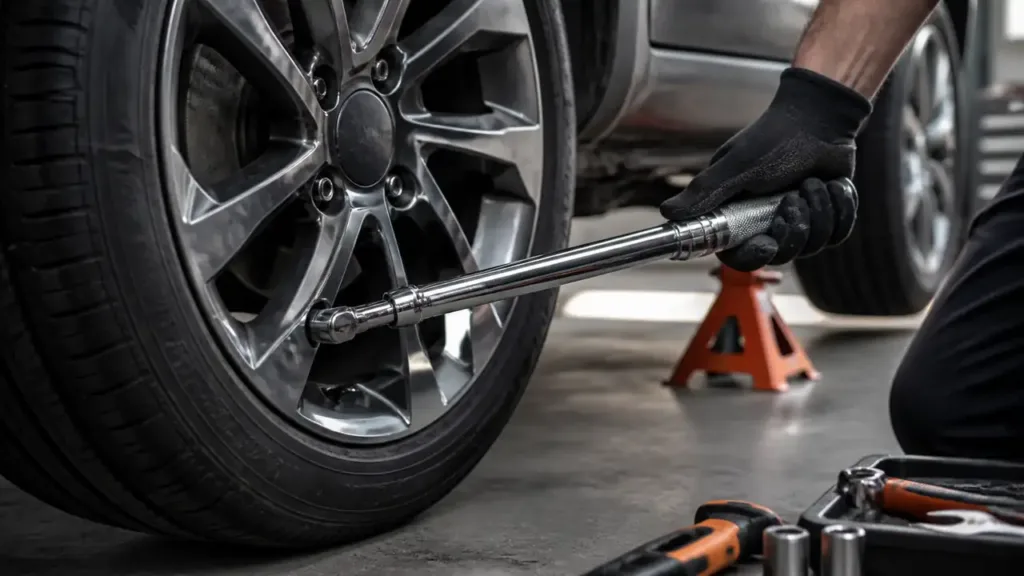
You remember the last time you tightened a wheel nut by feel and later heard an odd ping from the hub. That uneasy gut feeling is why most car owners start hunting for the best torque wrench for cars. Proper torque prevents stripped threads, warped rotors, and loose fasteners that can rattle you awake at 3 a.m. Whether you’re a weekend wrench who swaps brake pads between coffee runs or a backyard mechanic rebuilding an engine over a month, the right torque wrench saves parts and prevents costly repairs.
Buyers commonly make two mistakes. First, they pick a single-size or single-range wrench and expect it to cover everything, then wonder why lug nuts still feel wrong. Second, they buy based solely on price and miss features that matter in real use, like a loud tactile click, a reliable calibration record, or a 72-tooth head that lets you work in tight spaces. What matters most is matching range and accuracy to the tasks you actually do, plus a build that will survive the garage environment. Some people prioritize long range for lug nuts, others want a compact 3/8-inch for engine work. For most car owners, a calibrated 1/2-inch click wrench with a clear dual-scale is the practical sweet spot, and that is why the LEXIVON 1/2-Inch Click Torque Wrench sits at the top of this list.
If you are short on time, the comparison table below gives a fast overview of the top options and links to each full review so you can jump straight to the details that matter most to you.
Best Torque Wrench For Cars Comparison Table
| Product | Best For | Main Strength | Key Specs |
|---|---|---|---|
| LEXIVON 1/2-Inch Click Torque Wrench (LX-183) | Best Overall | Accurate, durable, clear scales | 10–150 ft·lb, +/-4% calibration |
| EPAuto 1/2-Inch Click Torque Wrench | Best Budget 1/2-Inch | Simple, reliable, includes extension | 10–150 ft·lb, ±4% pre-calibrated |
| Upgraded 3-in-1 Torque Wrench Set (8PCS) | Best For Versatility | Three drives in one kit with adapters | ±3% accuracy, 1/4, 3/8, 1/2 drives |
| DISEN 9PCS Click Torque Wrench Set | Best Value Set | Complete kit with durable case | ±3% accuracy, 1/4–1/2 drives |
| PUIBERS 3/8″ Inch-Pound Torque Wrench | Best for Small, Precise Tasks | Compact, high precision for in-lb work | 20–240 in·lb, ±3% |
| CRAFTSMAN 1/2″ Drive 50–250 Ft-Lb | Best Heavy-Duty Range | High max torque for trucks and SUVs | 50–250 ft·lb, ASME spec |
| HERONIX 1/2-Inch Click Torque Wrench | Best Budget-Performance | Good accuracy and 72-tooth ratchet | 10–180 ft·lb, ±3% |
| LEXIVON 3/8-Inch Click Torque Wrench (LX-182) | Best 3/8-Inch Option | Great for engine bay and accessory bolts | 10–80 ft·lb, ±4% |
| Uharbour Digital 1/2-Inch Torque Wrench | Best Digital/Pro Option | High precision, LED alerts, ±1% accuracy | 3.8–250.8 ft·lb, digital modes |
If you want to examine each option more closely, the detailed reviews below explain the practical differences and who will benefit most from each model.
1. Best Overall: LEXIVON Torque Wrench 1/2-Inch Drive Click 10~150 Ft-Lb/13.6~203.5 Nm (LX-183)

One reason this option stands out is its balanced mix of range, finish, and usable features. The LEXIVON 1/2-inch LX-183 covers the sweet spot for most car work, from wheel lug nuts to many engine and suspension fasteners. Its electro-black finish feels like a small detail until you pull it out after rainy roadside work and find the body still clean. The wrench ships pre-calibrated to +/-4% and includes a traceable calibration certificate, which is a small reassurance that pays off when you’re torquing safety-critical parts.
Imagine changing a set of brake rotors on a damp Sunday and being able to rely on a clear, high-contrast dual-scale that’s easy to set while holding a flashlight with your teeth. Or picture yourself under the car with limited swing arc and appreciating the reversible ratchet head. The LX-183’s knurled ergonomic handle reduces slippage when your hands are greasy and the audible click is crisp enough to feel and hear. For someone who does a mixture of weekend projects and routine maintenance, this wrench hits the practical marks without overspending on features you won’t use.
Pros
- Pre-calibrated with certificate for traceability.
- Durable Chrome Vanadium construction and corrosion-resistant finish.
- Easy-to-read patent-pending dual-range scale with high contrast.
- Comfortable knurled handle and reversible ratchet head.
- Good range for most car maintenance tasks.
Cons
- Accuracy is +/-4%, adequate for most users but not lab-grade.
- Case and accessories are basic compared with some multi-wrench kits.
This is the pick for the car owner who wants reliable results without fuss. It performs well on lug nuts, suspension bolts, and engine components. If you work on heavy-duty trucks that need very high torque, you may need a separate high-range wrench. Choose the LX-183 when you want a durable, trustworthy tool that feels professional in hand and saves time in the garage.
To buy this product, click here.
2. Best Budget: EPAuto 1/2-inch Drive Click Torque Wrench, 10-150 ft/lb

For a lot of DIYers the EPAuto is the first torque wrench they ever buy. It’s economical, straightforward, and gets basic automotive jobs done. The satin-finish body resists corrosion and the wrench comes with a plastic storage case and a 5-inch extension bar, which is a practical bonus when you hit hard-to-reach wheel studs. The dual-range scale and knurled handle make it easy to set and hold value even if you are in the driveway with the sun going down.
Think of the EPAuto as the reliable neighbor who shows up with a pizza and the right socket. For changing brake pads or tightening wheel bolts after a tire rotation, it delivers a clear click and stops you from over-torquing. Another real-world scenario is emergency roadside use: it’s light enough to stash in the trunk and robust enough to be used under pressure when you need a quick, accurate tighten.
Pros
- Very affordable for a 1/2-inch click wrench.
- Includes a 5-inch extension bar for reach.
- Pre-calibrated to ±4% and easy to read dual-scale.
- Non-slip knurled handle and included case for storage.
Cons
- Lower-end materials compared with premium brands.
- Case is basic and calibration may drift with heavy use.
Buy the EPAuto if you need an inexpensive, dependable wrench for periodic car maintenance and you do not require workshop-level durability. Skip it if you torque professionally every day or need sub-1% accuracy. It’s a great starter tool and a practical trunk companion.
To buy this product, click here.
3. Best For Versatility: Upgraded Torque Wrench Set 8PCS (1/4, 3/8, 1/2 Drive)

If your projects jump from bicycle stems to motorcycle cylinders to car wheel studs, a multi-drive set removes the constant swapping of tools. This 8-piece kit covers a broad torque spectrum with 1/4, 3/8, and 1/2-inch drives and a suite of extension bars and adapters. The set is calibrated to ±3% and includes a blow-molded case so everything stays organized. For hobbyists who like to keep a compact but capable toolkit, this set is a strong performer.
Picture a weekend where you tune a vintage bike in the morning, then work on a brake caliper in the afternoon. Instead of juggling three single wrenches, you switch drives and keep going. Another useful scene is a mobile gig where you need both a small in-lb wrench for electronics and a 1/2-inch for wheel nuts; this kit keeps you ready while saving trunk space.
Pros
- Wide coverage across 1/4, 3/8, and 1/2 drives.
- ±3% factory calibration with certificate for confidence.
- Includes multiple extension bars, adapters, and a sturdy case.
- 72-tooth ratchet and easy-to-use locking ring.
Cons
- More parts mean more to keep calibrated and stored properly.
- Heavier than a single-wrench solution.
This set is for the person who wants one compact kit to handle most jobs around the garage and road. It’s especially good if your work varies across precision small-bore tasks and heavier automotive fasteners. Professionals who rely on ultra-fast single-tool workflows may prefer individual pro-grade wrenches, but for most enthusiasts this kit covers all the bases.
To buy this product, click here.
4. Best Value Set: DISEN 9PCS Click Torque Wrench Set

This 9-piece DISEN kit leans into value without feeling cheap. It includes 1/4, 3/8, and 1/2 drive wrenches, a range of adapters, and a case that holds everything neatly. The factory calibration at ±3% is performance you can trust for car maintenance. The louder click feedback is handy when you work in the shop with background noise or when you are balancing under a fender with limited visibility.
Consider the routine of replacing wheel bearings. You’ll use different torque specs across knuckles, bolts, and the wheel. Having multiple calibrated tools ready prevents cross-using a wrench outside its ideal range. Or think about prepping a track day car where every fastener has a target torque. This kit simplifies that workflow because it gives you the right drive for each job in one place.
Pros
- Comprehensive kit that covers a wide variety of automotive tasks.
- Factory calibration to ±3% and durable quick-release ratchets.
- Clear audible click that is easy to detect in real work conditions.
- Sturdy case keeps everything organized and protected.
Cons
- More tools require careful storage to preserve calibration.
- Not as lightweight as single-wrench alternatives.
Buy this kit if you want a single purchase that prepares you for nearly any fastening scenario on a car, bike, or motorcycle. It’s a strong option for enthusiasts and light-duty pros who need breadth more than a single ultra-precise instrument. If you prefer the tactile simplicity of a single 1/2-inch wrench, one of the standalone options may be a better daily driver.
To buy this product, click here.
5. Best for Small, Precise Tasks: PUIBERS 3/8″ Drive Inch Pound Torque Wrench

Some tasks require fine control more than brute force. The PUIBERS 3/8-inch wrench is built for inch-pound work that appears on throttle bodies, motorcycle engine covers, and delicate interior components. With ±3% accuracy and a 72-tooth head, it gives short swing control and precise audible feedback. The included extension and adapter make it flexible in tricky engine-bay layouts.
Think about the small bolt on a thermostat housing that strips easily if over-torqued. Using a big 1/2-inch wrench for that is overkill and risky. Picture yourself assembling a performance intake manifold where gasket clamping sequences require exact in-lb values. In those situations the PUIBERS wrench feels calm and controlled in your hand while preventing common assembly mistakes.
Pros
- High precision for smaller torque ranges, ideal for in-lb work.
- 72-tooth ratchet for minimal swing arc in cramped spaces.
- Durable Cr-Mo construction and ergonomic grip.
- Includes an extension and adapter for flexibility.
Cons
- Not suitable for wheel lug nuts or high-torque tasks.
- Smaller range means you will need additional wrenches for heavier work.
Choose this wrench if your routine involves careful assembly, motorcycle or small-engine repairs, or precision fasteners on modern cars. It is the right specialist tool to complement a 1/2-inch wrench, not a replacement for heavy-duty torque requirements.
To buy this product, click here.
6. Best Heavy-Duty Range: CRAFTSMAN Torque Wrench, 1/2″ Drive, 50-250 FT-LB (CMMT99434)

If you work on trucks, SUVs, or heavy aftermarket parts that demand high torque, a common 10–150 ft·lb wrench won’t reach. The CRAFTSMAN 50–250 ft·lb wrench fills that gap with a robust range built to ASME specifications. Its bi-material handle is comfortable when you’re turning big fasteners and the stamped scales are durable under rough shop use. It is a trustworthy tool to have alongside a lower-range wrench for full coverage.
Picture replacing a wheel hub on a lifted pickup or torquing down suspension components with high-spec bolts. The Craftsman gives you the muscle without adding complex electronics. Another scenario is seasonal work on camper mounts and brackets that require tight, reliable torque values for safety. A high-range wrench like this saves time and avoids improvised torque methods that can damage hardware.
Pros
- Covers high torque needs up to 250 ft·lb for trucks and SUVs.
- Meets or exceeds ASME specs for dependability.
- Comfortable bi-material handle and locking feature for safe use.
- Durable case for storage and transport.
Cons
- Not accurate at very low torques; pair with a lower-range wrench for small fasteners.
- Bigger and heavier than lower-range models.
Buy this wrench if you frequently tackle axle nuts, suspension bolts, or any high-torque fasteners on larger vehicles. It is not a substitute for the precise control of a 3/8-inch in-lb wrench but completes a workshop toolkit for heavier jobs.
To buy this product, click here.
7. Best Budget-Performance: HERONIX 1/2 Inch Drive Click Torque Wrench
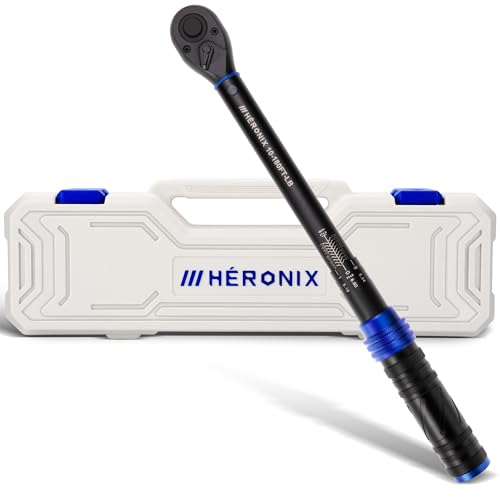
HERONIX aims to deliver strong shop features at a friendly price. It offers ±3% accuracy, a 72-tooth ratchet for tight arcs, and a traceable calibration certificate. The black-blue anodized handle is comfortable and helps the wrench stand out in a crowded toolbox. If you want near-pro performance without paying premium brand premiums, this is a solid middle ground.
Imagine working in a small garage with overhead lights that cast shadows. The laser-etched dual scales on the HERONIX read easily and the preset torque mechanism is quick to adjust. For weekenders rebuilding a clutch or installing aftermarket parts that have published torque specs, this wrench gives consistent, repeatable results across multiple jobs.
Pros
- Professional-style features with ±3% accuracy.
- 72-tooth ratchet minimizes swing for cramped spaces.
- Traceable calibration certificate included.
- Durable molded storage case for transport and protection.
Cons
- Build quality is good but not at premium-brand levels.
- Some users report the click is subtler at very low torques.
This HERONIX model is for enthusiasts who want reliable performance on a budget. It performs well across car maintenance tasks and is especially useful where a balance of accuracy, usability, and cost matters. If you need sub-1% accuracy or lifetime warranty support, consider a higher-tier professional model.
To buy this product, click here.
8. Best 3/8-Inch Option: LEXIVON 3/8-Inch Drive Click Torque Wrench (LX-182)
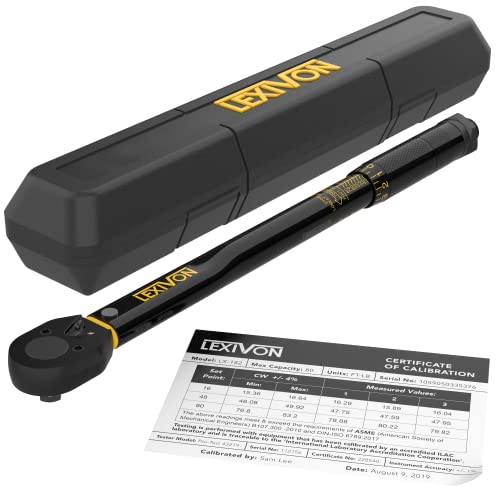
Not every fastener on a car needs a 1/2-inch torque wrench. The 3/8-inch LEXIVON LX-182 is designed for accessory bolts, alternator mounts, and many engine-bay tasks where a shorter handle and lighter feel make precision easier. It ships pre-calibrated to +/-4% and uses the same durable construction and electro-black finish as its larger sibling.
Put this wrench to work when tightening intake manifold bolts on a warm afternoon or when you are working in the tight engine bay of a compact car. Its smaller profile and clear yellow-on-black scale make it faster to set by feel. Another common use is fastener sequences on suspension components where using a full-size 1/2-inch wrench would be awkward or risk over-torqueing delicate parts.
Pros
- Compact and easier to maneuver in tight engine bays.
- Pre-calibrated with traceable certificate.
- Durable construction with corrosion-resistant finish.
- Clear, high-contrast dual-scale for quick readings.
Cons
- Narrower torque range than 1/2-inch models, so not ideal for lug nuts.
- Accuracy at very low in-lb values is limited compared with dedicated in-lb wrenches.
Choose the LEXIVON 3/8 if you spend more time inside the engine bay than under the car. It complements a 1/2-inch wrench very well and is often the tool you reach for first when swapping belts, sensors, or accessory brackets.
To buy this product, click here.
9. Best Digital/Pro Option: Uharbour Digital Torque Wrench 1/2 Drive

For precision-focused users or professionals who log torque values, the Uharbour digital wrench offers features that click-type wrenches cannot: ±1% accuracy, LED readout, vibration and buzzer alerts, and both peak and track modes. It covers a massive torque span and gives real-time feedback, which is useful when a spec requires a precise multi-stage tightening process. The digital interface also lets you switch units on the fly when service manuals use different systems.
Imagine performing a cylinder head install and using track mode to watch torque creep as bolts seat. Or think of a shop where technicians must meet tight tolerances for warranty work; the buzzer and LED make verification fast and auditable. For calibration-sensitive tasks and for people who like data-driven control, the digital wrench is a practical professional step up.
Pros
- High precision at ±1% and broad torque range.
- Multiple alert modes including buzzer, LED, and vibration.
- Peak and track modes for flexible workflows.
- Multiple unit display for international specs.
Cons
- Requires batteries and has a more complex interface than click wrenches.
- Higher cost and slightly more delicate electronics to protect.
Professional technicians and meticulous DIYers who want numerical confirmation should consider the Uharbour. It is excellent where accuracy and repeatable documentation matter. Home users who prefer simple, mechanical click feedback may find the extra features unnecessary, though the precision is undeniably attractive.
To buy this product, click here.
Best Torque Wrench For Cars FAQ
How do I choose the correct torque range for my car?
Start by listing the common tasks you perform. Wheel lug nuts typically need 80–120 ft·lb on many passenger cars, while suspension or axle nuts often require 150 ft·lb or more. If most of your work is wheel and engine accessory bolts, a 10–150 ft·lb 1/2-inch wrench covers most needs. For low-torque fasteners like hose clamps or throttle body bolts, a 3/8-inch or dedicated inch-pound wrench is better. If you work on trucks, pick a high-range tool like a 50–250 ft·lb model.
How often should I calibrate a torque wrench?
Calibration frequency depends on usage. For home users who torque a few times a month, recalibrate every 1–2 years. For professional shops or heavy use, recalibrate annually or after significant impact, dropping the tool, or suspecting a fault. Some manufacturers include a calibration certificate out of the box, which is a good baseline.
Can I use a click-type torque wrench to loosen bolts?
Click-type torque wrenches are designed primarily for tightening to a specified torque. Repeated use for loosening can wear the internal mechanism and affect accuracy. Use the torque wrench mainly for final tightening and use a breaker bar or impact tool for loosening where appropriate.
Are digital torque wrenches worth it for home mechanics?
Digital wrenches deliver superior accuracy and useful alerts. They are worth it if you need precise, repeatable values or if you document torque for warranty or track work. For occasional DIYers, a calibrated click wrench is usually sufficient and simpler to maintain.
What should I do if my torque wrench clicks before reaching the set value?
First, confirm you are using the wrench correctly: hold the handle at the marked gripping point, apply steady force, and avoid levering from the head or the very end of the handle. If it still clicks early, the wrench may need recalibration, or the internal mechanism could be damaged. Stop using it for critical fasteners until checked.
Does the ratchet tooth count matter?
Yes. A higher tooth count, like 72 teeth, reduces the swing arc required between clicks, which helps in tight spaces such as engine bays. If you frequently work where you cannot swing wide, prioritize a 72-tooth ratchet over a lower tooth count.
How should I store a torque wrench?
Store the wrench at its lowest torque setting to relieve spring tension. Keep it in its case if provided, in a dry place away from corrosive chemicals and extreme temperatures. Avoid using the wrench as a general breaker bar to preserve calibration.
Can I use an impact wrench instead of a torque wrench?
Impact wrenches are excellent for speed and removing stubborn fasteners, but they do not provide controlled torque for final tightening. Use an impact to remove or snug bolts, and finish to the specified torque with a calibrated torque wrench to ensure correct clamping force.
Final Verdict
For most car owners the best balance of accuracy, range, and durability comes from a calibrated 1/2-inch click torque wrench. The LEXIVON 1/2-Inch LX-183 is our top overall pick because it combines reliable factory calibration, a durable electro-black finish, and an ergonomic feel that makes routine work less fussy. It handles lug nuts, suspension bolts, and many engine fasteners with practical accuracy and a user-friendly scale.
If budget is the primary concern, the EPAuto 1/2-inch delivers solid performance at a lower entry cost. For those who need breadth rather than a single tool, the multi-drive sets from Upgraded (Matework) and DISEN give complete coverage for anything from delicate in-lb assemblies to heavier automotive fasteners. Professionals or data-focused enthusiasts will appreciate the Uharbour digital wrench for its ±1% accuracy and audit-friendly feedback. Match your purchase to the tasks you do most often, keep the wrench calibrated, and store it properly, and it will protect your parts as surely as a good torque spec does.