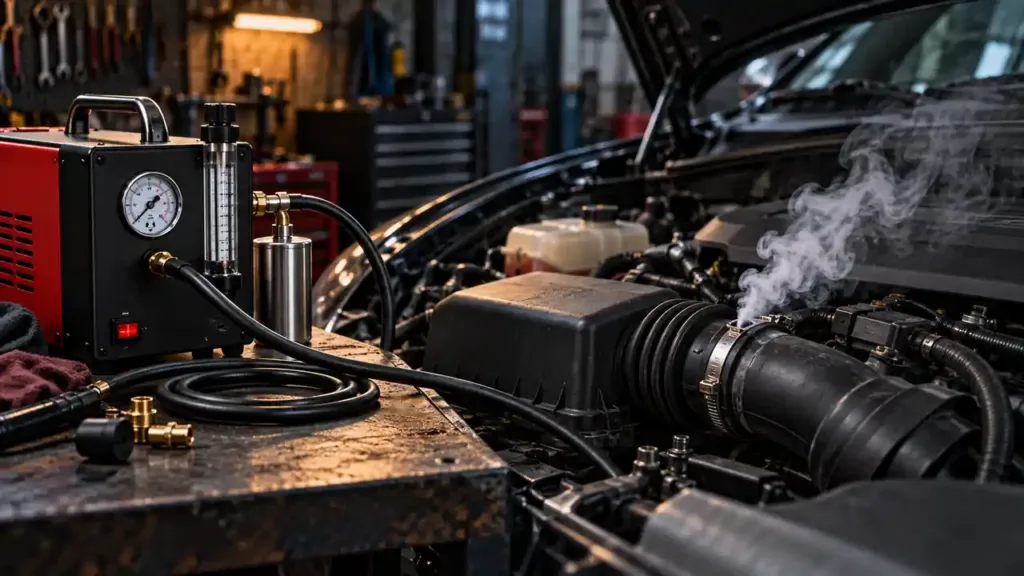
An intake or vapor-system leak can be difficult to locate by sight alone. A controlled smoke test makes an escape path visible, but choosing the wrong machine or pressure setting can create a new problem. The useful features are pressure control, a compatible connection, and a clear view of what the system is doing.
The best automotive smoke machine leak detector for low-pressure EVAP work may differ from one intended for a compatible boosted-intake test. A high maximum pressure is not a universal advantage. Confirm the vehicle's test procedure and the tool's actual regulation before making the connection.
We compare built-in-pump machines with shop-air models, identify gauge and flow-meter features, and distinguish genuine operating modes from accessory bundles. These are research-based selections for documented configurations, not claims that we have personally smoke-tested every vehicle system with each machine. These recommendations compare documented product features and current listed configurations, not hands-on test results. Verify the exact model and instructions before purchase. This article contains affiliate links; qualifying purchases may earn the site a commission.
Quick Answer
Start with the first option for the most balanced documented feature set, then use the alternatives below when their particular configuration better matches your job. Compatibility and the stated limitations take priority over the ranking.
- Best Overall: FOXWELL ST203 — Air and smoke modes; built-in air pump.
- Best for a Self-Contained Adjustable Unit: AutoLine Pro HyperSmoke — Built-in compressor; adjustable pressure.
- Best for Intake Connection Accessories: ANCEL S3000 Pro — Built-in air pump; pressure gauge.
Best Automotive Smoke Machine Leak Detector Comparison Table
| Product | Best For | Air-Supply Arrangement | Readout / Mode Distinction | Check Before Buying |
|---|---|---|---|---|
| FOXWELL ST203 | Best Overall | Built-in pump | Gauge; flow meter; air/smoke modes | Correct EVAP pressure must be confirmed |
| AutoLine Pro HyperSmoke | Best for a Self-Contained Adjustable Unit | Built-in compressor | Adjustable output; EVAP mode | Confirm the exact bundle before ordering |
| ANCEL S3000 Pro | Best for Intake Connection Accessories | Built-in pump | Pressure gauge; intake adapters | Verify system pressure regulation |
| AUTOOL SDT103 | Best for Low-Pressure Shop-Air Testing | External shop air | Low-pressure output; flow adjustment | Needs a separate compressor |
| MR CARTOOL T80 | Best for Visible Fluid Level | Built-in pump | Visible liquid level | Not for air-conditioning lines |
| Solary SD306 | Best for a Portable Flow-Control Setup | Built-in pump | Adjustable flow meter | Check allowable pressure by system |
| AutoLine Pro ShopSeries | Best for an Existing Air Compressor | External compressor | Workshop smoke system | Requires external air equipment |
| AutoLine Pro 9000 Pro Dual-Mode Smoke Tester | Best for Separate EVAP and Turbo Modes | Verify exact air configuration | Separate EVAP and turbo modes | Verify the current manual and supplier support |
| VEVOR Automotive Smoke Machine | Best for an Integrated Gauge Setup | Built-in pump | Pressure gauge; dual modes listed | Verify output limits before EVAP use |
1. FOXWELL ST203 — Best Overall

FOXWELL combines the controls most useful to a general diagnostic garage: a self-contained air supply, pressure visibility, and a flow indication. The air-only mode also lets you check a sealed setup before adding smoke. The pressure gauge and flow meter provide different information, which is valuable when evaluating a sealed test setup. Built-in air supply also keeps the ST203 independent of a shop compressor for its intended operation. Separate air and smoke modes give a reason to compare its controls with simpler units that only generate smoke.
Those controls make it more versatile than a simple smoke can, but a gauge is only helpful when the operator knows the system's permitted test pressure. FOXWELL suits a buyer who expects to use the extra indications rather than simply watching for visible smoke. An operator still needs to know which pressure is permitted for the actual circuit. Check the temporary caps and adapter seals before interpreting flow as evidence of a vehicle fault. Maintain the correct fluid level and approved consumables under the instructions so a weak smoke output is not confused with an absence of leaks.
Pros
- Air and smoke modes
- Built-in air pump
- Pressure gauge
- Flow meter
- Adjustable flow and pressure listed
Cons
- Correct EVAP pressure must be confirmed
- Smoke results still need diagnosis
To buy this product, click here.
2. AutoLine Pro HyperSmoke — Best for a Self-Contained Adjustable Unit

HyperSmoke is the more portable AutoLine choice when you do not want a separate compressor. Its different operating modes are a meaningful feature for a garage testing both low-pressure systems and compatible intake plumbing. The included automotive smoke fluid and intake accessories make the exact bundle important to the buying decision. An integrated compressor means the complete air arrangement travels with the machine rather than remaining at the workshop. Its adjustable operating approach is useful only when the correct low-pressure or other approved mode can be selected deliberately.
Keep those jobs separate in setup: a mode intended for another system should never be carried over to a sensitive vapor circuit by assumption. HyperSmoke is most attractive to someone who needs portability across different compatible test tasks. A fixed workshop with suitable regulated air may prefer the separate ShopSeries design. Confirm what arrives in the selected bundle, since extra fluid or accessories can change a listing without changing the core machine. Keep the approved fluid and connection components organized so mode flexibility does not turn into improvised setup.
Pros
- Built-in compressor
- Adjustable pressure
- EVAP operating mode
- Included automotive smoke fluid
- Intake connection accessories
Cons
- Confirm the exact bundle before ordering
- Higher-pressure mode is not for unrestricted EVAP use
To buy this product, click here.
3. ANCEL S3000 Pro — Best for Intake Connection Accessories

ANCEL's connection bundle is useful when you expect to test different intake openings rather than one recurring hose size. The bladder and cones can reduce the need to improvise seals. A cone assortment, intake bladder, and cap plugs address openings with different shapes rather than one universal test port. The pressure gauge provides a visible check on the setup when used within the proper regulation limits. Its integrated air pump also reduces the number of separate items required when moving the equipment between vehicles.
A poorly sealed adapter can look like a vehicle leak, so check the test-tool connection first before treating falling pressure or escaping smoke as proof of a failed engine component. The S3000 Pro is a useful comparison when connection flexibility is more important than adding every possible display feature. The bladder must still suit the opening and be used under its instructions. Establish that the test connection is sealed before moving on to suspect engine components. After use, inspect the delivery hose and temporary sealing accessories, because damage there can create misleading smoke escapes on the next job.
Pros
- Built-in air pump
- Pressure gauge
- Cone adapters
- Inflatable intake bladder
- Cap plugs and delivery hose
Cons
- Verify system pressure regulation
- Accessory fit varies with intake opening
To buy this product, click here.
4. AUTOOL SDT103 — Best for Low-Pressure Shop-Air Testing

The SDT103 is deliberately different from the built-in-pump machines. It suits an equipped shop that wants a low-pressure automotive smoke tool using an existing air supply. The listed 0–0.46 psi output identifies a low-pressure role that is very different from a high-output boost-test headline. External air supply is an explicit requirement, so the compressor and connection arrangement form part of the complete purchase. Its flow control provides another setup variable that needs to be understood alongside pressure regulation.
Its modest stated pressure is relevant to delicate systems, but you should still confirm the vehicle limit and the tool's current regulation instructions rather than assuming every EVAP circuit accepts the same setup. AUTOOL makes the most sense where the garage already has the suitable air equipment. It is less convenient for a user who expects to carry one self-contained unit to a driveway. Verify the current operating instructions rather than treating the low-pressure label as universal vehicle approval. Use the specified fluid and inspect the air and smoke connections so the machine's simple format does not encourage an undocumented setup.
Pros
- 0–0.46 psi listed output
- External air supply design
- Flow adjustment
- 12V power
- Dedicated automotive smoke function
Cons
- Needs a separate compressor
- Not a self-contained mobile unit
To buy this product, click here.
5. MR CARTOOL T80 — Best for Visible Fluid Level

The T80's visible fluid level is useful for keeping the machine ready and avoiding an unexplained loss of smoke output mid-test. Its integrated pump favors mobile use. An integrated pump avoids the need to route an additional air line around the vehicle. The visible liquid-level indication is useful when preparing the tool and checking that its smoke supply has not simply been exhausted. Its stated intake and pipe-testing uses should remain distinct from unsupported applications such as refrigerant-line diagnosis.
The listing's pressure capability is not a reason to apply that pressure to a fuel-vapor circuit; choose it only after confirming the required low-pressure arrangement for the intended application. The T80 is relevant when compact self-contained operation and visible fluid level are priorities. Its pressure capability still needs to be matched to the intended circuit rather than accepted as an EVAP setting. Check the level and approved fluid before beginning a diagnostic session. Inspect the delivery hose and adaptors afterward, since a damaged outlet connection can imitate a vehicle leak regardless of how well the main unit operates.
Pros
- Built-in air pump
- Liquid-level gauge
- 12V operation
- Overheat protection listed
- Intake and pipe testing applications
Cons
- Not for air-conditioning lines
- Listed pressure requires appropriate system regulation
To buy this product, click here.
6. Solary SD306 — Best for a Portable Flow-Control Setup

Solary is aimed at a garage wanting a portable machine with an adjustable flow indication. That can help distinguish a large unsealed opening from a smaller leak during a controlled test. The adjustable flow meter is a useful feature when comparing this Solary with a basic smoke generator. A built-in pump keeps its intended air source within the machine, supporting movement between vehicles without another compressor hose. The listed temperature protections concern the tool's operation and should not be interpreted as protection for every vehicle circuit connected to it.
Flow is not a substitute for pressure regulation, and smoke volume alone does not establish leak size. Compare the full operating instructions before using it on a sensitive circuit. SD306 is a candidate for buyers who want flow visibility in a portable arrangement. Pressure suitability remains a separate question to resolve from the current manual and vehicle procedure. Confirm the machine's own hose connection is sealed before judging the indicated flow. Follow the specified fill and storage instructions, because a compact instrument still depends on sound seals and the correct smoke fluid to give useful results.
Pros
- Integrated air pump
- Adjustable flow meter
- Temperature protection
- Compact carrying format
- Multiple pipe-test applications
Cons
- Check allowable pressure by system
- Fluid compatibility must follow instructions
To buy this product, click here.
7. AutoLine Pro ShopSeries — Best for an Existing Air Compressor

ShopSeries earns a separate recommendation because it uses shop air instead of the HyperSmoke's integrated compressor. That difference changes portability, storage, and setup. Using an external compressor changes both the equipment footprint and where the machine is most convenient. The metal body and supplied smoke fluid give the package a defined workshop role rather than a phone-app or screen-based diagnostic function. Its simple layout can be useful when the operator already has a suitable regulated air setup and wants fewer integrated air components.
It is a logical choice for a fixed garage with suitable regulated air already available. Include the necessary air regulation and hose arrangement in the purchase decision rather than comparing the bare machine alone. ShopSeries should be compared as part of that complete workshop arrangement. A buyer without an appropriate compressor needs to account for more than the smoke unit's storage space. Verify the allowed air connection and pressure setup instead of borrowing a procedure from HyperSmoke. Keep the machine's fluid and hose accessories ready together so a fixed-bay tool does not become inconvenient through missing supporting parts.
Pros
- External compressor operation
- Metal construction
- Automotive smoke fluid supplied
- Ceramic smoke-coil design
- Simple workshop arrangement
Cons
- Requires external air equipment
- Less self-contained than HyperSmoke
To buy this product, click here.
8. AutoLine Pro 9000 Pro Dual-Mode Smoke Tester — Best for Separate EVAP and Turbo Modes

The meaningful feature here is a separately labeled low-pressure mode and higher-pressure turbo mode. That makes it relevant to buyers with genuinely different test tasks, rather than those wanting the highest advertised pressure. The separately listed EVAP and turbo pressure modes make this an application-switching design rather than a single-output canister. A low-pressure circuit and a compatible boosted-intake test have genuinely different requirements. Those labels are useful only when the operator can confirm how the current machine selects and regulates each mode.
Its less established product identity warrants extra attention to instructions, regulation behavior, and replacement support before using it for an expensive diagnostic job. The 9000 Pro is most relevant to a user who actually needs both documented test categories. A workshop doing only one low-pressure task may have little reason to prioritize the higher-output mode. Verify the exact air-supply arrangement and included connection parts before treating the listing as a complete portable kit. Keep the mode instructions with the tool so a later user does not assume the previous pressure setting is appropriate for the next vehicle.
Pros
- Listed 0.5 psi EVAP mode
- Listed 1–30 psi turbo mode
- Two distinct pressure applications
- Automotive leak testing
- Mode-based operation
Cons
- Verify the current manual and supplier support
- Wrong-mode selection can damage a system
To buy this product, click here.
9. VEVOR Automotive Smoke Machine — Best for an Integrated Gauge Setup

VEVOR is a comparison option for buyers who want an integrated pump and visible pressure in one package. Confirm which controls regulate the machine and what the two modes actually do on the current model. The integrated gauge and pump provide a more specific setup than a smoke source that needs an unspecified external air supply. Dual-mode wording is worth investigating because different manufacturers use it to describe different operating choices. The current controls and documentation should establish what can actually be adjusted rather than leaving that decision to a general product title.
An inexpensive-looking gauge setup can still require additional precautions; select it by documented operating limits and suitable connectors rather than by a claim to find every leak. VEVOR is a sensible comparison when a buyer wants the main air and pressure indication in one unit. It becomes less suitable if the intended low-pressure application cannot be verified clearly. Examine the adapter inventory before assuming the machine can seal the chosen test point. Follow the approved fluid and hose-care instructions so a visible pressure reading is supported by a complete, sound test connection.
Pros
- 12V DC power
- Built-in pump
- Pressure gauge
- Dual operating modes listed
- Automotive pipe diagnostics
Cons
- Verify output limits before EVAP use
- No universal leak-detection guarantee
To buy this product, click here.
Buying Guide
Identify the system and permitted pressure
EVAP circuits, intake plumbing, and other automotive systems can have very different limits. Start with the specific vehicle procedure. A flow adjustment is not automatically a verified pressure regulator, and a high-pressure turbo mode must not be carried over into an EVAP test. If the machine's low-pressure control is unclear, do not assume the setup is suitable.
For related background, see What Causes Engine Misfires: Common Symptoms and Fixes.
Choose integrated air or shop air
A built-in pump reduces dependence on a separate compressor and can be convenient for mobile work. A shop-air machine may suit a fixed garage with the correct regulated supply already available. Compare the entire setup, including connectors and regulation. A low purchase price for the smoke unit alone can hide additional equipment needed to use it correctly.
Understand gauges and flow meters
A pressure gauge shows system pressure, while a flow indication can help assess whether air continues to enter a sealed test setup. Neither identifies the failed part automatically. Confirm that adapters, caps, and the tool itself are not leaking before interpreting a result. Smoke escaping at the test connection is different from a vehicle leak elsewhere in the circuit.
Use approved smoke fluid
Follow the machine's fluid instructions and fill limits. Do not substitute random oils or homemade mixtures because a listing mentions broad compatibility. The test involves sensors, seals, and sometimes fuel-vapor circuits, so the intended fluid and procedure matter. Temperature protection is a helpful tool feature, not permission to ignore specified operating time, ventilation, or system preparation.
For related background, see Why Is My Car Losing Power: Common Causes and Fixes.
Check adapters and documentation
A bladder, cone, service-port adapter, and cap set serve different openings. Match the actual test point and verify the seal before generating smoke. Clear instructions and identifiable support are especially valuable with lesser-known machines. Do not use a broad all-systems claim as evidence that a tool can test refrigerant lines or any other circuit outside its documented scope.
Frequently Asked Questions
Can I use the highest pressure to find a tiny EVAP leak?
No. Use only the pressure permitted by the vehicle procedure and a suitable regulated tool. More pressure can damage sensitive components.
Do all smoke machines need a compressor?
No. Some contain an air pump; others require shop air. Check the exact model rather than assuming the included power leads also provide air.
Does a flow meter replace a pressure regulator?
No. They serve different purposes. Confirm how the actual machine limits pressure for the intended test.
Can I use baby oil or mineral oil in any machine?
Use only fluid approved by that tool's instructions. A fluid accepted by one manufacturer is not automatically suitable for another.
Does visible smoke always identify the vehicle fault?
First rule out leakage at the machine's connection, temporary caps, and adapters. Then interpret the vehicle leak using its diagnostic procedure.
Final Verdict
FOXWELL ST203 is our overall starting point for an integrated pump, gauge, flow indication, and separate air/smoke modes. AutoLine Pro HyperSmoke is another self-contained option, while AUTOOL SDT103 serves a different shop-air workflow. Select by the actual system pressure limit and documented regulation, especially for EVAP work, rather than the highest advertised output. Confirm the exact model, included components, compatibility, and current instructions before ordering.