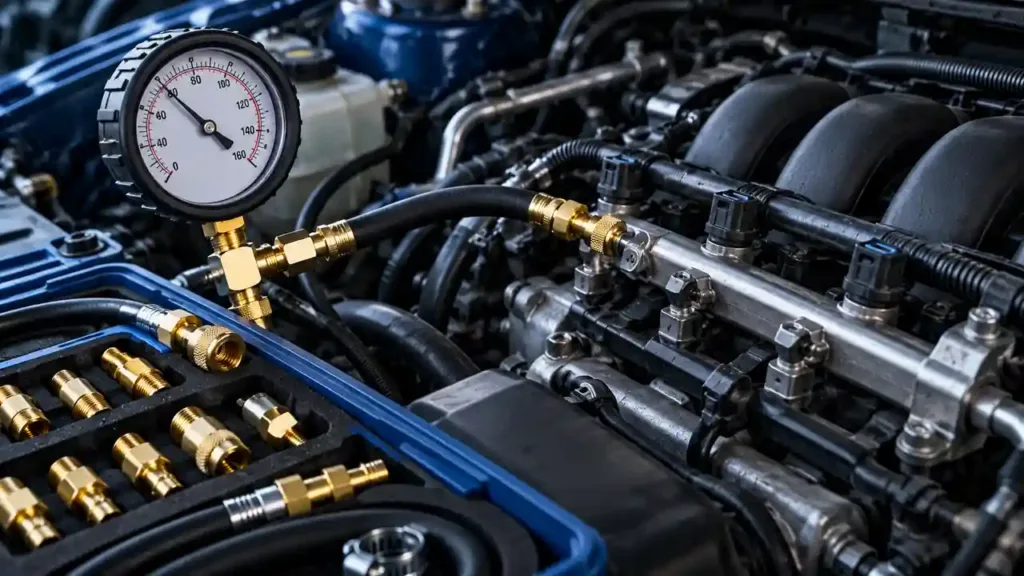
A hard start, loss of power, or suspected fuel-pump problem does not automatically mean the pump needs replacing. A suitable pressure tester can show whether fuel delivery meets the vehicle specification and whether pressure holds after shutdown. The difficult part is usually finding the correct connection, not buying the gauge with the largest number on its dial.
The best fuel pressure tester kit for a conventional port-injected engine may be completely unsuitable for the high-pressure side of a direct-injection or diesel system. This comparison focuses on conventional gasoline service kits, with a separate low-pressure carbureted-system option at the end. Check the service port, adapter dimensions, pressure range, and approved testing procedure before choosing one.
We prioritize documented connections, usable pressure control, readable gauges, and an organized adapter inventory. Digital kits offer different handling features from analog gauges, while master kits may include useful older-system connections that a small Schrader kit omits. These recommendations compare documented product features and current listed configurations, not hands-on test results. Verify the exact model and instructions before purchase. This article contains affiliate links; qualifying purchases may earn the site a commission.
Quick Answer
Start with the first option for the most balanced documented feature set, then use the alternatives below when their particular configuration better matches your job. Compatibility and the stated limitations take priority over the ranking.
- Best Overall: Lisle 55700 Master Fuel Injection Kit — PFI and TBI applications; test-port and inline connections.
- Best for a Simple Gauge Setup: OTC 5630 Fuel Pressure Test Kit — 0–100 psi scale; rubber-protected gauge.
- Best for Bleed-Hose Reach: Innova 3640 — 0–100 psi dial; two-inch gauge face.
Best Fuel Pressure Tester Kit Comparison Table
| Product | Best For | Gauge / Pressure Role | Connection Focus | Check Before Buying |
|---|---|---|---|---|
| Lisle 55700 Master Fuel Injection Kit | Best Overall | Check supplied gauge selection | PFI/TBI; port, inline, hose end | More fittings to organize |
| OTC 5630 Fuel Pressure Test Kit | Best for a Simple Gauge Setup | 0–100 psi analog | Basic compatible fuel connection | Fewer system-specific connections than a master kit |
| Innova 3640 | Best for Bleed-Hose Reach | 0–100 psi analog | Domestic adapters and import tee | Short gauge hose compared with some digital kits |
| BETOOLL Pro Analog Fuel Injection Kit | Best for Analog Adapter Coverage | 0–140 psi analog | Quick-coupler adapter assortment | Universal advertising is not a fitment guarantee |
| BETOOLL Digital Fuel Pressure Kit | Best for a Backlit Readout | 0–300 psi digital | Release hose and quick coupler | Display needs power |
| AUTOOL PT630 Digital Kit | Best for Holding Readings | Digital hold and min/max | Long hose and brass adapters | More controls than a basic dial |
| Orion Motor Tech Fuel Injection Pressure Kit | Best for Mixed Service Ports | 140 psi analog | Schrader, M6, M8–M14 fittings | Listed connector sizes do not cover every vehicle |
| OTC 4480 Stinger | Best for TBI Service | 0–100 psi analog | Includes GM TBI adapter | Bulkier than a basic gauge kit |
| Lisle 20300 Vacuum and Fuel Pump Tester | Best for Low-Pressure Carbureted Systems | Low-pressure and vacuum | Carbureted-system role only | Not a port-injection pressure kit |
1. Lisle 55700 Master Fuel Injection Kit — Best Overall

The 55700 is the strongest starting point for a garage that works on several conventional gasoline injection systems. Its attraction is connection flexibility, rather than an impressive maximum pressure number. The PFI and TBI coverage gives it a more specific purpose than a gauge advertised only as universal. Multiple connection styles matter when one car has a convenient test port and another needs an inline arrangement. Keeping the supplied component list with the kit also makes it easier to identify an unfamiliar adapter before fuel-system work begins.
A kit that can connect at a service port or in line gives you more diagnostic options when the next vehicle lacks an obvious Schrader valve. This is the set to investigate when connector coverage changes from job to job. An owner testing one known service port may find a smaller kit easier to manage. Account for the time needed to identify and inspect the correct fittings rather than treating every piece in the case as interchangeable. Store the adapters together after cleaning them under the tool instructions so the next setup is complete.
Pros
- PFI and TBI applications
- Test-port and inline connections
- End-of-hose test options
- Multiple system adapters
- Component list supplied
Cons
- More fittings to organize
- Direct-injection high-pressure testing is outside its scope
To buy this product, click here.
2. OTC 5630 Fuel Pressure Test Kit — Best for a Simple Gauge Setup

Choose the 5630 when your vehicle has a compatible connection and you want a conventional analog instrument. The protected gauge and release valve address everyday handling better than unnecessary accessories. The 0–100 psi scale is relevant to a compatible conventional system whose specified test pressure fits that range. Brass fittings and a rubber-covered gauge concentrate the package on the components actually handled during a test. A release valve is particularly useful when the diagnostic procedure calls for controlled pressure discharge before disconnection.
Its narrower measuring range is not a disadvantage when the vehicle specification sits comfortably inside it; connector fit is the decision that comes first. The simpler layout appeals to someone who does not need a large inventory of specialized adapters. It leaves fewer pieces to identify each time the case is opened. However, the needed vehicle connection must be confirmed before purchase rather than assumed from the brand name. Inspect the hose and relief arrangement before each session, because a protected dial does not prevent damage elsewhere in the assembly.
Pros
- 0–100 psi scale
- Rubber-protected gauge
- Brass fittings
- Pressure-release valve
- Hose and tubing supplied
Cons
- Fewer system-specific connections than a master kit
- Not a high-pressure GDI tester
To buy this product, click here.
3. Innova 3640 — Best for Bleed-Hose Reach

The long bleed-off hose is the practical reason to shortlist the Innova. It gives more freedom to route discharged fuel into a suitable container without holding that container next to a crowded rail. The two-inch dial keeps the instrument conventional and easy to interpret without navigating a screen. Its supplied domestic adapters and import tee broaden the possible connection arrangements beyond a single fixed hose end. That combination is useful when checking several older gasoline vehicles, provided the exact fittings match the service information.
The analog dial suits occasional diagnostics where a readable running-pressure result matters more than data storage or screen functions. Consider the complete hose layout before choosing the Innova solely for its bleed reach. The gauge hose itself is much shorter than the discharge hose, so the reading position still needs planning. Check that both hoses can be routed without stretching or contacting unsuitable surfaces. After the test, follow the handling instructions for residual fuel and inspect the fittings before putting the assembly away.
Pros
- 0–100 psi dial
- Two-inch gauge face
- 16-inch gauge hose
- Six-foot bleed hose
- Domestic adapters and import tee
Cons
- Short gauge hose compared with some digital kits
- Adapter fit still needs checking
To buy this product, click here.
4. BETOOLL Pro Analog Fuel Injection Kit — Best for Analog Adapter Coverage
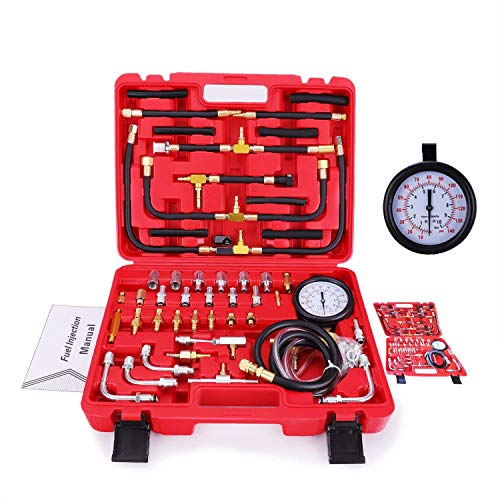
BETOOLL's analog set makes sense for a buyer who needs a broader assortment of connections but prefers a needle gauge. The quick coupler helps when changing adapters between jobs, while the case reduces the chance of losing a small fitting. A 140 psi analog scale provides more range than the smaller 100 psi gauges in this comparison. That changes the measuring envelope but does not establish suitability for every injection system. The molded case and quick-coupler connection are the more practical attractions when fittings are frequently changed between compatible jobs.
Treat its broad compatibility language cautiously and compare actual connector dimensions with your service information. This arrangement suits a mechanic who prefers seeing a needle move while pressure changes. Someone needing a held numeric reading may prefer the digital BETOOLL instead. Adapter condition deserves as much attention as gauge readability, particularly where a small seal determines whether the connection is sound. Return each fitting to its case position after use so a broad assortment remains useful rather than becoming an incomplete collection.
Pros
- 140 psi and 10 bar scales
- Quick-coupler hose connection
- Multiple hoses and fittings
- Molded storage case
- No display battery required
Cons
- Universal advertising is not a fitment guarantee
- No digital hold display
To buy this product, click here.
5. BETOOLL Digital Fuel Pressure Kit — Best for a Backlit Readout

This is a readability upgrade over the analog BETOOLL, not simply another color of the same kit. A backlit numeric display is useful when a gauge must sit in a shadowed engine bay. Four selectable units help when service information is written in a different scale from the one normally used in the garage. The backlit display is also a meaningful distinction when the gauge sits behind hoses or under a shroud. Its clear release hose supports an organized discharge arrangement under the approved test procedure.
Selectable units also reduce conversion work if the service specification uses kPa or bar. Do not confuse display resolution with independently verified measurement accuracy. Choose the digital kit for display functions that you expect to use, rather than for the 300 psi figure alone. The screen adds a power requirement that a mechanical dial avoids. Keep the display and controls protected during storage, and inspect the hose connections before trusting the first reading. A higher-resolution number remains unhelpful if an adapter leaks or the test condition differs from the vehicle specification.
Pros
- 0–300 psi range
- Backlit digital display
- Four selectable units
- Quick-coupler connection
- Release valve with clear hose
Cons
- Display needs power
- Higher range does not prove GDI compatibility
To buy this product, click here.
6. AUTOOL PT630 Digital Kit — Best for Holding Readings

The PT630 is aimed at buyers who want to capture a changing reading without watching a needle continuously. The long hose and screen-hold function can make documenting a test easier. The 2.8-inch display gives the PT630 room for more information than a simple needle face. Maximum and minimum readings can help document variation during an approved test without trying to remember every number. The long hose also offers more placement options, although its route must remain appropriate for the engine bay.
Its peak and minimum functions are useful diagnostic conveniences, but they still need a sound connection and a correctly interpreted manufacturer pressure specification. This feature set is most useful when recording results is part of the diagnostic routine. It is more elaborate than necessary for a single quick check on a readily accessible port. Confirm the selected unit and the instrument's zeroing instructions before comparing a result with service data. Store the hose without sharp bends and check the brass connections so extra reach does not become a source of avoidable damage.
Pros
- 2.8-inch backlit display
- Screen-lock function
- Maximum and minimum readouts
- 78.7-inch hose
- Brass adapter assortment
Cons
- More controls than a basic dial
- Hose rating does not override vehicle-system limits
To buy this product, click here.
7. Orion Motor Tech Fuel Injection Pressure Kit — Best for Mixed Service Ports

OMT's appeal is the explicit mix of threaded and service-port connections. Those dimensions give a buyer something more useful to check than a vague universal badge. The stated Schrader, M6, and M8–M14 connections give a buyer concrete dimensions to compare before ordering. That is valuable when the test point is known but a kit's generic vehicle list is too broad to be useful. The protected gauge casing adds handling protection while keeping the actual measurement on a familiar analog dial.
It is a sensible candidate for a small multi-car garage, provided the needed fitting is actually included and the test pressure falls within the gauge and hose limits. OMT is most compelling when its specific connection mix matches the vehicles in the garage. The assortment offers little advantage if the required port is the one fitting it does not include. Check thread engagement and the appropriate seal rather than judging compatibility from appearance alone. Keep the smaller adapters identifiable in storage so similar diameters do not lead to the wrong fitting being selected later.
Pros
- 140 psi gauge
- Schrader connection hose
- M6 connection hose
- M8–M14 adapters
- Protective gauge casing
Cons
- Listed connector sizes do not cover every vehicle
- No electronic recording
To buy this product, click here.
8. OTC 4480 Stinger — Best for TBI Service

The Stinger is worth comparing with a generic master set when an older throttle-body system is on the job list. Its named GM TBI adapter and provision for running and residual-pressure checks make the intended use clearer. The named TBI adapter gives an older-vehicle owner a clear reason to examine this set closely. The dual-scale gauge avoids a unit-conversion step when the specification is expressed in kPa rather than psi. A relief valve, discharge hose, and protective boot also keep the essential handling features together instead of leaving them as separate accessories.
It also suits someone who wants the test equipment organized as a service kit rather than loose fittings in a drawer. The Stinger is better evaluated as a complete conventional service package than as a bare gauge purchase. Its case is useful when adapters need to travel with the main instrument. Confirm the exact application chart because an older-system adapter does not establish coverage for unrelated modern systems. Cleaning and returning the discharge hose to the kit matters just as much as preserving the gauge itself.
Pros
- 0–100 psi dual scale
- GM TBI adapter included
- Import adapters included
- Relief valve and discharge hose
- Blow-molded case
Cons
- Bulkier than a basic gauge kit
- Coverage must be checked by application
To buy this product, click here.
9. Lisle 20300 Vacuum and Fuel Pump Tester — Best for Low-Pressure Carbureted Systems
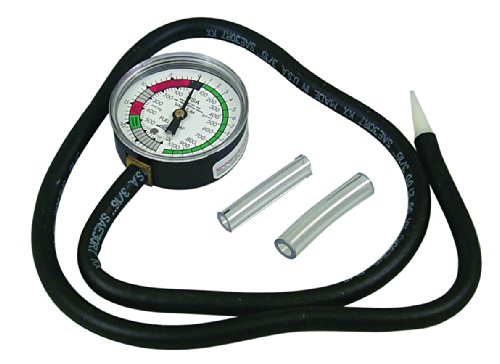
Lisle 20300 is the specialist alternative for a compatible low-pressure carbureted fuel-pump check, not another injection master kit. Its combined vacuum and pressure role is useful on older systems where a high-range injection gauge is the wrong category. A combined vacuum and pressure dial can serve a different diagnostic routine from a fuel-injection master set. The hose-based format is relevant to a compatible older engine with a low-pressure fuel-pump test procedure. Its compact arrangement also avoids carrying a large injection-adapter case when that equipment would not serve the job.
Keep it off a fuel-injection rail and verify the exact gauge scale and connection against the vehicle procedure before use. This is an application-specific selection rather than the ninth interchangeable version of a modern rail tester. Buyers maintaining only port-injected cars should concentrate on the other suitable connection kits instead. Check the actual scale on the supplied gauge and the connection instructions before using it on an older vehicle. Preserve the hose and fittings with the instrument, since a complete low-pressure setup is more useful than a loose dual-purpose dial.
Pros
- Low-pressure fuel-pump testing
- Vacuum-check function
- Analog dial
- Hose supplied
- Compact gauge format
Cons
- Not a port-injection pressure kit
- Confirm the low-pressure range before connecting
To buy this product, click here.
Buying Guide
Match the fuel system before the gauge
Identify whether the job is on port injection, throttle-body injection, a low-pressure supply circuit, or a high-pressure system. The kits here must not be treated as universal high-pressure GDI or diesel tools. Start with the factory test procedure and connector specification, then verify that both the gauge range and every hose or adapter in the pressure path are approved for the task.
For related background, see Signs of a Bad Fuel Pump: Symptoms, Causes, and What to Do.
Check connector geometry and access
A generic universal label is less useful than a named fitting size. Look for the correct Schrader connection, thread, tee, or application-specific adapter. Confirm the available working space as well. A fitting that has the right thread but cannot seat fully beside a bracket will not provide a reliable test and should not be forced into place.
Choose a useful range and readable display
Select a range that includes the expected pressure with suitable headroom. A higher maximum does not prove compatibility or better accuracy. Analog gauges do not need display batteries, while backlit digital gauges may be easier to read in a dark bay. Display resolution, calibration, and actual accuracy are different specifications; avoid choosing solely by the number of decimal places.
Plan fuel release and containment
A release valve and a properly routed bleed hose are practical features because residual fuel must be handled under the service procedure. Inspect the entire kit for damage and use an appropriate collection arrangement. Never loosen a hot or pressurized fuel connection merely to find out whether it has pressure. Keep ignition sources away and stop if a connection leaks.
For related background, see How Often Should You Inspect Fuel Pump: Signs and Timing.
Interpret the result as part of diagnosis
Record the specified test condition and compare like with like: key-on, running, residual, or loaded measurements are not interchangeable. Low pressure can involve more than the pump, while a normal idle reading may not settle a complaint under load. Check electrical supply, restrictions, regulation, and the vehicle's diagnostic sequence before converting a gauge result into a parts order.
Frequently Asked Questions
Can these kits test gasoline direct injection?
Do not connect these conventional service kits to a GDI high-pressure rail. A low-pressure feed test is a separate task and is appropriate only when the vehicle procedure and tool specifications explicitly permit it.
Is a digital gauge more accurate than an analog gauge?
Not automatically. Digital displays can be easier to read and may offer hold functions, but accuracy depends on the actual instrument specification, calibration, and a sealed connection.
Does low fuel pressure always mean a bad pump?
No. Electrical supply, restricted lines or filters, regulation problems, and other faults can affect the reading. Follow the diagnostic procedure for the exact vehicle.
Why does pressure fall after the engine stops?
Some pressure change can be normal, and the allowed hold time varies by vehicle. Compare with the specified residual-pressure test before diagnosing an injector, regulator, or check valve.
Do I need the largest master kit?
Only if its additional adapters serve vehicles you maintain. A smaller kit with the correct fitting, adequate range, and suitable release arrangement can be the better purchase.
Final Verdict
Lisle 55700 is our overall starting point for its mix of PFI/TBI applications and service-port, hose-end, and inline connections. OTC 5630 suits a simpler compatible gauge setup, while Innova 3640 is especially worth comparing for its long bleed hose. Keep the Lisle 20300 separate as a low-pressure carbureted-system option rather than an injection-rail tool. Confirm the exact model, included components, compatibility, and current instructions before ordering.