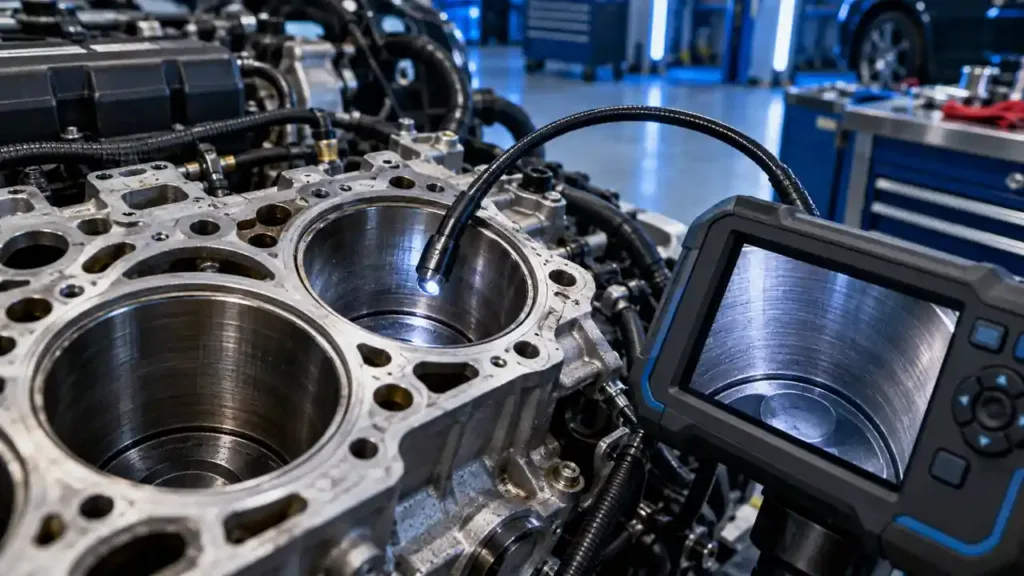
Seeing inside a cylinder or behind a component can answer questions that an external inspection cannot. The right borescope can help locate contamination, visible wear, or a foreign object before unnecessary disassembly. Its usefulness depends on reaching the part and focusing on it, not simply advertising more pixels.
The best automotive borescope for mechanics may use a steerable tip, fixed front and side cameras, or a compatible phone as the screen. These designs solve different problems. A long drain-camera cable is not automatically convenient for a short engine inspection, and a large camera head may not fit the available opening.
We compare probe access, steering, focal range, screen arrangement, lighting, and recording limitations. All inspections must respect temperature and mechanical-clearance limits. A borescope image supports diagnosis but cannot prove an engine's compression or remaining service life. These recommendations compare documented product features and current listed configurations, not hands-on test results. Verify the exact model and instructions before purchase. This article contains affiliate links; qualifying purchases may earn the site a commission.
Quick Answer
Start with the first option for the most balanced documented feature set, then use the alternatives below when their particular configuration better matches your job. Compatibility and the stated limitations take priority over the ranking.
- Best Overall: Teslong Articulating Borescope — Two-way steering; 4.5-inch ips screen.
- Best for a 6.2mm Steerable Probe: FOXWELL Y400 — 6.2mm listed probe; 220-degree two-way articulation.
- Best for a Slim Short-Cable Setup: Anykit 210-Degree Articulating Scope — 0.22-inch listed probe; two-way steering.
Best Automotive Borescope for Mechanics Comparison Table
| Product | Best For | Camera-Tip Design | Screen / Connection | Check Before Buying |
|---|---|---|---|---|
| Teslong Articulating Borescope | Best Overall | Two-way articulation | 4.5-inch standalone display | Confirm tip diameter against access hole |
| FOXWELL Y400 | Best for a 6.2mm Steerable Probe | 220-degree articulation; 6.2mm | Standalone inspection unit | Allow space for the bent tip |
| Anykit 210-Degree Articulating Scope | Best for a Slim Short-Cable Setup | 210-degree articulation; 0.22 inch | 4.3-inch display | Shorter reach than long cable scopes |
| DEPSTECH DS300 | Best for Fixed Front and Side Views | Fixed front and side lenses | 4.3-inch display; split views | No tip articulation |
| Teslong 5-Inch Dual-Lens Scope | Best for a Larger Fixed-Lens Screen | Fixed front and side lenses | 5-inch display | Eight-millimeter listed probe needs clearance |
| Teslong USB-C Articulating Scope | Best for a Compatible USB-C Phone | 180-degree articulation | Compatible USB-C phone and app | Requires compatible phone and app |
| Daxiongmao Articulating Scope | Best for a 4.5-Inch Steering Display | 210-degree articulation | 4.5-inch display | Confirm exact probe dimensions |
| DXZtoz Two-Way Articulating Scope | Best for a Published Close-Focus Range | 220-degree articulation; 8.5mm | 4.3-inch display | 8.5mm listed probe can limit entry |
| TGJOR 5-Inch Dual-Lens Live-View Scope | Best for Live Viewing Without Recording | Fixed front and side lenses | 5-inch live view; no recording | Listing explicitly excludes photos and video |
1. Teslong Articulating Borescope — Best Overall

Teslong's articulating design is the most versatile starting point for looking around inside a compatible cylinder rather than only straight ahead. Its built-in display avoids tying the inspection to a phone. The 4.5-inch IPS screen gives the operator a dedicated view without finding a compatible phone first. A five-foot semi-rigid cable is a practical length to compare with the shorter access path of many engine inspections. Two-way movement is most useful when the desired surface sits beside or behind the initial line of sight.
Steering helps you examine a wall or valve area, but a clean-looking image cannot prove compression, bearing condition, or remaining engine life without supporting diagnostics. This Teslong suits a mechanic who wants controlled viewing direction in a standalone tool. A fixed dual-lens model may be simpler when front and side views already cover the intended surface. Confirm the available room for tip movement after the probe enters the cavity. Return the head to the position required for withdrawal and inspect the lens and cable afterward, following the manufacturer's handling limits.
Pros
- Two-way steering
- 4.5-inch IPS screen
- Five-foot semi-rigid cable
- Standalone operation
- Adjustable viewing direction
Cons
- Confirm tip diameter against access hole
- Not an engine-condition measurement tool
To buy this product, click here.
2. FOXWELL Y400 — Best for a 6.2mm Steerable Probe

FOXWELL gives buyers a useful diameter and steering specification to compare with the actual access opening. Its slim steerable tip is relevant when a larger inspection head cannot enter the passage. A stated 6.2mm tip gives the FOXWELL a useful dimensional identity before the engine is opened. The thumb-wheel control also distinguishes its steering method from simply twisting a fixed cable and hoping the view changes. Its 220-degree two-way movement is relevant to aiming at a nearby surface, subject to the space actually available inside the assembly.
Remember that entry diameter and room to articulate are different requirements: a probe that passes through a hole may still lack space to turn safely inside the cavity. Y400 is particularly worth examining where entry diameter has ruled out a larger scope. The steering specification should not be mistaken for permission to bend the tip against an obstruction. Check the current focal-distance and temperature requirements before using the camera in the engine. Keep the head clean and operate the mechanism gently so access benefits are not undermined by a dirty lens or damaged articulation.
Pros
- 6.2mm listed probe
- 220-degree two-way articulation
- Thumb-wheel control
- Standalone inspection format
- Engine-access applications listed
Cons
- Allow space for the bent tip
- Check temperature limits before insertion
To buy this product, click here.
3. Anykit 210-Degree Articulating Scope — Best for a Slim Short-Cable Setup

Anykit's short cable and slim head suit localized engine inspection more naturally than a long drain-camera cable. Image flipping can help orient a view when the probe enters from an awkward angle. The four-foot cable can be easier to manage for a localized engine inspection than a much longer pipe-camera lead. Its 4.3-inch display keeps the viewing system self-contained, while image flipping helps orient a picture taken from an unusual approach. The listed 0.22-inch tip is another concrete dimension to compare with the available opening.
Its value is controlled access, not a headline pixel number. Check the focal distance and clean the lens before deciding whether an apparent mark is actually on the component. Anykit is a useful comparison when a slim articulated head and relatively short cable are the main requirements. The shorter cable becomes a limitation if the work also involves deeper duct or cavity inspection. Establish that the target sits within the stated focal range rather than relying on digital enlargement. Check and clean the lens under the instructions before storage so the next view is not obscured by residue from the previous job.
Pros
- 0.22-inch listed probe
- Two-way steering
- 4.3-inch screen
- Four-foot cable
- Image-flip function
Cons
- Shorter reach than long cable scopes
- Steering mechanism needs gentle handling
To buy this product, click here.
4. DEPSTECH DS300 — Best for Fixed Front and Side Views
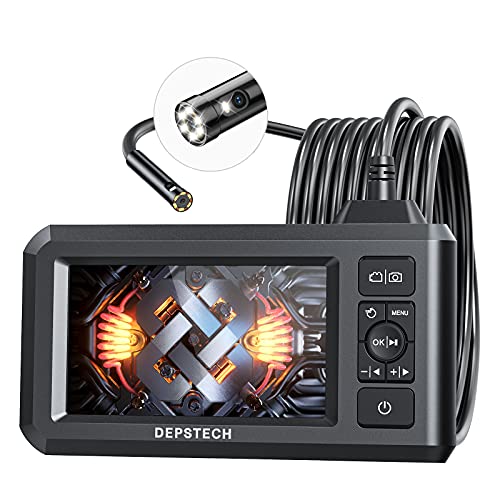
DEPSTECH offers a different way to see sideways: a second lens rather than a moving tip. That is useful when you want a front view and nearby wall view without using a screw-on mirror. The fixed side camera removes the need to aim a forward lens through a separate mirror attachment. Split-view modes can also help relate a wall detail to the direction in which the probe is traveling. Its 16.5-foot cable gives the DS300 a broader cavity-inspection role than a tool chosen only for short cylinder access.
It is also a sensible mixed home-and-garage choice, though the long cable requires management when the actual inspection is only a short distance inside an engine. DEPSTECH makes sense when side viewing matters more than steering the physical tip. A mechanic needing to look back around an obstruction should compare an articulating design instead. Plan where the unused cable will sit so the long lead does not pull at the probe during close work. Inspect both camera windows after use, because contamination on the side lens can be overlooked when only the forward image is checked.
Pros
- Dual lenses
- Split-screen modes
- 4.3-inch display
- 16.5-foot cable
- Rechargeable battery
Cons
- No tip articulation
- Long cable can be awkward for cylinders
To buy this product, click here.
5. Teslong 5-Inch Dual-Lens Scope — Best for a Larger Fixed-Lens Screen

This Teslong is a genuine alternative to its articulating models because it uses fixed forward and side cameras with a larger display. It suits inspections where switching views is enough and tip steering is unnecessary. The five-inch display is a meaningful viewing difference from the smaller standalone options. Independent lighting for the forward and side cameras can help manage reflections when changing between surfaces. The listed 8mm probe, however, is an access specification that should be checked before the larger screen is treated as an advantage.
Check the stated probe diameter carefully for spark-plug or injector access; a larger screen does not compensate for a camera head that cannot reach the component. This fixed-lens Teslong is a practical comparison for mixed engine, wall, and duct inspection. Its long cable and two viewpoints may serve those tasks without a steering mechanism. Confirm that the intended engine opening accepts the complete head rather than just the cable behind it. Clean both lens areas and keep the lead organized so a versatile cavity camera remains manageable during a much shorter automotive inspection.
Pros
- Five-inch screen
- Forward and side cameras
- Independent camera lighting
- 16.5-foot cable
- Rechargeable battery
Cons
- Eight-millimeter listed probe needs clearance
- No articulating tip
To buy this product, click here.
6. Teslong USB-C Articulating Scope — Best for a Compatible USB-C Phone

The phone-based Teslong makes sense when you prefer using a compatible existing screen and saving inspection media directly through its app. Its articulated tip distinguishes it from basic USB inspection cameras. The USB-C format moves the screen and recording interface onto the user's own supported phone. A supplied holder can keep that screen attached to the hand-control arrangement instead of requiring another person to hold it. The 180-degree steerable head still makes this a different tool from a basic fixed USB camera.
Confirm the exact phone and operating-system support first, and consider whether you want your daily phone beside oily components during a longer diagnostic session. Choose this version when phone compatibility and app-based media handling are desirable parts of the workflow. A dedicated-screen model avoids depending on a daily phone during dirty garage work. Verify the exact operating-system and connector support before relying on the shape of the USB port. Consider where images will be stored and how the holder will fit the phone case, since those details affect practical use more than connector branding alone.
Pros
- 180-degree steering
- USB-C connection
- Phone holder
- Photo and video through app
- Adjustable LEDs
Cons
- Requires compatible phone and app
- Phone can be exposed to garage dirt
To buy this product, click here.
7. Daxiongmao Articulating Scope — Best for a 4.5-Inch Steering Display

Daxiongmao offers a standalone articulating arrangement for buyers comparing steering and screen size together. The relevant question is how easily the head reaches and frames the intended part, not whether its resolution label sounds larger than a competitor's. The 4.5-inch display provides a dedicated working view while the two-way tip is positioned. Its stated 210-degree articulation is useful when the target cannot be framed by moving a fixed lens straight ahead. Adjustable lighting should be considered alongside that steering, particularly when a polished metal surface reflects light back into the camera.
Check the current temperature and liquid restrictions; a water-resistant probe is not permission to inspect a running engine or a hot combustion chamber. Daxiongmao is a useful comparison for buyers prioritizing a standalone articulated arrangement. Confirm the current head dimensions rather than assuming every scope with the same screen size fits the same opening. Treat the probe's environmental rating separately from its allowed temperature and liquid exposure. Inspect the lens and steering action after use so a blurred view or a stiff mechanism is not ignored at the start of the next inspection.
Pros
- 210-degree articulation
- 4.5-inch IPS screen
- Adjustable viewing angle
- 1080p listed imaging
- Water-resistant probe claim
Cons
- Confirm exact probe dimensions
- Water rating does not establish hot-oil compatibility
To buy this product, click here.
8. DXZtoz Two-Way Articulating Scope — Best for a Published Close-Focus Range

DXZtoz publishes a close-focus range that is useful for judging whether a nearby cylinder surface will be sharp. Its steering wheel helps aim the tip after entry, but the relatively larger head needs checking against the opening. The published one- to fifteen-centimeter focal range gives DXZtoz a concrete close-view specification to assess. That matters when a cylinder wall or another target will sit only a short distance from the lens. Its adjustable LEDs and steering wheel provide ways to change the view before resorting to digital zoom.
Compare focus distance before zoom claims: enlarging a blurred image does not reveal a small crack that the lens failed to resolve. This scope suits a buyer who has checked that the relatively larger head can enter the required opening. A slimmer articulating camera is the better category to compare when access is the first constraint. Make sure the tip can return to the required withdrawal position without force. Clean the lens and protect the articulation during storage, because steering and close focus are useful only when the head remains mechanically sound and optically clear.
Pros
- 220-degree steering
- 4.3-inch screen
- One- to fifteen-centimeter focus range
- Adjustable LEDs
- Photo-oriented inspection format
Cons
- 8.5mm listed probe can limit entry
- Digital zoom cannot restore missing detail
To buy this product, click here.
9. TGJOR 5-Inch Dual-Lens Live-View Scope — Best for Live Viewing Without Recording

This camera is a conditional pick for someone who only needs a live inspection. The explicit lack of recording is a meaningful limitation and should not be buried beneath the large-screen description. The five-inch display and two fixed viewpoints support direct observation without a phone connection. A 16.4-foot cable can make the same instrument useful for longer accessible cavities around the garage. Its stated close-focus range is worth comparing with the distance to the automotive target, especially when the task is inspection rather than searching down a long passage.
Choose a recording-capable alternative if you need to document findings, compare an area later, or send an image to a technician before authorizing a repair. TGJOR is appropriate when the buyer genuinely needs only a live image. The absence of recording becomes important if findings must be shared or compared after reassembly. Decide that documentation requirement before ordering instead of assuming a large display includes storage. Keep both lens windows clean and manage the spare cable length so the simple live-view arrangement remains practical beside a confined engine bay.
Pros
- Five-inch display
- Front and side views
- 16.4-foot cable
- Adjustable illumination
- Published close-focus range
Cons
- Listing explicitly excludes photos and video
- No articulating head
To buy this product, click here.
Buying Guide
Measure access and room to turn
Compare the probe diameter with the actual opening and consider the space required for articulation after entry. A tip that fits through a hole may not have room to bend safely inside. Check the camera-head length and cable bend limits as well. Never force the steering mechanism or withdraw a bent tip through an opening that requires it to be straight.
For related background, see What Causes Oil Consumption: Common Engine Leaks and Burning.
Choose articulation or a second lens
Articulation lets you aim a camera at different surfaces after entry. A fixed side lens offers a sideways view without a moving tip. Both can be useful, but their access and handling differ. Choose according to what you need to see: a nearby cylinder wall, a valve area, or a straight passage may favor different camera arrangements.
Prioritize focus and lighting
A published focal range helps determine whether the lens can resolve the intended surface at close distance. Adjustable light reduces glare on reflective metal and helps in darker cavities. Resolution labels and digital zoom are not substitutes for focus. Clean the lens and change lighting before treating a blurry spot or reflection as evidence of a damaged component.
Decide whether documentation is necessary
Some cameras display a live view but cannot save photos or video. That can be sufficient for a quick inspection, but not for documenting a finding or discussing it with another technician. Phone-connected models add app and operating-system requirements. Check those details before purchase, including whether the phone connection is supported rather than merely sharing the same connector shape.
For related background, see What Happens If Turbocharger Fails: Symptoms and Risks.
Respect engine and probe limits
Inspect only under an appropriate stopped and cooled service procedure. Waterproofing does not establish compatibility with hot oil, fuel, or a running engine. Keep accessories secure so nothing detaches inside the assembly. A photograph can show a visible concern, but combine it with the service history and relevant tests before drawing conclusions about the cause or required repair.
Frequently Asked Questions
Is an articulating borescope always necessary?
No. A fixed front-and-side camera may be enough. Articulation is valuable when you need to aim the tip at a surface that a fixed lens cannot frame.
Can a waterproof probe go into a hot engine?
Not by assumption. Check the actual temperature and liquid limits, and use a stopped, appropriately cooled inspection procedure.
Does higher resolution guarantee a better diagnosis?
No. Access, focus, lighting, lens cleanliness, and interpretation can matter more than a larger resolution label.
Can every camera record video?
No. One live-view option here explicitly lacks recording. Confirm photo and video capability if you need evidence or later comparison.
Can a borescope prove an engine is healthy?
No. It shows visible surfaces within its field of view. It does not replace compression, leak-down, oil-pressure, or other relevant diagnostic tests.
Final Verdict
Teslong's standalone articulating scope is our overall starting point for controlled engine inspection. FOXWELL Y400 is worth comparing for its stated slim probe and steering geometry. DEPSTECH DS300 offers fixed front and side views instead of articulation, while the USB-C Teslong suits a compatible phone workflow. Confirm access, focal distance, and recording needs before choosing. Confirm the exact model, included components, compatibility, and current instructions before ordering.